


What carabiners/shackles/swivels are for and when they really affect reliability
In daily work, the carabiners/shackles/swivels are often considered secondary components. In reality, precisely because they connect, bind, or allow rotation between multiple elements, they play a decisive role in the operational continuity of a plant, a handling system, or a technical setup. When one of these components wears out, jams, or is chosen inconsistently with the application, the problem does not remain isolated: it can involve cables, ropes, connection accessories, and anchor points.
A good carabiners/shackles/swivels guide starts from a simple principle: it is not only important “if the component closes,” but how it performs over time, how often it is opened, in what environment it operates, and with which other elements it comes into contact. In many applications, the difference between replacement, repair, or scheduled maintenance arises precisely from this.
In practical terms, these components are used to:
- create quick connections between different parts of the system;
- allow disassembly and reconfiguration without invasive interventions;
- reduce twisting and misalignments, especially in the case of swivels;
- manage connection points subject to frequent use;
- facilitate control, inspection, and maintenance operations.
Se stai valutando il componente più adatto per il tuo impiego, può essere utile confrontare le soluzioni disponibili nella sezione dedicata ai componenti di collegamento e approfondire anche le differenze tra accessori e ricambi presenti nello store.
The key point is this: not all signs of wear require the same response. In some cases, it is advisable to replace immediately; in others, it is possible to intervene with cleaning, functional verification, and efficiency restoration. Understanding the difference helps avoid both unnecessary downtime and the opposite risk, that is, continuing to use a component that has already exceeded the acceptable reliability level.
When replacement is the safest choice
Replacement is generally the best choice when the component shows visible deformations, advanced wear marks in contact areas, closing difficulties that cannot be resolved with simple maintenance, or corrosion affecting structural parts. The presence of abnormal play, irregular rotation, or recurring jams is also a signal not to be underestimated.
In these cases, insisting on an improvised repair can turn into a false economy. If you have doubts about the compatibility of the replacement, check the product sheet the intended type of use and the coupling characteristics with other system elements.
When scheduled maintenance prevents downtime and premature replacements
The carabiners/shackles/swivels maintenance becomes strategic when the component is exposed to dirt, moisture, residues, frequent openings, or continuous rotations. In these contexts, periodic checks allow early detection of the first signs of functional decay: abnormal friction, less smooth closures, accumulations at moving points, or the beginning of surface oxidation.
Well-planned maintenance is not only to “make the component last longer.” It is mainly to keep the system's behavior predictable, reducing the risk of sudden problems during use.
Compatibility, measurements, and technical checks before replacing carabiners/shackles/swivels
One of the most common mistakes is looking for a replacement by only considering the general shape. In reality, compatibility should be understood more broadly: dimensions, opening methods, type of coupling, available space, frequency of use, and operating environment are all factors that influence the choice.
When deciding whether to replace or keep an existing component, it is advisable to start with some essential checks:
- check if the current connection works in alignment or undergoes torsion and misalignment;
- verify if the system requires frequent openings or a more stable connection over time;
- observe any interference with cables, ropes, chains, or other accessories;
- assess the condition of contact surfaces and moving parts;
- consider the operating environment, especially if moisture, dust, or aggressive agents are present.
This phase is also important to understand if a repair really makes sense. If the problem arises from poor original compatibility, intervening only on the damaged component risks not solving the real cause of the malfunction.
Measurements and dimensions: what to check without stopping at just the diameter
When comparing similar components, the focus is often on a single measurement. This is a reductive approach. To avoid mistakes, also consider clearance, opening, thickness of the parts to be connected, maneuvering space, and freedom of rotation. A formally compatible component may prove inconvenient or inadequate once installed.
Se il sistema è già in esercizio, può essere utile confrontare il componente esistente con le soluzioni presenti nella guida ai ricambi e agli accessori tecnici, così da valutare in anticipo eventuali differenze di montaggio o utilizzo. Quando un dato non è immediatamente disponibile, la regola migliore resta una: check the product sheet.
Materials, working environment, and frequency of use
The choice between replacement and maintenance also depends on the context. A component used occasionally in a clean environment may require less frequent checks compared to one used intensively, with constant exposure to external agents or residues that compromise the movement of parts.
For this reason, a correct technical assessment is not limited to “whether it still works or not.” One must ask how much reliability margin remains and whether the component is still consistent with the work it is required to perform today. In systems that have undergone modifications, expansions, or partial replacements, this check is even more important.
Typical errors in ordering or installing carabiners/shackles/swivels
Many problems attributed to wear actually arise from an initially inaccurate choice or from an installation that does not respect the correct working method of the component. Recognizing these errors helps avoid repeated replacements and set up more effective maintenance.
Choosing the “similar” component instead of the compatible one
One of the most common mistakes is ordering a replacement based on visual similarity. Two components may look equivalent but differ in closure system, useful space, freedom of rotation, or interface method with the rest of the assembly. The result is forced assembly, awkward maneuvering, or accelerated wear.
Per ridurre questo rischio, conviene consultare anche contenuti di supporto come la guida alla scelta dei componenti di collegamento, utile per confrontare applicazioni e logiche di utilizzo senza fermarsi all’aspetto esterno.
Ignoring early signs of wear or blockage
Another frequent mistake is continuing to use the component until the problem becomes evident. In reality, early signs are often clear: less smooth opening, irregular rotation, abnormal noise, residues in moving parts, difficulty in reclosing, or slight deformations. Intervening at this stage often allows calmly choosing between maintenance and replacement, without reaching an unexpected downtime.
A simple visual and functional inspection routine can make a difference. There is no need to complicate the process: just define who checks, what to observe, and when to replace the component without waiting for complete failure.
Installing without verifying behavior in operation
A component correctly mounted on a bench may behave differently once in use. Lateral stresses, unexpected rotations, impacts, vibrations, or contacts with other parts can cause abnormal wear. For this reason, after installation it is useful to verify the actual behavior of the connection, especially in the early stages of use.
This attention is particularly important when the component is inserted into an existing system, perhaps with accessories that work with geometries or movements not perfectly aligned. In these cases, scheduled maintenance is not just a conservative measure: it is a tool to confirm that the choice made is really correct.
Products, spare parts, and accessories useful for effective scheduled maintenance
When talking about maintenance, the issue is not just “replace when necessary.” A more effective approach involves organizing the inspection of carabiners/shackles/swivels together with other elements that contribute to the functioning of the connection. This allows identifying the causes of problems and not just their effects.
For example, a component that tends to jam or wear out quickly may not be the source of the problem. Factors that may influence include:
- connecting accessories that are not perfectly compatible;
- presence of recurring torsions in the system;
- accumulation of dirt or residues in moving areas;
- assemblies that are too tight or, conversely, unstable;
- interference with other components during work.
For this reason, it is useful to consider not only the main replacement, but also the complementary accessories che possono migliorare il comportamento complessivo dell’insieme. Una panoramica più ampia si può ottenere consultando le soluzioni per manutenzione e ricambistica, dove è più semplice valutare il sistema nel suo insieme.
When repairing makes sense and when it doesn't
Repairing makes sense especially when the problem concerns dirt, stiffening of movement, loss of fluidity or small non-structural functional defects. In these cases, thorough cleaning, checking moving parts, and verifying the fit can restore the component to a reliable usable condition.
On the other hand, if deformations, marked wear in contact areas, advanced corrosion, or persistent difficulties in closing and rotating emerge, replacement remains the most rational path. Continuing to use a compromised component can transfer the problem to other elements of the system, increasing downtime and intervention complexity.
How to set up scheduled maintenance without complicating the work
Effective scheduled maintenance does not have to be heavy or bureaucratic. It can be based on a few clear steps:
- identify the most stressed connection points;
- establish periodic visual inspections;
- check opening, closing, and rotation where expected;
- note components that show recurring wear;
- assess whether the problem depends on the component or the system in which it works.
This method helps to transform the carabiners/shackles/swivels maintenance into a useful and sustainable practice, not an occasional activity done only when a failure occurs. Additionally, it allows for more precise spare parts planning and reduces errors during reordering.
Se vuoi approfondire il tema delle verifiche periodiche e della scelta dei ricambi, può essere utile consultare anche gli approfondimenti tecnici del blog, dove trovi contenuti pensati per orientare acquisti e manutenzione in modo più consapevole.
Recommended products
Go to the Carabiners/Shackles/Swivels category
 Twisted stainless steel shackle microcast mm 5 – code: 08.856.05 – Osculati
 Galvanized steel omega shackle 25 mm – code: 0123425 – Motomarine
 Stainless steel swivel with double eye snap hook + snap hook d. 10 – code: 01.429.02 – Osculati
 Stainless steel carabiner with ring 80 mm – code: 09.195.08 – Osculati
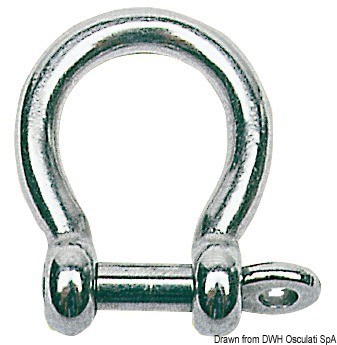 Stainless steel shackle d. 12 mm - Code: 08.421.12 - Osculati
 Stainless steel recessed hinge pin d. 14 – code: 01.080.14 – Osculati
 Stainless steel D shackle 5 mm wide – code: 08.325.05 – Osculati
How to choose between immediate replacement and scheduled inspection
To decide well, it is advisable to ask yourself three simple questions. Is the component still intact? Does it work smoothly and consistently with the application? Is the problem local or system-wide? The answers help determine whether to intervene immediately with a replacement or if it is more useful to review the entire connection.
In general, replacement is preferable when integrity or functionality is clearly compromised. Scheduled maintenance is the right choice when the component is still recoverable and periodic checks can prevent rapid deterioration. Repair, finally, only makes sense if it does not mask a structural or compatibility problem.
A carabiners/shackles/swivels guide really useful does not just indicate which component to buy: it helps to understand when to intervene, how to prevent recurring errors and what checks to make before ordering. This is the most effective approach to buying better and keeping the system reliable over time.
If you are considering a replacement or want to better organize the maintenance of your technical connections, explore the dedicated category and the brand pages available in the Technofluid store: you will find useful solutions to compare components, accessories, and spare parts more quickly and consistently with your application.
FAQ
When is it better to replace carabiners, shackles, or swivels instead of repairing them?
It is advisable to replace them when they show deformations, obvious wear in the contact areas, significant corrosion, persistent closing difficulties, or irregular rotation that cannot be resolved with simple maintenance.
Is scheduled maintenance of carabiners/shackles/swivels really useful?
Yes, especially in contexts with frequent use, dirt, moisture, or recurring twists. Periodic checks help to identify blocks, abnormal friction, and wear in advance, reducing the risk of sudden stoppage.
How to check the compatibility of a spare part?
It is not enough to compare the general shape. It is important to check dimensions, opening, usable space, coupling methods, freedom of rotation, and usage conditions. If a detail is not clear, check the product sheet.
What are the most common errors during the ordering phase?
The most common mistakes are choosing a component just because it is similar to the existing one, not checking the actual mounting dimensions, and neglecting the system's behavior in operation, such as torsions or interference with other elements.
When can a repair make sense?
It may make sense if the problem concerns dirt, stiffening of the movement, or poor fluidity and there is no structural damage. However, if the component is compromised in its integrity, replacement remains the safest choice.


