What hardware is used for on nautical and industrial systems
When talking about hardware in a professional context, it does not only refer to fastening elements or support components, but to a set of solutions that contribute to the functionality, operational continuity, and orderly management of systems. In nautical and industrial applications, hardware comes into play in many daily activities: assembly, closure, adjustment, anchoring, protection, and maintenance of parts subject to frequent use or demanding working conditions.
A good hardware guide it helps to navigate among components that, although seemingly secondary, can have a concrete impact on installation practicality and ease of subsequent intervention. In an onboard technical room, for example, the correct choice of fastening systems and support accessories can simplify access to compartments and make the arrangement of parts more orderly. In an industrial system, instead, hardware is often involved in the stability of panels, doors, supports, passages, and closures that require long-term reliability.
The central point is this: hardware should not be considered a detail to be defined at the last moment. On the contrary, it is an integral part of the practical design of the system. A selection consistent with the usage context can facilitate the initial assembly, reduce on-site adaptations, and make the hardware maintenance during the installation's life cycle.
For those working at the machine edge, technical compartments, panels, covers, doors, or support structures, it is useful to have an overview of the available families and their applications. To deepen the context of related plant components, it may also be helpful to consult the section dedicated to technical components and the guides for choosing spare parts.
Most common practical applications
In the nautical and industrial sectors, hardware is used in very different situations, but with recurring needs:
- fastening of panels and coverings to protect technical areas or sensitive parts;
- closure of doors and compartments that require quick access for inspection or service;
- support of accessory elements in areas subject to vibrations or movements;
- organization of passages for a more orderly arrangement of components and lines;
- replacement interventions on worn or no longer suitable elements for the operational context.
In all these cases, hardware must be understood as part of the system and not as a simple complement. Compatibility with materials, thicknesses, sizes, and mounting methods makes the difference between a clean installation and a solution that requires continuous adjustments.
Compatibility, measurements, and technical checks of hardware
One of the most frequent mistakes in choosing hardware is relying only on the shape or apparent function of the component. In reality, to achieve a reliable result, it is necessary to carefully check some technical aspects before ordering and installation.
The first check concerns the application context. A marine system has different requirements compared to a fixed industrial system: exposure, accessibility, frequency of use, and maintenance methods change. Even within the same sector, a component intended for a protected area should not be evaluated like one installed in a high-use area or under more demanding conditions.
Check dimensions, fixing points, and access
Before selecting a hardware item, it is advisable to verify:
- useful mounting measurements, including center distances, compatible diameters, and thicknesses;
- available space for opening, closing, or operation of the component;
- type of support on which it will be installed;
- future accessibility for inspection, disassembly, or replacement;
- interferences with other nearby elements.
This step is essential especially when working on existing systems, where spaces are already defined and any modification can have repercussions on the whole. Hardware chosen without prior verification may theoretically be suitable but impractical during actual assembly.
If you have doubts about dimensions, compatibility, or installation methods, the most correct criterion is always one: check the product sheet. The available documentation helps avoid interpretation errors and compare alternatives more precisely.
Materials and combinations with the system
Another often underestimated aspect concerns the combination between hardware and materials present in the system. Panels, structures, covers, supports, and fixing surfaces may require different solutions depending on their configuration. It is not enough that the component “fits” or “mounts”: it must integrate properly with the support and the intended use.
In a proper hardware guide, material evaluation also helps prevent premature replacements, forced assemblies, or untidy adaptations. For those managing interventions on complex systems, it is useful to maintain consistency between already installed components and new spare parts, thus simplifying maintenance and procurement.
To navigate between related families and complementary components, you can also consult the solutions for technical installation and accessories for nautical and industrial systems.
Typical errors in hardware ordering or installation
Many hardware-related problems do not depend on the component itself, but on an incomplete evaluation during the ordering phase or an installation carried out without considering the real context. Identifying the most common errors helps avoid stoppages, returns, and wasted time in the workshop or on site.
Purchasing based only on visual similarity
A component may look identical to the one to be replaced but differ in decisive details such as attachments, dimensions, mounting direction, or usage mode. This often happens when reordering a spare part based on a photo or visual memory. The result is an apparently correct item that does not integrate with the system.
To reduce risk, it is advisable to always gather essential information before ordering: measurements, application, mounting support, and required function. If available, compare the component with its technical data sheet.
Neglecting future maintenance
Another common mistake is choosing a solution that works during installation but complicates subsequent management. In a professional context, the hardware maintenance is as important a criterion as the initial installation. An inconvenient access, an impractical closure, or a fastening that requires complex disassembly can slow down every subsequent intervention.
When possible, it is useful to ask:
- will the component be easily reachable?
- can it be replaced without dismantling adjacent parts?
- does it allow quick checks during routine maintenance?
- does it integrate with the logic of the existing system?
These questions help to choose with greater operational foresight, especially in systems where intervention times matter.
Ignoring the direction or mounting configuration
Some hardware items require attention to direction, position, or installation configuration. Ordering without checking this aspect can lead to immediate incompatibilities. The same applies to components that must work in combination with other elements already present: if the interface changes, mounting can become problematic.
For this reason, a good practice is always to check the whole assembly and not the single isolated piece. The hardware must interact with the system in which it is inserted, not just with the fixing point.
Products, spare parts, and accessories useful for a more effective choice
In daily work on nautical and industrial systems, hardware is often selected together with other support or complementary components. Thinking in terms of a system helps build a neater solution, simpler to manage, and more consistent with operational needs.
When evaluating a replacement or a new component, it is also useful to consider the useful accessories that can improve installation, protection, or ease of use. These are not superfluous additions but elements that often affect the final quality of the installation.
How to read hardware from a replacement perspective
In the case of replacements, the priority is to restore functionality without introducing new issues. For this reason, it is advisable to check:
- compatibility with the existing component or housing;
- consistency with the actual use of the system;
- ease of integration with elements already present;
- availability of related accessories to complete the installation.
Proper management of replacements reduces improvised interventions and helps maintain more uniform operational standards. This is particularly useful in systems with multiple access points, multiple technical compartments, or multiple stations to keep aligned.
When it is advisable to also consider related accessories
In many cases, the difference between an essential installation and a well-finished solution lies precisely in the accessories. Complementary, support, or protective elements can make the installation more stable and simplify use over time. Even in this case, the choice should be made based on the specific application and not by generic analogy.
If you are building a technical bill of materials or planning a revision intervention, it may be useful to consult the categories dedicated to plant maintenance to identify in a single step the families of components most consistent with the work to be done.
An orderly approach to choosing hardware allows you to:
- reduce procurement errors;
- simplify the work of installers and maintenance personnel;
- improve continuity between initial assembly and replacement;
- optimize component management over time.
Recommended products
 Twisted stainless steel shackle microcast mm 5 – code: 08.856.05 – Osculati
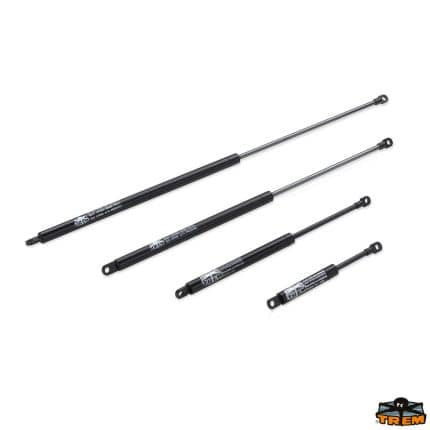
 Telescopic gas spring 900 mm 42 kg – code: M3542900 – Trem
 Spring stainless steel compass 26 mm B-D – code: 38.421.78 –
 Galvanized steel omega shackle 25 mm – code: 0123425 – Motomarine
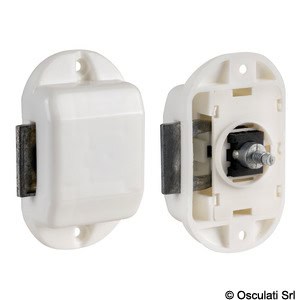
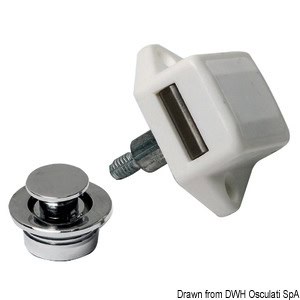 Chrome-plated brass button 19 mm – code: 38.182.10 – Osculati

Operational FAQs on hardware for plants
In technical work, the most frequent questions almost always concern compatibility, replacement, and correct matching with the existing system. For this reason, it is useful to approach the choice with a practical method: identify the function of the component, check the measurements, verify the mounting support, and already consider future maintenance from the start.
The hardware it is not just a finishing detail, but an element that affects the quality of the installation and the simplicity of subsequent interventions. In the nautical and industrial fields, careful selection helps avoid improvised adaptations and keeps the system more orderly, accessible, and manageable.
If you are looking for a solution suitable for your system, explore the category dedicated to hardware and the brands available in the store: you can compare options based on the application, check details in the product sheets, and more easily identify the component consistent with your intervention.
FAQ
How to choose the right hardware for a nautical or industrial system?
It is advisable to start from the actual application: component function, mounting support, available space, accessibility, and maintenance needs. Before ordering, always check measurements, configuration, and compatibility in the product sheet.
What checks to do before ordering a hardware spare part?
It is useful to check dimensions, center distances, thicknesses, mounting direction, fastening methods, and the presence of any interference with other system components. If the component works together with other accessories, also verify the overall compatibility.
Why is hardware also important in maintenance?
Because a correct choice not only facilitates the initial assembly but also makes inspection, disassembly, and replacement easier. Hardware suitable for the context helps reduce inconvenient interventions and subsequent adjustments.
Can I choose a hardware component based only on its appearance?
No, because similar components can differ in size, mounts, configuration, or intended use. Visual similarity does not guarantee compatibility: for a correct choice, it is always better to compare the data available on the product sheet.