


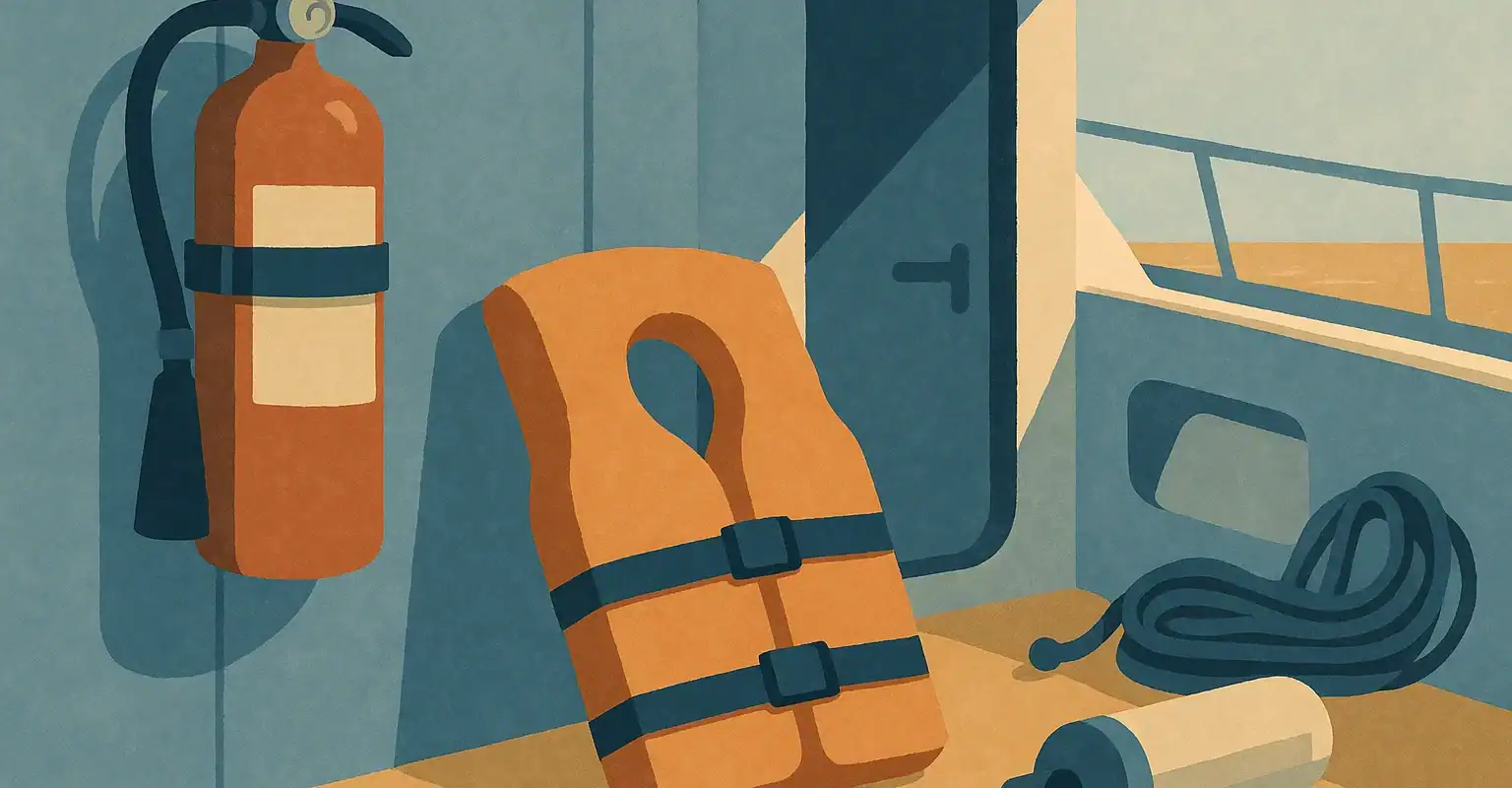
Every boat owner, sooner or later, finds themselves staring at that red plate fixed to the straw mat or near the electrical panel and wondering if it is really the right one for their boat. This is not a trivial question: the boat fire extinguisher is not an optional accessory, but a safety equipment element required by Italian law based on the hull length, engine power, and the distance from the coast intended to be navigated. Understanding which model to choose, where to install it, and how often to have it checked means avoiding fines during a Coast Guard inspection, but above all having on board a truly effective tool in case of a fire outbreak.
Why fire-fighting equipment is mandatory on board
Unlike a car, a boat underway has no immediate escape routes: a fire on board, however small, can quickly turn into a serious emergency, especially if it involves the engine compartment or the electrical system. For this reason, the Recreational Boating Code and related implementing decrees precisely establish the minimum number of fire extinguishers, their extinguishing capacity, and their placement on board recreational units.
The regulation distinguishes boats based on three main parameters:
- the overall length of the hull;
- the presence and power of the inboard or internal engine;
- the distance from the coast within which the unit is authorized to navigate.
Those who want to deepen their understanding of the overall legal framework can consult the entry dedicated to recreational boating on Treccani, useful to frame how safety at sea is regulated systematically and not left to the discretion of the individual boat owner.
Boat fire extinguisher: types and extinguishing capacity codes
Not all fire extinguishers are equivalent: their effectiveness depends on the fire class they can extinguish and the amount of extinguishing agent contained.
The codes 13A 89B C: what they mean
On the labels of approved nautical fire extinguishers, you find codes like 13A, 89B, C. These are not arbitrary codes but indicate the fire class for which the extinguisher is certified:
- A — fires of solid materials (wood, fabrics, plastic);
- B — fires of flammable liquids (gasoline, diesel, oils);
- C — fires of flammable gases.
The number preceding the letter expresses the unit of measure of the extinguishing capacity established by technical standards: the higher the number, the larger the fire surface the extinguisher can put out under standardized test conditions. For a more technical overview of the operation and types of extinguishing agents, the Wikipedia entry dedicated to fire extinguishers offers a good introductory starting point.
On board a recreational boat, where the main risk concerns electrical systems and flammable bilge liquids, multipurpose powder extinguishers with the code 13A 89B C represent the most widespread standard because they simultaneously cover classes A, B, and C.
How many extinguishers are needed based on distance from the coast and engine power
This is the question that generates the most uncertainty among boaters, because the number of extinguishers required is not fixed but varies based on the combination of several factors.
Units within 6 miles from the coast
For small-sized boats navigating within 6 miles, the minimum equipment generally requires only one portable fire extinguisher, provided it has an extinguishing capacity adequate for the length of the hull and the power of the installed engine.
Navigation beyond 6 miles and higher power motor units
As the distance from the coast and the engine power increase, the regulations generally require:
- a greater number of portable fire extinguishers, distributed in different points of the boat;
- a higher overall extinguishing capacity, calculated by summing the ratings of the individual devices;
- in some cases, a fixed extinguishing system in the engine compartment, mandatory beyond certain power thresholds.
Precisely because of the variability of these thresholds — which can be updated by new decrees — it is always advisable to check the current regulations directly with the competent Port Authority before planning the purchase of the equipment, rather than relying on outdated information found online.
Where to place the fire extinguisher on board
The position of the fire extinguisher is no less important than its extinguishing capacity: an efficient device but unreachable within seconds loses much of its usefulness.
The most common technical guidelines provide to:
- install at least one fire extinguisher near the helm station, easily accessible to the helmsman;
- place a second device near the engine compartment, but not inside the compartment itself;
- avoid areas subject to direct moisture, intense salt spray, or excessive vibrations that could damage the valve;
- mark the position with appropriate visible signage, including the CE mark required by regulations.
Precisely for this reason, many shipyards and maintenance providers apply a CE extinguisher sticker next to the bracket, so that the device is immediately identifiable even by those unfamiliar with the boat's internal layout, a requirement often requested during document checks.
Periodic inspection and maintenance of the marine fire extinguisher
An expired or uninspected fire extinguisher is practically equivalent to having no fire-fighting equipment on board. Regulations require periodic checks to be carried out at authorized centers, which verify:
- the integrity of the cylinder and valves;
- the pressure of the extinguishing agent via a pressure gauge;
- the absence of corrosion or damage to the bracket and discharge hose;
- the validity of the certification shown on the label.
The inspection expiry is indicated with a tag applied by the authorized refilling center: it is good practice to check it at the start of each season, even before launching the boat, so as not to find oneself with an extinguisher out of inspection during a dockside or navigation check.
How to choose an approved marine fire extinguisher
La scelta del modello dipende dalle dimensioni dell’imbarcazione e dalla capacità estinguente richiesta dalla dotazione minima obbligatoria. Per imbarcazioni di medie dimensioni, un estintore 2kg 13A 89B C rappresenta spesso la soluzione più equilibrata tra peso, ingombro e potere estinguente, adatto sia come dotazione principale sia come apparecchio aggiuntivo su unità che richiedono più estintori a bordo.
Per imbarcazioni più piccole o come estintore secondario da tender, gozzo o piccola barca a motore, un estintore 1 kg 8A 34B C può essere sufficiente a soddisfare i requisiti minimi, pur offrendo una capacità estinguente inferiore rispetto ai modelli da 2 kg. In ogni caso, è fondamentale verificare che l’apparecchio scelto riporti la marcatura di omologazione e sia accompagnato dalla documentazione tecnica richiesta per i controlli in banchina.
Domande frequenti sull’estintore barca
Quanti estintori servono obbligatoriamente su una barca a motore? Il numero varia in base alla lunghezza dello scafo, alla potenza del motore e alla distanza dalla costa entro cui si naviga. Le unità più piccole entro le 6 miglia possono richiedere un solo estintore, mentre imbarcazioni più grandi o che navigano oltre tale limite necessitano generalmente di più apparecchi con capacità estinguente complessiva superiore.
Cosa significa la sigla 13A 89B C su un estintore nautico? Indica le classi di incendio per cui l’estintore è certificato: A per i solidi, B per i liquidi infiammabili, C per i gas. I numeri esprimono la capacità estinguente misurata secondo le norme tecniche di riferimento, con valori più alti corrispondenti a una maggiore efficacia.
Ogni quanto va revisionato l’estintore di bordo? La revisione deve essere effettuata periodicamente presso centri autorizzati che verificano pressione, integrità della bombola e validità della certificazione. La cadenza è indicata sul cartellino apposto dal centro stesso ed è opportuno controllarla a ogni avvio di stagione nautica.
Dove va posizionato l’estintore a bordo di una barca? Deve essere collocato in un punto facilmente raggiungibile, tipicamente vicino al posto di guida e in prossimità del vano motore senza però trovarsi al suo interno, al riparo da umidità eccessiva e segnalato con apposita etichettatura visibile.
È obbligatorio l’estintore anche su piccole imbarcazioni e tender? Sì, anche le unità di dimensioni ridotte con motore installato sono generalmente tenute a disporre di almeno un estintore portatile adeguato alla potenza del motore, secondo quanto stabilito dalla normativa vigente e verificabile presso la Capitaneria di Porto competente.
Prima di salpare, vale sempre la pena dedicare qualche minuto a verificare che l’estintore a bordo sia del tipo corretto, correttamente posizionato e in regola con la revisione: una dotazione di sicurezza aggiornata non è solo un obbligo normativo, ma la prima vera garanzia di tranquillità in navigazione.


