When you really need an electric motor for an inflatable boat
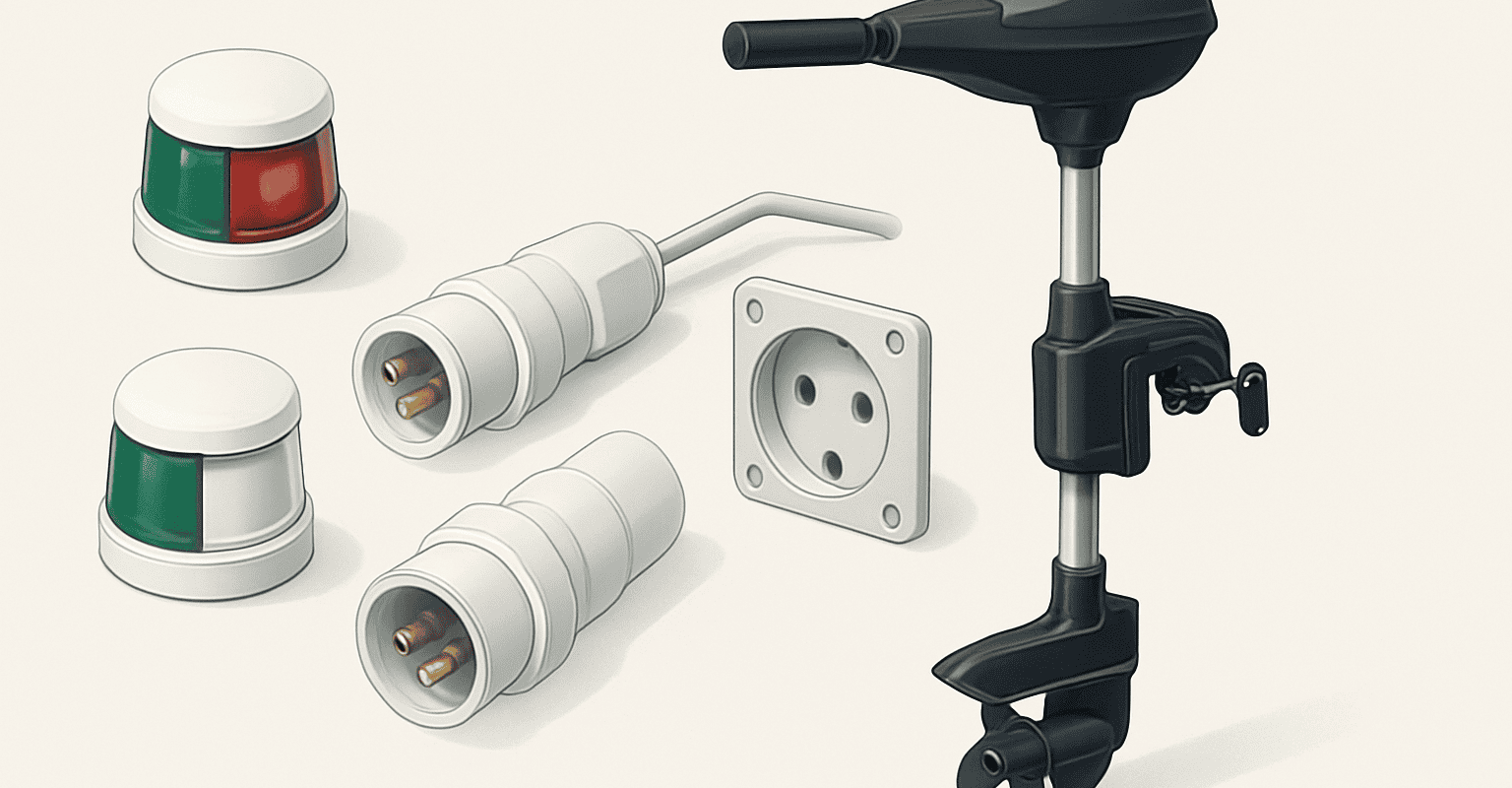
The electric motor for inflatable boat it is not a “fashion” choice, but a concrete solution in various usage scenarios. It becomes particularly interesting when the goal is to manage precise movements, controlled maneuvers, and an orderly onboard setup, especially if already present on board lights, headlights, plugs, and sockets that require a consistent electrical distribution.
In practice, it makes sense to consider it when the inflatable boat is used for:
- slow and controlled approaches;
- maneuvers in tight spaces;
- short outings with strong attention to system simplicity;
- integration with electrical accessories already present on board;
- configurations where wiring order and ease of connection make a difference.
Many users focus only on thrust or size, but the most underestimated technical point is another: how the motor interacts with the rest of the system. If navigation lights, courtesy lights, power outlets for accessories, or quick connection plugs are installed on the inflatable boat, the choice cannot be made by isolating the motor from the rest.
A good initial criterion is to distinguish between occasional use and recurring use. In the first case, a basic configuration may be enough, as long as it is orderly. In the second, it is better to think from the start about a more rational electrical base, with protected connections, well-positioned outlets, and wiring that does not hinder movement on board.
If you are reviewing the system as a whole, it can be useful to also delve into the topic of onboard instrumentation and connections dedicated to electrical accessories. The same applies to those who want to improve visibility and operational safety with lights and nautical lamps integrated in a coherent way.
Real applications where the choice really makes a difference
There are practical cases where an electric motor for an inflatable boat brings obvious advantages, but only if the installation is well thought out:
- Inflatable boats with compact console: space is limited and every extra cable can create disorder. Here plugs and outlets must be easy to reach but not unnecessarily exposed.
- Setups with additional lights: if in addition to the main lights there are additional light points, the power distribution must be planned to avoid improvised connections.
- Frequent use in launching or approaching: quick, reliable connections that are easy to disconnect when necessary are needed.
- Modular configurations: those who frequently remove or reposition accessories should pay particular attention to the quality of the sockets and the logic of the connections.
In all these scenarios, the correct question is not only “which motor do I choose?”, but also which electrical architecture truly supports the real use of the inflatable boat.
Electric motor for inflatable boat compatibility: differences between solutions, measurements and connections
The theme of electric motor for inflatable boat compatibility is central, because it involves multiple levels: structure of the inflatable boat, arrangement of accessories, type of connection and consistency with the lighting system. A purely “mechanical” compatibility is not enough if the connections are inconvenient, exposed or unintuitive.
The differences between solutions are mainly seen in these aspects:
- mounting position and accessibility of connections;
- cable routing in relation to seats, lockers and console;
- presence of plugs and sockets dedicated or universal;
- integration with lights and lamps already installed;
- ease of disconnection for storage, maintenance or transport.
Physical compatibility and system compatibility are not the same thing
A common mistake is to only check if the motor can be mounted on the inflatable boat. In reality, it is also necessary to assess whether the onboard electrical system is ready to handle it without improvised adaptations. For example, a setup with multiple loads may require a more orderly distribution, with well-separated sockets and easily identifiable lines.
If the inflatable boat already has a power network for lamps, internal lights or console accessories, it is important to avoid unclear “cascading” connections. The cleanest solution is one that clearly distinguishes the loads, reducing the risk of errors during use or during inspection interventions.
For those considering a complete upgrade, it can be useful to consult an overview of plugs and sockets for nautical systems and check the product sheet for the type of connection best suited to their setup.
Lights, lamps, plugs and sockets: the real integration challenge
In the cluster Electricity and Instrumentation, the connection between engine and onboard accessories is often the factor that determines the final quality of the installation. Lights, headlights, plugs and sockets are not secondary elements: they influence order, reliability, and daily practicality.
A well-designed system should allow to:
- immediately recognize the connection points;
- avoid unnecessary crossings between engine cables and light cables;
- keep sockets accessible even with lockers or seats in use;
- reduce unprotected temporary connections;
- simplify any checks or replacements.
This is particularly important in inflatables where space is limited and the arrangement of accessories is very compact. A poorly placed socket or an improperly guided cable bundle can become a practical problem after just a few outings.
Measurements and layout: what to observe before ordering
Without going into unspecified details, there are some essential checks to make before ordering:
- actual space available in the installation area;
- bulk of cables during steering, locker openings, or seat movements;
- distance between engine, battery, and socket points;
- presence of lights or lamps sharing wiring paths;
- need to quickly disconnect the system at the end of the outing.
When a detail is not clear, the best rule is simple: check the product sheet and compare the configuration with the actual layout of your inflatable, not with an “eyeball” estimate.
Mistakes to avoid in choice or assembly
Most problems do not arise from the component itself, but from an incomplete assessment of the whole. An electric engine for an inflatable can work well on paper but be inconvenient in practice if the installation does not consider accessories, passages, and usage habits.
Underestimating the cable routing
The first mistake is to think of cables only as a final detail. In reality, the routing of wiring affects order, operational safety, and system durability. If cables pass near walking areas, frequent openings, or places where equipment accumulates, the installation immediately loses quality.
A good installation involves logical passages, clean curves, and easily inspectable connection points. This is even more true if the inflatable also has navigation lights or stern lamps with existing wiring.
Using plugs and sockets inconsistent with the setup
Another common mistake is choosing plugs and sockets based only on immediate availability, without considering the context. In a compact inflatable, a socket that is too exposed or hard to reach makes every connection uncomfortable. In a more accessorized setup, unclear connections increase the risk of errors during assembly and disassembly.
It is better to favor a simple logic: every connection must be intuitive, accessible, and consistent with the arrangement of other utilities. If you have doubts about compatibility between connectors and the existing system, check the product sheet.
Ignore interaction with lights and light points
Many systems are updated “in blocks”: first the engine, then the lights, then possibly additional sockets. The result is often a sum of individually correct interventions, but not very harmonious as a whole. If the inflatable boat already has beacons and light points installed, the new engine should fit into a readable structure, not create a second improvised parallel system.
For this reason, it is advisable to think from the start about a wiring map: where the power supply starts, where the cables run, which sockets remain free, which devices share the same area. It is a simple approach that avoids many subsequent corrections.
Neglecting the actual use of the inflatable boat
A perfect workshop installation can prove inconvenient on the water if it does not take into account daily actions: getting on and off, opening lockers, moving bags, mounting equipment, connecting lights or disconnecting the engine at the end of the day. The best choice is one that remains practical even after many repeated operations.
Those who often use the inflatable boat dynamically should prioritize ease of access, quick connections, and orderly arrangement of components. In this sense, consulting a selection of electrical accessories for the boat can help build a more coherent system, not just a single isolated purchase.
Products and categories to consider for a more orderly system
When evaluating an electric engine for an inflatable boat, it is useful to think in terms of functional categories and not just individual components. The goal is to achieve a clean, readable, and easy-to-manage system. In this perspective, the areas to consider are several and closely connected to each other.
Lights and lamps to complete onboard visibility
If the inflatable boat is already prepared or being updated, lights and headlights they should be considered together with the engine. Not because they necessarily have to share everything, but because they take up space, require wiring, and influence the placement of connections. An orderly system comes from an overall vision.
In particular, it is advisable to check:
- where the existing cables run;
- which areas are already occupied by supports or cable glands;
- if the light points make access to sockets more complex;
- if the onboard layout allows for simple maintenance.
Plugs and sockets as a key point of practicality
Among all accessories, plugs and sockets they are often the ones that determine the perceived quality of the system. A well-thought-out connection simplifies use, storage, and checks. An improvised connection, on the other hand, complicates everything: engine connection, light management, cable order, and access to other accessories.
For this reason, it is useful to choose components consistent with the type of use of the inflatable boat and the expected frequency of connection/disconnection. If the system must be dismantled often, ease of use becomes a decisive criterion. If instead the installation remains stable, the cleanliness of the layout and protection of connection points matter more. In any case, check the product sheet for intended use and declared compatibility.
Instrumentation and support accessories
A well-organized system is not limited to “making the engine work.” It must also make general system control simple. For this reason, in many cases it makes sense to consider engine, connections, and onboard instruments together, so as to avoid subsequent disharmonious additions.
Those rethinking the setup may find an overview of electricity and nautical instrumentation useful, especially to understand how to better distribute loads and keep the system readable over time.
Recommended products

 10" Wound Wire Cartridge 20 micron – code: 10MP20 – Idromar
 Desalination maintenance kit – code: Cleaning Kit (SC1 + SC2) – Schenker
 Stainless steel clamps Norma 12–22 mm – code: FAI0012022 – Toscogomma
 Brush with spring - code: SGM45 - Gianneschi Pumps and Blowers


How to choose with a technical and comparative approach
If the intent is to compare solutions seriously, the best criterion is to start with three practical questions:
- Where will the engine be installed and how accessible is the area?
- What other electrical utilities are already present, including lights, headlights, plugs, and sockets?
- Will the system remain stable or will it need to be disassembled and reconnected often?
From here comes a truly useful comparison. The winner is not the “most complete” solution overall, but the one that integrates best with your inflatable boat. The electric motor for inflatable boat compatibility should be read exactly like this: not as a single measurement or a single connection, but as coherence between structure, wiring, accessories, and usage routine.
In a technical comparison, always observe:
- simplicity of the cable path;
- order of connection points;
- ease of access to sockets and plugs;
- interference with headlights, lights, or onboard equipment;
- practicality in assembly and disassembly operations.
If your goal is to set up a reliable and clean system, explore the category dedicated to electricity and instrumentation or the reference brand for nautical components: you will find coordinated solutions to build a tidier system, from managing the electric motor for inflatable boat to the details of lights, headlights, plugs, and sockets.
FAQ
How to check the compatibility of an electric motor for a dinghy?
Compatibility must be checked on multiple levels: available space, mounting position, cable routing, accessibility of connections, and integration with the existing system. If the inflatable boat already has lights, lamps, plugs, or sockets, it is advisable to check the type of connection required in the product sheet and compare it with the actual onboard layout.
Do lights and lanterns affect the choice of electric motor for a dinghy?
Yes, because they take up space, require wiring, and may share the same cable routing areas. An electric motor must also be chosen considering the arrangement of lights and headlights, so as to avoid messy connections or inconvenient access points.
Is it better to install dedicated plugs and sockets for the electric motor of the inflatable boat?
In many cases yes, because a dedicated connection makes the system neater and more intuitive. The choice depends on the setup of the inflatable boat and the frequency with which the system is connected or disconnected. For the correct type of connection, check the product sheet.
What is the most common mistake when assembling an electric motor for a dinghy?
The most common mistake is underestimating the cable routing and the interaction with other onboard electrical accessories. Even a suitable engine can be inconvenient if plugs, sockets, lights, and light points have not been considered together during installation.
When is it advisable to review the entire electrical system of the inflatable boat?
It is advisable to do this when the electric motor is added to an already well-equipped setup, or when the system has grown over time with subsequent modifications. In these cases, a comprehensive review helps to make the connections clearer and daily use more practical.