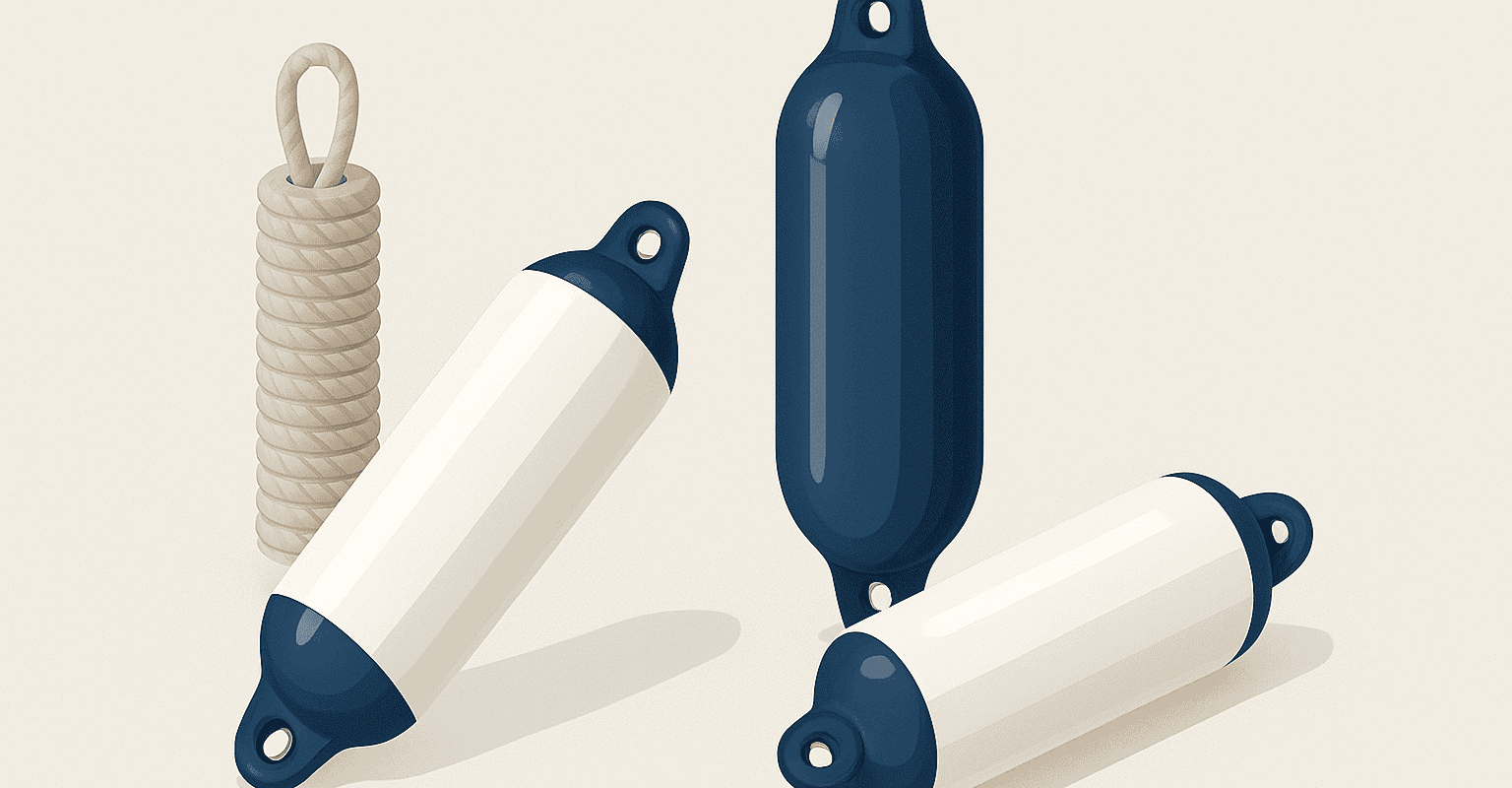
When boat fenders are really needed
I boat fenders are not an accessory to be evaluated only based on habit or the aesthetics of the deck. Their real usefulness emerges when analyzing the context of use of the boat, the type of mooring, the geometry of the hull, and above all the compatibility with the system and with the available attachment points. In many situations the problem is not having or not having fenders, but understanding which solution is really convenient based on how the boat is managed every day.
Those who navigate between different ports, frequent side dockings, or quays with varying heights know well that a generic protection can prove ineffective. On the contrary, a reasoned choice reduces impacts, rubbings, and corrective maneuvers. For this reason, in the best nautical technical guides, the topic is addressed starting from three simple questions:
- how mooring normally takes place;
- which surfaces of the boat are most exposed to contact;
- which attachment or support systems are already present on board.
If the boat often enters tight berths or docks alongside structures with edges, the fender becomes an operational protection, not a secondary element. If instead the boat almost always stays in the same mooring, it may be more useful to consider a stable configuration consistent with the freeboard setup. In both cases, the correct evaluation always starts from the real usage situation.
Un altro aspetto spesso sottovalutato riguarda la gestione a bordo. Un parabordo efficace ma scomodo da posizionare, difficile da regolare o poco compatibile con cime, golfari o tientibene finisce per essere usato male. E quando la protezione viene montata in fretta, troppo alta o troppo bassa, perde gran parte della sua funzione. Per approfondire i criteri di allestimento può essere utile consultare anche le nostre guide tecniche nautiche e i contenuti dedicati alla gestione dell’ormeggio.
Boat fenders: differences between solutions, sizes, and compatibility
Comparing the various solutions means going beyond the most immediate distinction between shapes or sizes. The real difference lies in the compatibility between fender, boat, and onboard system. 316 stainless steel pipe price compatibility boat fenders compatibility, in fact, refers to a set of practical factors that affect the final result.
Shape matters, but only if interpreted in the right context
Not all hulls react the same way to contact with docks, poles, or other boats. A solution may work well on a regular side and be less suitable on hulls with pronounced volumes, external handrails, or protruding accessories. The shape of the fender must therefore be interpreted in relation to:
- the boat's side profile;
- height of the most likely contact point;
- presence of cable glands, battens, or structures that interfere with positioning;
- ease of adjustment during maneuvering.
In practice, there is no universally best solution: there is the one most consistent with your setup. If you have doubts about the intended use, check the product sheet the recommended type of application.
The measurements should be read together with the freeboard
One of the most common mistakes is choosing the fender by only looking at the apparent size. In reality, the useful measurement is the one that allows the protection to work at the point where the boat really risks contact. A fender that is too small may not cover the exposed area; one that is too bulky can be inconvenient to handle and less stable in fixing.
To understand which solution is best, observe:
- the height of the gunwale relative to the dock;
- the usual position of the mooring lines;
- the possible tendency of the boat to move with wind or swell;
- the distance between the available fixing points.
This approach is more useful than any choice “out of habit,” because it links the measurement to the concrete function. In a truly technical logic, measurements are not evaluated in isolation, but always in relation to the behavior of the boat at mooring.
Compatibility with the system: the criterion that changes the choice
The theme of boat fenders compatibility mainly concerns how the system integrates with what is already on board. If the attachment points are inconvenient, if the lines work poorly, or if the fender interferes with other accessories, the solution may be theoretically valid but impractical in daily use.
Compatibility must be checked at least on these aspects:
- fixing points: where and how you can hang the fender without creating obstruction;
- adjustment: how quickly you can adjust the height during docking;
- stowage: where it is stored when not needed;
- interferences: presence of pulpits, handrails, scuppers, or side accessories;
- onboard routine: large or small crew, frequent or occasional maneuvers.
In altre parole, la soluzione giusta non è solo quella che protegge, ma quella che riesci a usare bene ogni volta. Per un approfondimento sui sistemi di bordo collegati all’ormeggio, puoi consultare anche i contenuti tecnici dedicati agli accessori nautici.
Mistakes to avoid when choosing and installing boat fenders
Many problems attributed to fenders actually depend on an initially unthoughtful choice or an improvised installation. Even a good solution can become ineffective if positioned without considering the actual impact point or the dynamics of mooring.
Choosing based on habit rather than use
One of the most common mistakes is replicating the configuration seen on other boats. But two boats similar in size can have very different needs if the port, type of berth, or arrangement of attachment points change. The nautical technical guides most useful insist precisely on this: the choice must always be adapted to the context.
If you almost always moor on the same side, for example, it makes sense to consider a more stable and quick-to-prepare configuration. If instead you alternate different dockings, a more flexible solution may be preferable. Copying a standard setup without this analysis often leads to inefficient use.
Positioning the fender too high or too low
The fender works well only if it is at the point where contact occurs. When hung too high, the hull remains exposed. When left too low, it can swing badly or fail to protect the critical part of the hull. This mistake is especially common in quick maneuvers, when the attachment is improvised at the last moment.
To avoid this, it is advisable to do a practical test while mooring, observing where the boat tends to approach the structure. It is not enough to “place it by eye”: a real, even visual, check during docking is needed.
Ignoring the boat's behavior in lateral movement
Not all boats remain still in the same way once at the dock. Some tend to rotate, others to shift laterally, and others still behave differently between bow and stern. If the fender is placed uniformly without considering these differences, some areas remain vulnerable.
A more correct approach involves identifying:
- the points where the boat touches first;
- the areas where friction increases;
- the zones that change height based on load or wave motion;
- the sides where the attachment is more stable.
This type of analysis is simple but often overlooked. Yet it is what distinguishes a “present” protection from a truly effective protection.
Neglecting compatibility with ropes and accessories
Another typical mistake concerns interference with already installed equipment. If the fender obstructs the passage of a rope, gets stuck near an accessory, or makes boarding uncomfortable, it will end up being moved or used improperly. Compatibility with the system is not a detail: it is an essential condition.
Before defining a configuration, always check if the chosen system remains practical even during:
- entry and exit from the berth;
- adjustment of mooring lines;
- crew passage along the hull;
- quick stowage at the end of the maneuver.
Per chi sta rivedendo l’assetto complessivo dell’ormeggio, può essere utile leggere anche gli approfondimenti su cime e accessori di coperta.
Products and categories to consider for a technical choice
When comparing the boat fenders, the most useful way to navigate is not to look for the “best model overall,” but to identify the most suitable category for your onboard system. This approach helps filter options based on real compatibility and not just shape or perceived bulk.
The categories to consider should be read together with these criteria:
- main type of mooring: side, temporary, seasonal, with limited or more open spaces;
- boat configuration: gunwale, bulwark, handrail, side accessories;
- onboard management: experienced crew, solo maneuvers, need for speed;
- available space: both for installation and storage onboard.
In a technical evaluation, it is also advisable to distinguish between primary protection and support protection. In some setups, in fact, choosing only one element is not enough: what matters is how multiple protection points work together during mooring. This does not mean complicating the equipment, but making it consistent with the real behavior of the boat.
If you are comparing different options in the catalog, the advice is to carefully read the description, application images, and installation notes. Where a detail is not specified, check the product sheet. It is the most correct way to understand if a solution integrates well with your setup.
Per una panoramica più ampia puoi esplorare anche le soluzioni per l’ormeggio e la protezione della barca, oltre ai contenuti collegati alle attrezzature di bordo. In questo modo il confronto non resta astratto, ma diventa parte di una valutazione tecnica completa.
One last important point: not all needs arise from the risk of direct impact. In many cases the real problem is repeated rubbing, which requires stable protection, well positioned and easy to adjust over time. For this reason, those looking for a truly convenient solution should think in terms of continuity of use, not just occasional protection.
Recommended products

 10" Wound Wire Cartridge 20 micron – code: 10MP20 – Idromar
 Stainless steel clamps Norma 12–22 mm – code: FAI0012022 – Toscogomma
 Brush with spring - code: SGM45 - Gianneschi Pumps and Blowers


How to understand which solution is really convenient based on the system
Making an effective choice means putting together all the factors seen so far in a concrete logic. The right question is not “which fender do others choose?”, but which configuration works best on my boat, with my mooring and with my system.
To simplify the evaluation, you can follow this sequence:
- Observe the actual contact point during usual maneuvers.
- Check the available attachment points and the ease of adjustment.
- Check for interferences with ropes, accessories, and passages on board.
- Consider storage when the fender is not in use.
- Compare the product sheet with your actual setup.
If even one of these steps is overlooked, the solution may seem valid on paper but turn out to be uncomfortable or ineffective in practice. On the contrary, when compatibility has been well verified, the boat fenders become an integral part of mooring management and not an accessory to be arranged at the last moment.
If you want to navigate the available options with a more technical approach, explore the dedicated category and related catalog content: you will find a selection designed to help you evaluate the most suitable solution for your onboard system and your way of using the boat.
FAQ
How to understand if the boat fenders are compatible with my onboard system?
You need to check where they can be fixed, how easy it is to adjust them during mooring, if they interfere with ropes or accessories, and where they can be stored. If a detail is not clear, check the product sheet.
Is the size of boat fenders chosen only based on the size of the vessel?
No. The measurement must be evaluated together with the freeboard, the type of quay, the most likely contact point, and the behavior of the boat at mooring. A correct choice always arises from the context of use.
Why can a fender be ineffective even if it seems the right size?
Often the problem is not the size itself, but the positioning. If the fender is mounted too high, too low, or in a spot that does not coincide with the contact area, the protection is significantly reduced.
Better a stable solution or a more flexible configuration?
It depends on how you use the boat. If you almost always moor in the same context, a stable configuration can be more practical. If you often change port or side of docking, a more adaptable solution is advisable.
What is the most common mistake when choosing boat fenders?
Choosing out of habit or copying other boats without considering mooring, attachment points, available accessories, and onboard routines. The best choice is always the one consistent with your setup and the actual use of the boat.