


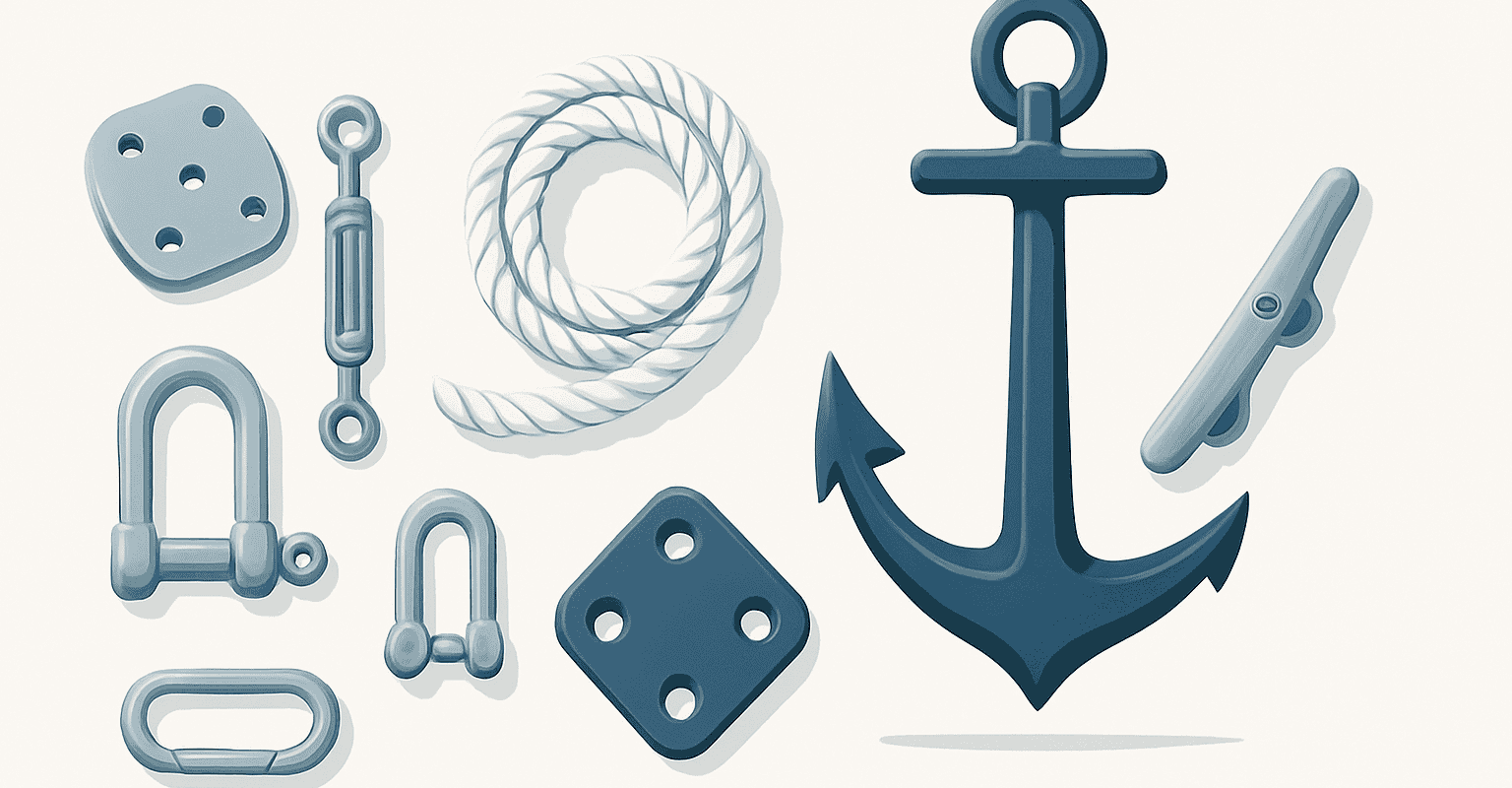
When online marine hardware is really needed
Buy online marine hardware does not simply mean searching for a component and adding it to the cart. In the nautical field, even a seemingly simple accessory can affect assembly, space requirements, sealing, ease of use, and integration with parts already on board. For this reason, a correct choice always starts with a precise question: is that component compatible with my installation?
Online research becomes truly useful when you need to quickly compare multiple solutions, check construction details, and carefully read the technical sheets. In many cases, the main advantage is not just the availability of the catalog, but the ability to evaluate in advance the shape, fastening, materials, and intended use, reducing the most common errors.
The nautical technical guides they are particularly useful in some recurring situations:
- when you need to replace an existing element without modifying holes or supports;
- when you are completing a new setup and want to maintain consistency between components;
- when you have doubts about attachments, center distances, locking systems, or installation methods;
- when you need to understand if a solution is suitable for use on deck, in the cabin, or in a technical compartment;
- when you want to avoid incompatibilities between hardware, supports, and mounting surfaces.
Another often underestimated aspect concerns the real context of use. On a boat, there is almost never a truly “universal” component: thicknesses, geometries, accessibility, exposure to external agents, and usage methods vary. This is why the topic online marine hardware compatibility is central: the correct choice depends less on the category alone and much more on the relationship between the component and the system in which it will be installed.
Se stai confrontando più opzioni, può essere utile approfondire anche altre guide tecniche nautiche dedicate al montaggio e alla selezione dei componenti di bordo. Un percorso di lettura ben costruito aiuta a distinguere rapidamente ciò che è intercambiabile da ciò che richiede verifiche aggiuntive.
Differences between solutions, measurements, or compatibility in online marine hardware
The comparison between similar items is where most mistakes are made. Two components may seem equivalent in photos but differ in details that directly affect the possibility of assembly. In online marine hardware, compatibility should be understood as a set of factors, not as a single measurement.
Shape and space requirements: the first check to make
Even before material or finish, it is advisable to verify the geometry of the piece. A component may be correct in function but unsuitable in terms of space, orientation, or mechanical travel. This is especially true when the replacement is made on an existing base.
Always check:
- overall dimensions;
- position of the fixing points;
- possible right or left orientation;
- space needed for opening, rotation, or locking;
- interference with bulkheads, covers, handles or other nearby accessories.
If the detail is not clear, check the product sheet. In case of doubt, it is useful to compare the component with close-up photos of the existing installation, taking note of the actually necessary dimensions.
Mounting and support compatibility
Another critical point concerns how the hardware connects to the structure. It is not enough to know that an accessory serves the same function: you need to understand if its fastening system is consistent with the available support. Holes, centers, thicknesses and type of surface can radically change the final result.
The most useful checks are:
- type of mounting provided;
- number and arrangement of anchoring points;
- compatibility with the material of the installation surface;
- presence of any backplates, bases or complementary accessories;
- need for adaptations that could complicate assembly.
A conscious purchase starts precisely here: not from visual similarity, but from the technical correspondence between component and support.
Materials and operating environment
On nautical technical guides, the material should not be considered only in aesthetic terms. On a boat, the installation position makes the difference: a component intended for a sheltered compartment does not work under the same conditions as one exposed to splashes, humidity or frequent use on deck. For this reason, it is important to carefully read the indicated intended use and check in the product sheet if the component is designed for that context.
When comparing multiple solutions, always ask yourself:
- where the component will be installed;
- how much it will be exposed to water, salt, or condensation;
- if it will be subject to frequent maneuvers;
- if it must integrate with other hardware already on board.
Per orientarti meglio tra materiali, finiture e applicazioni, può essere utile consultare una sezione dedicata agli accessori nautici tecnici o ad approfondimenti specifici sulla scelta dei componenti per interni ed esterni.
Mistakes to avoid in choice or assembly
Many problems arise not from the product itself, but from a selection process that is too quick. When purchasing online marine hardware compatibility and assembly must be evaluated together. Separating these two aspects often leads to incorrect orders, avoidable returns or untidy adaptations.
Choosing “by sight” without comparing dimensions
The most common mistake is trusting the photo. Images help to understand the type of item, but do not replace checking the measurements. Even minimal differences in hole position or body height can prevent correct assembly.
A practical method is to first take the measurements of the component to be replaced and then compare them point by point with the technical sheet. If some information is not available, check the product sheet or look for related support content.
Ignoring the direction or logic of installation
In some cases compatibility depends on the opening direction, lever position, latch orientation or locking direction. This type of detail is often overlooked until assembly, when correcting it becomes more complicated.
Before purchasing, observe the existing installation and note:
- how the component moves;
- from which side it is operated;
- what free space is needed to use it correctly;
- if there are paired parts that require alignment.
Do not consider the complete system
The hardware rarely works alone. Hinges, locks, supports, bases, handles, and fastening accessories are part of a whole. Replacing only one element without evaluating the rest can create misalignments, unwanted play, or difficulties in use.
To avoid this problem, always think about the complete system:
- does the new component interact with those already installed?
- does it require complementary accessories?
- does it maintain the same mounting logic as the existing system?
- does it allow a direct replacement or does it require adaptations?
Se stai intervenendo su più punti della barca, può essere utile consultare anche una raccolta di soluzioni per il montaggio nautico per avere una visione più coerente dell’insieme.
Neglecting the installation surface
A component that is correct on paper can become unsuitable if the mounting surface is not flat, accessible, or sufficiently stable. This is especially true in retrofits, where the existing structure imposes precise limits.
Before ordering, check:
- thickness and shape of the support;
- accessibility from the rear side, if necessary;
- possible presence of curves or obstacles;
- consistency between the component base and the available area.
This preventive attention saves time and reduces the risk of having to modify the support unexpectedly.
Products and categories to consider for a more precise choice
When talking about online marine hardware, the catalog may seem very large. However, to choose well, it is not necessary to explore everything randomly: it is better to start from the function the component must perform and only then move on to compatibility details.
The categories to evaluate most often fall within areas such as:
- components for opening and closing doors, lockers, and hatches;
- fastening and support elements for panels or light structures;
- accessories for handling, locking, or retention;
- solutions for completing existing installations;
- coordinated components to standardize assembly across multiple edge areas.
The key point is to avoid selection based solely on the category name. Within the same family, there can be variants designed for different uses, with differences in assembly, size, and interface. For this reason, the nautical technical guides are useful: they help to read categories functionally, not just commercially.
An effective approach is this:
- identify the actual function of the part to be replaced or installed;
- define the context of use on board;
- take measurements and note fastening points;
- compare the available variants;
- check all non-obvious details in the product sheet.
Se vuoi approfondire la logica di scelta per famiglie di componenti, puoi consultare anche una panoramica sulle categorie tecniche nautiche oppure esplorare contenuti dedicati ai sistemi di fissaggio e chiusura.
Another useful criterion is consistency between existing components and new additions. In many installations, maintaining a homogeneous line simplifies both assembly and future maintenance. This does not mean necessarily looking for an identical item, but finding a solution that respects the same construction logic.
Quando il catalogo è ampio, la ricerca può essere semplificata filtrando per applicazione, tipo di montaggio o famiglia di utilizzo. In questo modo si riduce il numero di opzioni non pertinenti e si lavora su un confronto più tecnico. Se disponibile, può essere utile anche consultare una selezione per brand nautici o per linee omogenee di componenti, così da mantenere maggiore continuità nell’installazione.
Recommended products

 10" Wound Wire Cartridge 20 micron – code: 10MP20 – Idromar
 Brush with spring - code: SGM45 - Gianneschi Pumps and Blowers
 Stainless steel clamps Norma 12–22 mm – code: FAI0012022 – Toscogomma


Technical questions to ask before ordering
Before completing the purchase, it is worth pausing for a moment and doing a final check. Just a few well-posed questions can avoid most errors:
- am I replacing an existing component or creating a new installation?
- have I taken the actual measurements of the mounting point?
- is the fastening system compatible with the structure?
- Does the component work in the same direction and with the same logic as the previous one?
- Are there complementary accessories to consider?
- Is the intended use consistent with the environment in which it will be installed?
This checklist is simple but very effective. In most cases, the difference between a correct and a problematic purchase depends precisely on these preliminary checks.
If you are looking for a reliable solution for your setup or for an exact replacement, explore the category dedicated to marine hardware or browse the available brands to find components consistent with your assembly and the real needs on board.
FAQ
How to check the compatibility of nautical hardware online before purchase?
The most useful check starts from measurements, fixing points, dimensions, and installation direction. It is not enough for the component to look similar: it must be consistent with the existing support and the required function. If a detail is not clear, check the product sheet.
Can I replace a nautical component by choosing one that looks similar?
Not always. Two items may appear very similar but differ in pitch, mounting base, orientation, or usage mode. Before ordering, it is advisable to compare the actual dimensions and evaluate the complete system in which the component will be installed.
What is the most common mistake when buying nautical hardware online?
The most common mistake is choosing only based on the photo or the category name, without checking measurements, fastenings, and compatibility with the edge structure. A second very common mistake is ignoring the opening direction or the assembly logic of the existing component.
Do nautical technical guides really help in making a choice?
Yes, because they allow you to read the components in a functional and comparative way. A good guide helps to distinguish between similar items, to understand which checks to make before ordering, and to reduce the risk of incompatibility during assembly.
When is it advisable to also check the installation surface?
Always, especially in replacements on existing systems. Thickness, accessibility, flatness, and available space can directly affect assembly. Even if the component is correct for function, it might not be suitable for the structure it must be attached to.


