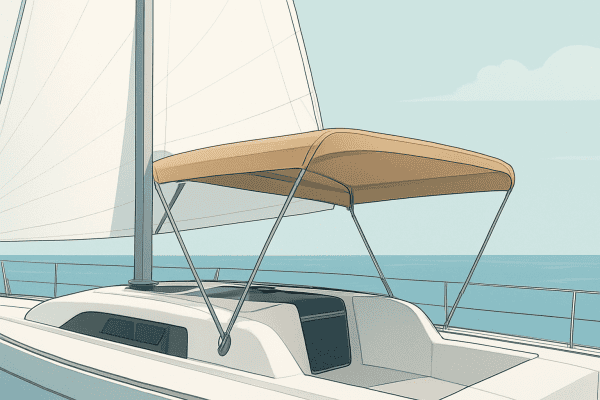
When a DIY boat awning is really needed
The topic DIY boat awning often attracts those who want to improve comfort and protection on board without immediately starting from a complex solution. In reality, the choice does not only concern the installation, but above all the compatibility with the boat, the actual use and the type of coverage needed during navigation or at anchor.
An awning can be useful in very different contexts: day trips, fishing, anchorage stops, short transfers, staying in port. However, the way it must work changes. On some boats, it is mainly important to create shade in the cockpit; on others, it is more important to have a structure that is quick to open and close, with minimal bulk when not in use.
Those looking for nautical technical guides on this subject often compares apparently similar solutions but with substantial differences. The right question is not only “can it be installed?”, but “does it integrate well with spaces, passages, accessories, and existing attachment points?”.
Before considering an order, it is advisable to carefully observe some practical aspects:
- area to be covered and desired shading level;
- presence of roll-bars, handrails, consoles, or windshields that may interfere;
- useful height to move without obstacles;
- available anchoring points and their actual position;
- ease of opening and closing during daily use;
- storage space when the awning is not in use.
In many cases, DIY makes sense when the boat has a linear configuration, with free areas and easily accessible fixings. It becomes more delicate when the deck has irregular geometries, accessories mounted near the edges, or narrow passages towards stern and bow. In these situations, the difference between a practical and an uncomfortable solution depends on details that often emerge only after careful measurement.
To better navigate between useful components and accessories, it can be helpful to also consult nautical technical guides dedicated to assembly and to delve into fastening systems for deck accessories, so as to understand whether your installation requires only a simple adaptation or a more careful check.
Differences between solutions, sizes, or compatibility of the DIY boat awning
The central issue, when talking about DIY boat awning compatibility, is to distinguish between a theoretically mountable solution and one that is truly suitable for use. Two awnings may seem equivalent at first glance, but they differ in structure, opening, bulk, and behavior once installed.
Geometric compatibility: width, height, and useful development
The first check concerns the geometry of the boat. It is not enough to measure the width of the point where you plan to fix the structure. You also need to understand:
- where the useful edges for mounting are located;
- whether the surface is regular or has marked curves;
- if the awning opening interferes with seats, lockers, or backrests;
- if the final height allows a comfortable posture on board.
A roughly taken measurement often leads to two opposite problems: insufficient coverage or an overly invasive structure. For this reason, when a detail is unclear, check the product sheet which dimensions are required and from which point they must be taken.
Functional compatibility: how you will really use the awning
Compatibility is not just a matter of size. The type of use also matters. An owner who uses the boat mainly at anchor has different needs compared to someone who frequently enters and leaves the port or requires coverage that leaves some passages free. In practice, you need to ask:
- will the awning remain open for long periods or be closed often?
- is more central shade needed or protection over a specific area?
- must it coexist with other accessories already installed?
- should the mounting be reversible or stable over time?
These questions help avoid a common mistake: choosing based on the general appearance without verifying the consistency with the real routine on board.
Structure and fixing points: where the real difference lies
One of the most underestimated elements concerns the fixing points. A boat may seem ready to receive an awning, but not all available points offer the same convenience. Some are easy to reach but unfavorable for opening; others allow good tension of the structure but limit the helmsman's movements or access to the seats.
In a technical evaluation it is advisable to check:
- alignment between the two sides of the mounting area;
- solidity of the support on which the hardware will be fixed;
- rotation space of the structure when opening and closing;
- interferences with cushions, covers or accessories already present.
If you are comparing multiple options, it is useful to also read about solutions for nautical accessories compatible with different configurations and to consult insights on surveys and measurements on board, thus reducing the margin of error before purchase.
Mistakes to avoid in choice or assembly
In the comparison between various solutions, the most common mistakes do not depend on a single component but on a sequence of evaluations made too quickly. The DIY boat awning works well when chosen with a technical approach, not when decided solely based on the declared measurement or the general shape.
Measure only once and from a single point
One of the most frequent mistakes is taking only one cross measurement and considering it sufficient. In reality, the useful width can vary greatly between one point and another on the same boat. Furthermore, the ideal area for fixing does not always coincide with the one that offers the best coverage.
The safest practice is to take multiple measurements, note the exact points, and compare the result with the boat's configuration. If the technical sheet requires specific references, check the product sheet how to carry out the correct survey.
Underestimating the space when closed
Many users evaluate the awning well when open but neglect where it will be positioned when closed. This detail affects the livability of the cockpit, access to lockers, and freedom of movement during maneuvers. A structure that seems perfect when open can become uncomfortable if, once closed, it occupies an area already heavily used.
Before ordering, always imagine two scenarios:
- boat in use with awning open;
- boat in motion or in storage with awning closed.
Both must be practical.
Ignoring interferences with existing accessories
Consoles, handrails, backrests, supports, lights, or other elements mounted on deck can limit installation more than it seems. Even a few centimeters of difference can change the ideal fixing point or force a less efficient position.
For this reason, in nautical technical guides more useful, interference control always comes before the final choice. It is a simple but decisive step: observe the area from multiple angles, simulate the opening, and check if the awning will obstruct passages or frequent accesses.
Confusing theoretical compatibility with real compatibility
Another typical mistake is thinking that a “universal” solution is automatically suitable for any boat. In practice, real compatibility depends on how the structure fits into the available space and how comfortable it is in daily use.
The real question is not whether the awning can be installed, but whether once mounted:
- allows a useful coverage;
- maintains free passages;
- does not make boat handling uncomfortable;
- is consistent with the way you actually use the boat.
This is the key point of the topic DIY boat awning compatibility: the correct choice comes from the combination of measurements, structure, and usage scenario.
Products and categories to consider
When comparing available options, it is useful to think in terms of functional categories and not just shape or size. The goal is to build a coherent configuration, where the bimini integrates with the mounting components and the layout of the boat.
In a technical evaluation, it is advisable to consider:
- main structure in relation to the available space;
- fastening accessories compatible with the installation point;
- support components useful for stability and practicality;
- spare parts or complementary elements to be checked based on the chosen configuration.
This approach is more effective than searching for an isolated solution, because it reduces the risk of incompatibility between structure and hardware. Those preparing a reasoned purchase can also explore categories dedicated to nautical accessories for coverage and mounting and consult other technical content to choose consistent components.
Another useful aspect is to distinguish between simple installations and installations that require more careful verification. If your boat has regular spaces, easy access to fastening points, and no obvious obstacles, the selection is more straightforward. If instead the deck is complex or already full of accessories, it is advisable to carefully examine every detail before ordering.
At this stage, it is important not to look for shortcuts. The DIY boat awning gives satisfactory results when the choice is made with technical logic: first check compatibility, then compare solutions in the most suitable category. If information about measurements, attachments, or installation methods is not immediately clear, check the product sheet.
Recommended products

 10" Wound Wire Cartridge 20 micron – code: 10MP20 – Idromar
 Brush with spring - code: SGM45 - Gianneschi Pumps and Blowers
 Stainless steel clamps Norma 12–22 mm – code: FAI0012022 – Toscogomma


Choose methodically before ordering
Before proceeding, gather measurements, photos of the mounting area, and information about existing fastening points. This helps you compare categories more precisely and identify the solution most consistent with your boat. If you are evaluating the catalog, explore the section dedicated to accessories and coverage systems of the brand or reference category: starting from a well-organized technical selection makes it easier to find a DIY boat awning truly compatible with real onboard use.
FAQ
How to check the compatibility of a DIY boat awning with your own boat?
Compatibility must be checked on multiple levels: useful width of the fixing point, available height, presence of accessories that may interfere, and ease of opening and closing. A generic measurement is not enough: it is advisable to take multiple points and compare them with what is indicated in the product sheet.
What is the most common mistake when choosing a DIY boat awning?
The most common mistake is choosing based on appearance or a single measurement, without considering the actual use on board. A solution may seem suitable but turn out to be uncomfortable if it obstructs passages, lockers, or already installed accessories.
When does it make sense to choose a DIY boat awning?
It makes sense when the boat has a simple configuration, with accessible attachment points and enough space for opening and closing. If the deck is irregular or heavily accessorized, it is better to carefully check every detail before ordering.
Why are the awning measurements alone not enough to choose?
Because real compatibility also depends on the position of the fastenings, the closing clearance, the useful height, and interferences with other edge elements. Measurements are only part of the technical evaluation.
What to check before ordering a DIY boat awning?
Before ordering, it is advisable to gather precise measurements, photos of the installation area, information about the available supports, and check if the structure allows free movement on board. If a detail is not clear, check the product sheet.