


When boat anchors are really needed
Talking about boat anchors usefully means going beyond the simple idea of “stopping the boat.” In practice, the anchor comes into play whenever it is necessary to maintain a position with greater control, reduce the risk of drifting, and manage a stop more predictably than an improvised maneuver. It is precisely here that many nautical technical guides are decisive: not so much to explain the basic action, but to help avoid assessment errors that, in the field, become recurring problems.
A very common misconception is to think that all anchors are interchangeable. In reality, the choice depends on several factors: type of boat, bow configuration, anchoring line, usual seabed, and available space on board. Even when two solutions seem similar, their actual behavior can change depending on how they are installed and paired with the correct accessories.
The situations in which a suitable anchor really makes a difference are numerous:
- temporary stops at anchor or in sheltered areas;
- position management during operational or recreational breaks;
- maneuvering safety when a stable reference is needed;
- onboard backup in case of necessity or unforeseen events.
Il punto centrale non è solo avere un’ancora a bordo, ma avere una soluzione coerente con l’uso reale dell’imbarcazione. Chi naviga saltuariamente tende spesso a sottovalutare questo aspetto; chi invece consulta con attenzione le guide tecniche nautiche sa che la differenza tra una sosta tranquilla e una gestione complicata nasce quasi sempre da una scelta fatta troppo in fretta.
It is also worth remembering that the anchor never works alone. Bow roller, chain, rope, windlass, and bow geometry influence the final result. For this reason, before choosing a solution, it is advisable to observe the whole system and not just the main component. If you have doubts about the correct pairing, check the product sheet and compare the indications with your boat’s configuration.
Boat anchor compatibility: differences between solutions, sizes, and configurations
The theme of boat anchor compatibility is one of the most underestimated and, at the same time, one of the most important. Many problems do not arise from an “incorrect” anchor per se, but from a solution incompatible with the rest of the anchoring system. In other words, a good anchor can perform poorly if placed in an inconsistent configuration.
Shape and geometry are not secondary details
The differences between the various types of anchors affect how the component positions itself, penetrates the seabed, and settles during traction. This aspect matters especially in the presence of variable seabeds or when the boat changes orientation. A geometry more suited to a certain context may be less practical in another, especially if the bow has limited space or a bow roller with restricted passages.
Among the aspects to carefully evaluate are:
- overall size during storage;
- alignment with the bow roller and with the bow roller;
- stability when resting when the anchor is in the resting position;
- smooth sliding during lowering and retrieval.
A common mistake is to focus only on the anchor's profile without checking how it behaves during the transition between stowage and use. If the anchor tends to get stuck, rotate poorly, or hit the bow, the problem is not only practical: it can result in wear, loss of time, and less smooth maneuvers.
Compatibility with chain, rope, and accessories
When talking about boat anchor compatibility, the anchoring line must also be considered. Chain and rope must be consistent with the overall system, as well as any joints, swivels, and connection points. An incorrect pairing can compromise the smoothness of retrieval or create abnormal tensions during use.
In particular, it is advisable to check:
- the compatibility of the connection between anchor and line;
- the correct seat on the bow roller or on the bow support;
- the possible interference with the windlass or with the chain passage;
- the consistency between size and onboard configuration.
Se un componente sembra adattarsi “quasi bene”, spesso non è abbastanza. In ambito nautico, i compromessi di montaggio sono una delle principali cause di malfunzionamenti ripetuti. Per approfondire il tema dell’abbinamento tra accessori e impianto, può essere utile consultare una sezione dedicata ai componenti per l’ancoraggio o leggere altre guide tecniche correlate.
Measurements: how to think without excessive simplifications
Measurements should never be interpreted in isolation. Choosing an anchor just because it “fits onboard” or looks visually proportionate is a risky shortcut. The size must be considered together with the boat's structure, intended use, and compatibility with the bow system.
For a correct evaluation, it is useful to ask some practical questions:
- does the anchor fit stably without forcing?
- is retrieval carried out with a regular attitude?
- Are there unwanted contact points with the hull or bow roller?
- Does the current configuration allow for easy use even in non-ideal conditions?
If the answer to any of these points is unclear, the choice needs to be further examined. In these cases, the best rule is simple: check the product sheet and compare the information with the actual configuration of your boat.
Mistakes to avoid when choosing or installing boat anchors
Most problems related to boat anchors do not depend on obvious defects, but on recurring errors during selection, installation, or use. These are common mistakes, often underestimated because they seem like small details. In reality, these very details affect reliability, practicality, and operational safety.
Choosing based on habit rather than the actual configuration
One of the most common mistakes is replicating the solution seen on another boat, without considering that every bow has different geometries and clearances. An anchor that works well on one boat may be inconvenient or incompatible on another. The nautical technical guides most useful ones emphasize this point: there is no universally valid choice, but a correct choice for a specific configuration.
Copying a solution without verification risks having:
- unstable support on the bow roller;
- interferences during retrieval;
- imperfect alignment of the anchoring line;
- difficulty storing at the bow.
Neglecting installation and contact points
Another typical mistake concerns installation. Even a well-chosen anchor can cause problems if the fastening, positioning, or line routing have not been carefully evaluated. Vibrations, impacts, and repeated friction are signs not to ignore. They often indicate that the system is not working in alignment or that a component is not suitable for the existing support.
The most common signs of installation needing review are:
- unusual noises during navigation or retrieval;
- lateral movements of the anchor in resting position;
- rubbing on parts of the bow;
- jamming in the passage between lowering and storage.
When one of these symptoms appears, it is advisable to intervene immediately. Postponing often means turning a small misalignment into a structural problem or less reliable maneuver handling.
Underestimating the seabed and type of use
A less obvious but very common mistake is choosing without considering where and how the boat is used. Those who alternate short outings, occasional stops, and areas with different seabeds have different needs compared to those who use anchoring more regularly. So it is not enough to ask “which anchor to install,” but also “in which contexts it will be used most often.”.
This approach helps to avoid two opposite extremes:
- a theoretically valid solution but impractical in the onboard routine;
- a solution easy to stow but inconsistent with actual use.
Per orientarti meglio, può essere utile confrontare i contenuti dedicati agli accessori nautici di coperta con altre risorse tecniche del catalogo, così da valutare il sistema nel suo insieme e non come somma di pezzi separati.
Ignoring maintenance and periodic checks
An anchor requires not only the correct choice but also attention over time. Connections, attachment points, and surfaces subject to wear must be checked regularly. The problem is not only visible wear: often the first signs are small play, no longer stable rests, or less smooth maneuvers.
A periodic check should include:
- inspection of connection points;
- observation of any deformations or abrasions;
- verification of stability on the bow support;
- inspection of smoothness of lowering and retrieval.
If you notice abnormal behavior, do not improvise adaptations. It is better to compare the configuration with the available guidelines and, if necessary, check the product sheet.
Products and categories to consider for a consistent anchoring system
When addressing the topic of boat anchors with a technical approach, it is useful to think in terms of systems and not individual components. This means evaluating not only the anchor but also all categories that influence its actual functioning onboard. It is a more solid approach, especially for those who want to avoid incompatibilities and subsequent corrective interventions.
The areas to consider are generally these:
- anchors and connection accessories;
- chains, ropes, and terminals;
- bow rollers, rollers, and supports;
- recovery systems and related components;
- protective elements against impacts and abrasions.
The advantage of this method is practical: instead of asking whether an anchor is “good,” one asks whether it is really suitable for their boat and their system. It is the logic that distinguishes a quick purchase choice from an effective technical evaluation.
Chi cerca una panoramica utile può partire da raccolte tematiche come le guide per l’attrezzatura nautica, dove spesso emergono collegamenti preziosi tra componenti che, a prima vista, sembrano indipendenti. Per esempio, un problema attribuito all’ancora può in realtà dipendere dal supporto di prua o da un passaggio non ottimale della linea.
Another important aspect is continuity of use. A coherent configuration does not just “work,” but simplifies daily management: less friction, fewer manual corrections, less risk of impacts, and greater fluidity in maneuvers. This is particularly relevant for those who want an orderly and reliable system even in the most frequent operations.
Before completing the choice, it is therefore advisable to check:
- if the component is designed for the type of installation present on board;
- if the space is compatible with the bow area;
- if the connection with other elements is linear and free of forced adaptations;
- if daily use is simple, stable, and repeatable.
This type of preventive check reduces many of the critical issues that only emerge after installation. And, above all, it helps select solutions truly consistent with one’s boat.
Recommended products

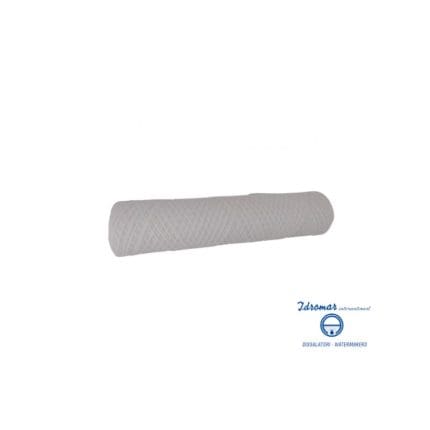 10" Wound Wire Cartridge 20 micron – code: 10MP20 – Idromar
 Stainless steel clamps Norma 12–22 mm – code: FAI0012022 – Toscogomma
 Brush with spring - code: SGM45 - Gianneschi Pumps and Blowers


Recurring problems of boat anchors and how to prevent them
Among the most frequent problems related to boat anchors there are those that manifest gradually. They do not always appear as obvious faults: they often start with small signals, easy to ignore, which however anticipate suboptimal compatibility or an installation to be reviewed.
Anchor that does not settle well on the support
If the anchor does not find a stable resting position, the discomfort is not only aesthetic. An uncertain support can cause impacts, oscillations, and localized wear. In these cases, it is important to check the alignment between anchor, bow roller, and contact points. Even a minimal difference in geometry can affect overall stability.
Recovery that is not smooth or with jams
When recovery is not linear, the cause may depend on a combination of factors: poorly oriented connections, narrow passages, inconsistent supports, or an anchoring line not suitable for the configuration. Acting only on the symptom rarely solves the problem definitively. It is better to analyze the complete system.
Noises, abrasions, and unwanted contacts
Metallic noises, marks on the bow, or recurring abrasions almost always indicate compatibility issues that need to be investigated. They are useful signals because they show where the system is working poorly. Ignoring them often leads to progressive wear and less precise anchoring management.
To prevent these problems, it is advisable to adopt a simple routine:
- observe the behavior of the anchor during lowering and recovery;
- check the resting position after each use;
- check for any signs of contact on nearby surfaces;
- review the configuration if friction or abnormal movements appear.
If you want to choose more consciously among compatible categories and accessories, explore the section dedicated to anchoring solutions and find the setup best suited to your boat. A well-matched system simplifies maneuvering, reduces recurring problems, and makes every stop in the water more reliable.
FAQ
How to understand if an anchor is compatible with my boat?
Compatibility must be assessed considering the bow roller, bow support, anchor line, and recovery method. It is not enough for the anchor to fit into the available space: it must also be securely housed and operate without interference. If in doubt, check the product sheet.
What are the most common mistakes when choosing boat anchors?
The most common mistakes are choosing out of habit, copying the configuration of another boat, neglecting the actual space at the bow, and not checking the compatibility with chain, rope, or connecting accessories.
Why does the anchor get stuck or recover poorly?
Usually the problem depends on a configuration that is not perfectly consistent: unsuitable bow support, poorly oriented connections, narrow passages, or anchoring line not properly matched to the system.
When is it advisable to check the anchoring system?
It is useful to check it periodically and whenever abnormal noises, rubbing, lateral movements, or difficulties in the transition between lowering and storage appear. Even small signals can indicate a compatibility or assembly problem.
Do nautical technical guides really help in choosing the anchor?
Yes, because they allow evaluating the anchor as part of a complete system and not as an isolated component. A good technical comparison helps prevent assembly errors, incompatibilities, and recurring problems in daily use.


