


When you really need marine hardware near me
Search marine hardware near me does not only mean finding a conveniently located store. In practice, this search almost always arises from a concrete problem: a component to replace quickly, a compatibility doubt, an installation that doesn’t convince, or the need to compare multiple solutions before working on board.
In the context of nautical technical guides, proximity is especially useful when you want to reduce the margin of error. Seeing materials, fittings, dimensions, and fastening systems in person helps avoid hasty purchases. However, proximity alone is not enough: the real point is to understand if the chosen component is suitable for the intended use.
Many users start the search because they find themselves in one of these situations:
- they need to replace a worn element without having the original code;
- they notice unusual play, oxidation, or difficulty opening and closing;
- they need to verify measurements and spacing before installation;
- they want to understand if an accessory is compatible with the support already installed;
- they are comparing multiple materials for an environment exposed to humidity and salt spray.
In all these cases, the local search is only the first step. The second, much more important, is to read the technical context of the part: where it will be installed, what stresses it will work under, on which surface it will be fixed, and with which other components it will have to interact.
To delve deeper into the topic of the correct choice of onboard components, it can be useful to also consult guides and technical insights and content dedicated to nautical maintenance, so as to arrive at the selection with a more complete picture.
Differences between solutions, measurements, or compatibility in marine hardware near me
One of the most common mistakes is thinking that two similar components are automatically interchangeable. In reality, when talking about marine hardware near me compatibility, several factors come into play that are often not immediately visible.
Mechanical compatibility: shape is not the only thing that matters
A component may seem correct at first glance but turn out to be unsuitable once installed. Mechanical compatibility concerns, for example, the type of fastening, hole positions, movement orientation, available space for opening or closing, and interaction with nearby parts.
Before choosing, it is always advisable to check:
- hole center distance and fixing diameter;
- thickness and nature of the mounting surface;
- opening or rotation direction;
- actual space occupied in working position;
- presence of components that may obstruct movement.
If any of these data are unclear, the safest solution is simple: check the product sheet.
Materials and operating environment
In boating, the material is not a minor detail. A component installed in an indoor and sheltered environment may have different requirements compared to one mounted in a more exposed area. The wrong choice does not always create an immediate problem, but it can cause premature wear, blockages, or maintenance difficulties.
For this reason, in the best nautical technical guides, the comparison between solutions is not limited to aesthetics or shape. The context must always be evaluated: exposure to moisture, frequency of use, contact with other metals, need for periodic disassembly, and ease of cleaning.
Functional compatibility: same apparent use, different behavior
Two items may belong to the same family but offer different behavior in operation. They differ in the type of closure, stability, precision of fit, or the way they distribute stress on the support surface.
This aspect is often underestimated by those looking for marine hardware near me with the idea of quickly replacing a part. In reality, a correct replacement requires understanding not only “what it mounts,” but also “how the component works” once installed.
To better navigate materials, fastenings, and applications, it can be useful to consult an overview of fastening systems or insights on solutions for deck and interiors.
Mistakes to avoid in choice or assembly
Most problems do not arise from obvious defects, but from small wrong assessments made at the beginning. Here are the most frequent mistakes to avoid when selecting or installing hardware for nautical use.
Choosing “by eye” without precise measurement
Measuring roughly is one of the main causes of incompatibility. Even a minimal difference between holes, stops, or clearances can turn a simple assembly into a forced adaptation. The advice is always to take measurements directly on the existing component and on the installation surface, not relying on memory or quickly taken photographs.
When possible, it is useful to note:
- distance between holes;
- width and height of the part to be replaced;
- available space around the fixing point;
- thickness of the support;
- possible presence of gaskets, spacers, or backing plates.
Ignoring the surface on which the component is to be mounted
A very common mistake is to focus only on the accessory and not on the base that will support it. Curved surfaces, thin panels, supports that are not perfectly flat, or materials already marked by previous drillings can compromise the final result.
If the support is irregular or weakened, even a theoretically correct component can perform poorly. In these cases, it is advisable to check if adaptations, reinforcements, or a different fastening system are needed. If the detail is not clearly indicated, check the product sheet.
Mounting without evaluating the actual movement
Once installed, the component must be able to operate without abnormal friction, interference, or lateral stresses. This is especially true for elements that open, close, lock, or guide a movement. Mentally testing the usage cycle before mounting helps prevent many problems.
The right questions to ask are:
- Is there enough space for full movement?
- Is the gripping point still accessible?
- Does the fastening properly transfer the load?
- Are there nearby parts that could hit or rub?
Neglecting compatibility between metals and accessories
In a marine environment, the pairing of different materials deserves attention. It is not only about durability over time but also about maintenance, disassembly, and the behavior of the assembly. Often the main component is replaced but fastening elements or secondary accessories that are not perfectly consistent with the new configuration are reused.
A good practice is to evaluate the system as a whole, not the single isolated piece. This approach reduces the risk of having to intervene again shortly after.
Forcing installation to fit an incorrect component
When an element does not match existing holes, stops, or alignments, the temptation is to modify it or adapt the support. Sometimes this choice seems to save time, but often leads to a less stable, less clean, and harder to maintain result.
If the component requires significant modifications to be mounted, it is likely not the right solution. From a technical perspective, it is better to stop and recheck compatibility, measurements, and intended use.
Products and categories to consider
When searching for marine hardware near me, it is useful to think in terms of function and not just the name of the piece. This helps to more quickly identify the correct family and compare truly relevant alternatives.
The categories to consider, in general, include components for fastening, closing, support, movement, opening, and finishing. The choice of the right category depends on three elements: position on board, type of use, and compatibility with the hardware already present.
A practical method is to start with these questions:
- Does the component serve to locking, connect o support?
- Does it work in a point subject to vibrations or frequent use?
- Does it need to integrate with existing parts or replace the entire system?
- Is it visible and therefore relevant also from a finishing point of view?
- Does it require complementary accessories for correct mounting?
This approach is particularly useful in competitor-driven research, where datasheets, images, and similar solutions are often compared without a real technical analysis. Instead of stopping at visual similarity, try to reconstruct the function of the piece in the overall system.
If you are considering a replacement or a new installation, it can be useful to also explore the sections dedicated to technical accessories to have a broader view of the solutions compatible with your project.
Another important aspect concerns the completeness of the intervention. Many problems arise because only the most obvious component is replaced, leaving secondary elements already worn, misaligned, or no longer suitable in place. In these cases, the result is only partial: the new part is there, but the system continues to function poorly.
For this reason, in nautical technical guides, often the emphasis is on a simple principle: before purchasing, observe the whole. Check how the component connects to other elements, if the support is still in good condition, and if the new assembly requires additional accessories. Again, if information is not explicitly provided, check the product sheet.
Recommended products

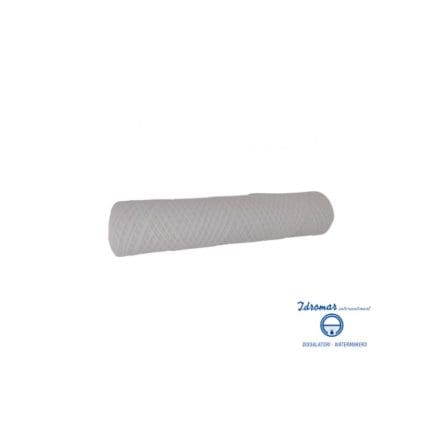 10" Wound Wire Cartridge 20 micron – code: 10MP20 – Idromar
 Stainless steel clamps Norma 12–22 mm – code: FAI0012022 – Toscogomma
 Brush with spring - code: SGM45 - Gianneschi Pumps and Blowers
 Desalination maintenance kit – code: Cleaning Kit (SC1 + SC2) – Schenker


How to avoid recurring problems with a more technical approach
The difference between an improvised replacement and a correct choice almost always lies in the method. A technical approach does not mean complicating the work, but reducing unforeseen issues. Before looking for the closest or most similar solution, it is advisable to gather some essential information.
Checklist before purchase
- photograph the mounted component from multiple angles;
- record measurements, holes, thicknesses, and dimensions;
- note where it is installed and how it is used;
- check for signs of wear also on the support;
- assess whether the problem concerns only the part or the entire system;
- compare the data with the available technical description.
This simple check helps avoid most of the typical mistakes made by those who look marine hardware near me compatibility without having a complete picture.
When it is advisable to stop and double-check
There are signs that suggest not proceeding automatically. For example: holes that do not match, the need to force the assembly, movement that is not smooth even during testing, support that flexes, or doubts about the material. In all these cases, insisting is rarely the best choice.
It is better to return to the starting data, compare measurements and function again, and verify if there is a solution more suitable for the real application. This is the true value of nautical technical guides: not pushing towards a generic choice, but helping to recognize the solution consistent with the context.
If you want to navigate among components, accessories, and mounting solutions, explore the catalog sections and available brands: you will be able to compare categories and technical details more consciously, identifying the option best suited to your onboard installation.
FAQ
How do I know if a marine hardware component is compatible with the one already installed?
Check hole spacing, dimensions, direction of opening or rotation, type of fastening, and mounting surface. Do not rely solely on the external shape: if a detail is missing, check the product sheet.
Can I replace a nautical component with a similar one found by searching for nautical hardware near me?
Only if measurements, function, and mounting method really match. Two components that look similar can work differently or require different fastenings.
What is the most common mistake in choosing marine hardware?
The most common approach is to choose by eye, without taking precise measurements and without considering the support on which the component will be installed. Even small differences can cause assembly or operational problems.
Why is material compatibility important in marine hardware?
Because in a marine environment, humidity, salt, and contact between different components can affect durability, maintenance, and ease of disassembly. It is always better to evaluate the system as a whole.
When is it advisable to consult nautical technical guides before purchasing?
It is advisable to do it when you need to replace a part without the original code, when you have doubts about measurements or compatibility, or when the component works in a critical point and you want to avoid selection or assembly errors.


