When you really need a boat table
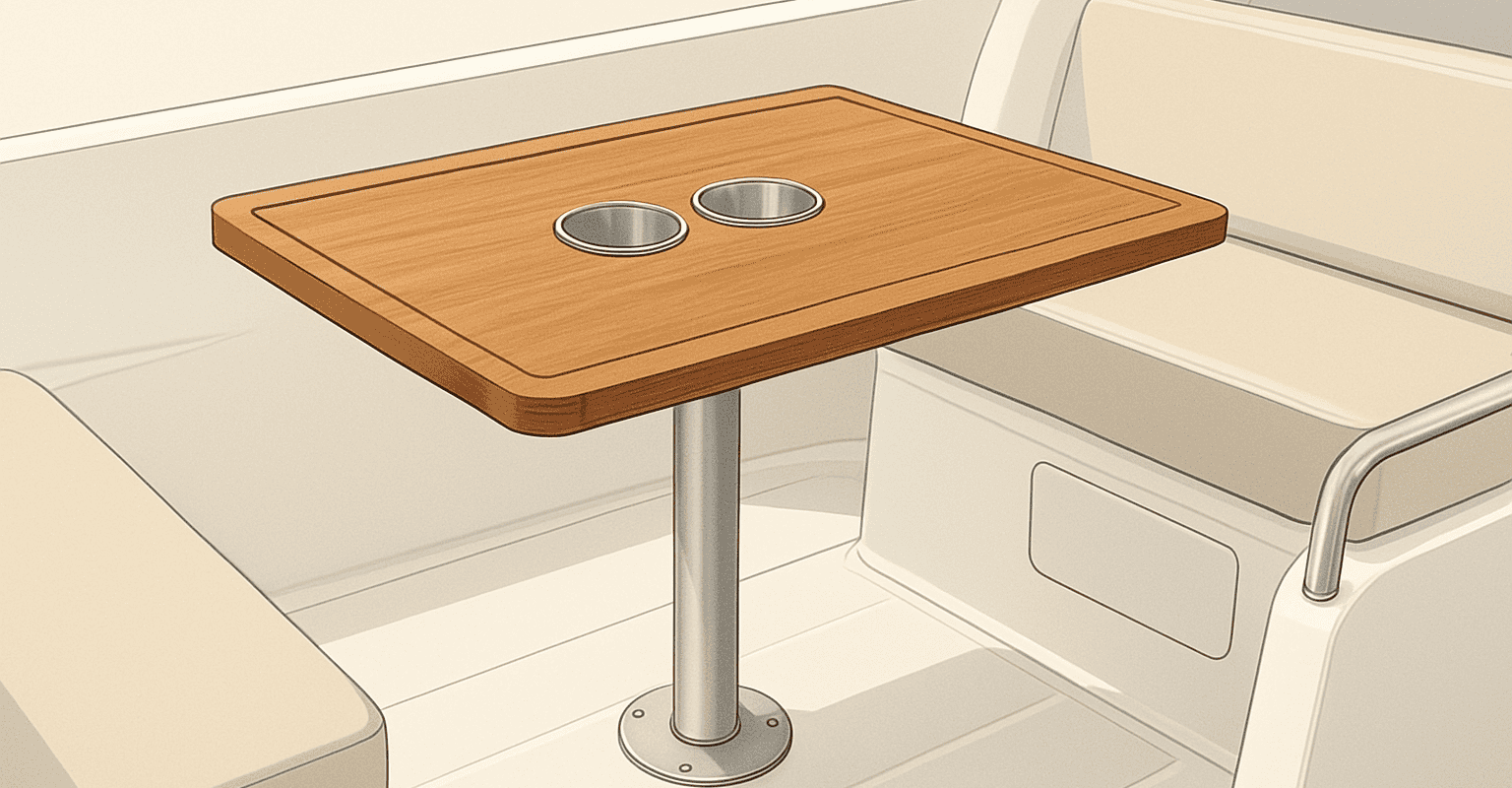
The boat table it is not an accessory to be evaluated only based on aesthetics or available space. In the nautical field, the correct choice mainly depends on system, dinette configuration, fixing points, and usage methods. This is precisely where many superficial evaluations lead to impractical installations, unnecessary bulk, or partial compatibility with the existing structure.
On a boat, the table can serve very different functions: a social surface in the cockpit, support for the indoor dinette, a convertible element into a relaxation area, or a support surface to be used only during reduced navigation or at anchor. Understanding which solution is truly convenient means starting from a simple question: how is the system on which the table will work made?
By system, in this context, it does not only mean the base or the support leg, but the whole of:
- structure of the top and its support;
- presence of recessed or plug-in bases;
- telescopic or adjustable systems;
- seats and cushions that interfere with movements;
- possible transformations of the dinette;
- technical spaces under the top or under the floorboards.
Those looking for nautical technical guides on this topic, there is usually already a concrete doubt: replace only the top, change the support, adapt an existing base, or redo the complete system. The answer is never the same for everyone because the real convenience depends on how much the current system can be recovered without forcing.
A first useful criterion is to distinguish between replacement need and conversion need. In the first case, the system works, but the top is worn or not very suitable. In the second, however, the problem is deeper: incorrect height, insufficient stability, excessive bulk, or incompatibility with the seat arrangement. This difference completely changes the type of choice.
Se vuoi approfondire il rapporto tra accessori, arredi e componenti di bordo, può essere utile consultare anche altre guide tecniche nautiche dedicate alla configurazione degli spazi interni ed esterni.
Differences between solutions, sizes, or compatibility of the boat table
The central point is not just choosing a table, but verifying the real boat table compatibility with what is already installed. Two solutions that appear similar can behave very differently once installed on board.
Existing base or complete system
The first check concerns the support. If the boat already has a fixed or removable base, it is necessary to understand if the new table can work with that system without critical adaptations. In many cases the problem is not the top, but the interface between top and support: attachments, seats, diameters, plates or mounting dimensions may not match.
When the base is sound and well positioned, it may be convenient to keep the system and intervene only on the top or the upper part of the support. If instead the system shows play, instability or a poorly functional geometry, it is often more sensible to consider a wider replacement. In these cases it is always advisable check the product sheet if the component is designed for installation on an existing base or for a complete system.
Static footprint and footprint in use
A common mistake is to measure only the space occupied by the table when it is stationary. In reality, on a boat the’dynamic footprintalso counts: how much space is needed to sit down, get up, rotate around the top, store it or transform it. A table that seems correct on paper can become uncomfortable if it interferes with passages, lockers, backrests or openings.
For this reason it is useful to evaluate:
- free space around the top when the seats are occupied;
- interference with hatches, drawers or technical compartments;
- possibility of quick removal when the table is not needed;
- compatibility with any dinette completion cushions.
This practical reading helps to understand whether a compact, removable, adjustable or more structured solution is convenient.
Useful height and real function
Not all boat tables are designed for the same use. Some are intended as a simple support surface, others become part of a transformation of the living area. The difference is important because it changes the required working height. If the table must integrate with seats and cushions, its height cannot be evaluated abstractly: it must be read together with the geometry of the dinette.
In a technical choice, the right question is not “do I like this model?”, but “is this configuration consistent with my onboard setup?”. If the table must lower, rotate or be removed, each additional function requires precise compatibility with the support and the available space.
Materials and installation context
The choice of material is not only about taste. In the cockpit, cabin or exposed areas, the table works under different conditions. Ease of cleaning, resistance to moisture, stability of the top and behavior over time matter. Here too, however, the material must be read together with the system: a well-made top mounted on an inadequate support does not solve the problem.
Se stai valutando componenti collegati all’arredo tecnico di bordo, può essere utile confrontare anche altri accessori nautici per la dinette o sistemi di supporto compatibili con gli spazi della tua imbarcazione.
Mistakes to avoid in choice or assembly
In practice, the most common mistakes arise from a too quick approach: only the visible top is compared and everything underneath is neglected. In reality, the correct installation of a boat table depends on details that directly affect usability and durability.
Choosing based on shape without checking the attachment
A top with apparently correct dimensions can be incompatible if the fastening system does not match the existing structure. Before purchasing, it is essential to check:
- type of upper attachment;
- presence of plate or dedicated seat;
- compatibility with column, leg or base already installed;
- need for additional accessories for installation.
If this data is not immediately available, the safest solution is to check the product sheet and compare the useful dimensions with the system already on board.
Ignoring the underlying structure
The anchoring point must be carefully evaluated. A table used often, or intended for a passage area, experiences stresses that cannot be left to chance. If the support rests on an unsuitable surface, the problem does not emerge immediately, but over time it can result in play, noise, or perceived poor stability.
For this reason, in nautical technical guides, compatibility should never be read only as a match between components, but also as consistency with the structure that houses them.
Not considering daily use
A table can be technically mountable but impractical. This happens when real use is neglected: dining on board, transforming the dinette, accessing lockers, the need to clear the passage, storing the top when not needed. The best solution is almost always the one that reduces compromises in daily use, not the one that seems most complete overall.
Before choosing, it is advisable to simulate some concrete actions:
- sitting down and standing up with the table in position;
- opening nearby compartments;
- assessing side access;
- understanding if the top obstructs movements or view;
- checking if removal is simple or laborious.
Adapting too much instead of choosing the right component
When the boat table compatibility it is not clear, one tends to think that a small adjustment solves everything. In reality, forcing a system with improvised plates, spacers, or solutions not designed to work together can complicate maintenance, stability, and practicality. If the starting system is very different from the required one, it is often better to opt for a coherent solution from the beginning.
Per un confronto più ampio tra componenti di arredo tecnico e supporti di bordo, puoi consultare anche una selezione di soluzioni per l’allestimento nautico utili a leggere meglio la compatibilità tra elementi.
Products and categories to consider
When comparing available alternatives, the most useful way to navigate is to think in terms of functional categories, not individual items. This approach helps to understand which family of solutions is truly suitable for your system.
Replacement tables for existing systems
This category is suitable for those who have a still valid base or column and want to renew the top or restore a more practical configuration. It is the most straightforward choice when the system is sound and the issue concerns only wear, top shape, or space management.
In this case, you mainly need to check:
- mounting scheme;
- useful dimensions of the top;
- consistency with the usage area;
- any predisposition for existing supports.
Complete systems for new dinette configuration
If the goal is to change how the area is used, it may be more sensible to consider a complete system. This is the typical situation for those who want to improve stability, practicality, or transformation of the dinette without being tied to a system designed for different needs.
Here the advantage is not so much having “more functions,” but obtaining a coherent set between base, support, and top. In a technical evaluation, this coherence is often the real element that makes the difference over time.
Support accessories and complementary components
In some cases, the table is not the only element to review. Bases, columns, plates, fastening elements, or components that improve integration and stability may come into play. Even if the focus remains on the table, the correct choice often comes from a broader vision of the whole.
Per questo può essere utile esplorare anche componenti tecnici per il montaggio nautico e accessori collegati all’arredo di bordo, così da evitare acquisti scollegati tra loro.
How to understand which solution is really worth it
To decide practically, this scheme can help:
- keep the existing system if the base and support are reliable and the problem concerns only the top or superficial usability;
- update support and top if the current attachment limits choice or creates instability;
- evaluate a complete system if you need to change the function of the dinette or correct a poorly ergonomic configuration;
- always check compatibility between dimensions, fastenings, and actual available space;
- never separate the choice of the table from the installation context.
In other words, the most convenient solution is not the apparently simplest one, but the one that requires fewer compromises once installed. This is the criterion that distinguishes a correct choice from a theoretically compatible purchase.
Recommended products

 10" Wound Wire Cartridge 20 micron – code: 10MP20 – Idromar
 Brush with spring - code: SGM45 - Gianneschi Pumps and Blowers
 Stainless steel clamps Norma 12–22 mm – code: FAI0012022 – Toscogomma


Useful links to deepen your choice
Se stai confrontando più opzioni, può essere utile proseguire la lettura con altre risorse dedicate alle guide tecniche per accessori nautici e alle soluzioni di arredo funzionale per interni ed esterni di bordo. Un confronto ragionato tra supporti, basi e configurazioni ti aiuta a individuare il boat table most suitable without relying solely on the appearance of the top.
If you want to navigate among the available solutions, explore the dedicated category or the reference brand: it is the fastest way to compare components consistent with your system and check which configuration can offer the best boat table compatibility for your boat.
FAQ
How do I know if a boat table is compatible with the existing system?
You need to check the type of base installed, the attack system between support and deck, the useful dimensions, and the actual space available around the dinette or cockpit. If some data is unclear, check the product sheet.
Is it better to replace only the tabletop or the entire system?
It depends on the condition of the existing support. If the base and column are stable and functional, replacing the top may be enough. However, if there are issues with size, height, or stability, it is often more effective to consider a complete system.
What is the most common mistake when choosing a boat coffee table?
The most common mistake is choosing based on the shape or size of the table without checking attachments, base, interferences with seats and passages. Compatibility must always be considered as a whole between the table, support, and edge structure.
Is the size of the coffee table enough to choose the right model?
No. In addition to the plan measurement, useful height, movement area, access to lockers, possible transformation of the dinette, and consistency with the fastening system matter. A correct measurement alone does not guarantee practicality on board.
When is it better to choose a removable solution?
A removable solution is useful when the space needs to remain flexible, the passageway must be cleared often, or the small table is used only at specific times. Even in this case, it is important to check compatibility with the base and support.