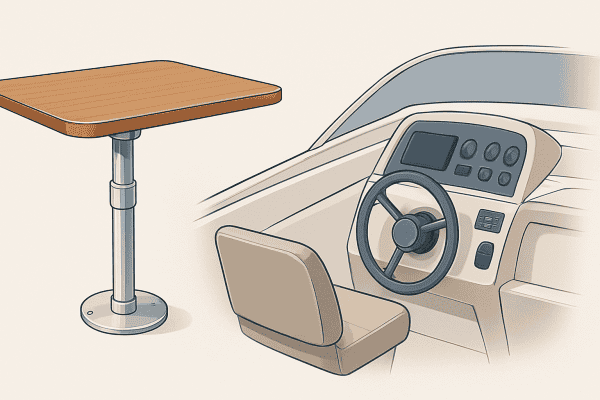
When boat design accessories are really needed
In the world of boating, talking about boat design accessories does not mean stopping at aesthetics. A well-chosen accessory affects the usability of spaces, the visual coherence of deck and interiors, daily practicality, and, above all, compatibility with the boat. In a technical guide, the point is not to chase the “most beautiful” solution in absolute terms, but to understand when a design accessory makes sense and which criteria allow selecting it without mistakes.
The demand grows especially in three situations. The first is refit, when you want to update the boat’s image while maintaining a clean and current line. The second concerns replacing worn components with elements more consistent with the existing layout. The third is new installation on boats where every detail must harmonize with materials, finishes, and existing spaces.
In all these cases, the nautical technical guides help avoid a superficial choice. An accessory may look correct in photos and prove unsuitable once installed, perhaps due to proportions, spacing, thicknesses, or fixing methods. For this reason, before evaluating the visual effect, it is advisable to analyze the context: installation area, intended use, exposure to external agents, frequency of use, and interaction with other nearby components.
If you are comparing different options, it can be helpful to also explore solutions for nautical outfitting, deck accessories, and onboard environment finishes, so as to evaluate the whole rather than the individual isolated element.
Design does not only mean style
In technical language, the design of an accessory includes shape, ergonomics, integration, and ease of handling. A well-designed element must fit in without creating obstacles, unwanted protrusions, or visual and functional discontinuities. This applies both to external areas and internal environments, where the relationship between volumes and passages is even more delicate.
A correct approach starts with a simple question: does this accessory really improve the onboard experience? If the answer is yes, then design becomes a concrete value. If instead it adds complexity, requires invasive adaptations, or breaks the overall balance, it is worth reconsidering the choice.
Differences between solutions, measurements, and boat design accessory compatibility
Comparing alternatives is the heart of every informed choice. When looking for boat design accessories, the difference is not only in shape but in how each solution fits the boat. The issue of boat design accessory compatibility is central because it involves geometries, supports, materials, and intended use.
Two apparently similar accessories can have very different construction logics. Some are designed for discreet integration, others for a more marked visual impact. Some favor essential lines, others work on more evident details. However, when choosing, the main criterion always remains adherence to the real installation context.
Measurements to check before choosing
Among the most underestimated aspects are the measurements. It is not enough to verify that the accessory “fits”: you need to understand how it occupies the space and if it leaves enough margin for correct use. The most useful checks concern:
- overall size, especially in passage areas or near other elements;
- center distance and fixing points, if replacing an existing component;
- support thickness, useful for evaluating hold and mounting;
- depth or projection, important to avoid interference;
- orientation of the accessory in relation to the installation surface.
When this data is not immediately clear, the best solution is simple: check the product sheet. It is an essential step to reduce the risk of incompatibility and to correctly compare models with similar settings but different sizes.
Compatibility between materials and surfaces
Compatibility is not only about dimensions. The relationship between the accessory and the mounting surface is also decisive. A flat base, a slightly curved area, a panel with a delicate finish, or a part exposed to frequent use require different evaluations. A refined design accessory can lose effectiveness if installed on an unsuitable surface or if it creates excessive contrast with the surrounding materials.
For this reason, in the best nautical technical guides, material control should always be accompanied by proportion checks. A consistent choice considers:
- visual uniformity with the elements already present on board;
- adaptability of the support base;
- consistency with the overall style of the boat;
- ease of cleaning and management in daily use.
If you are considering a broader update, it can be useful to also consult the guides on nautical materials and insights on accessory compatibility.
Integrated solutions and visible solutions
Another important difference concerns the type of visual presence. Integrated solutions tend to blend with the boat's structure and are often preferred when seeking formal continuity. Visible solutions, on the other hand, can become a distinctive element, provided they do not appear out of scale with the environment.
The choice depends on two factors: the aesthetic language of the boat and the function of the accessory. In an essential context, a too marked presence can be discordant. In a more refined setup, a well-visible detail can instead strengthen the project's identity.
Mistakes to avoid in choosing or mounting
Many problems arise not from the product itself, but from an incomplete evaluation before purchase or from an installation carried out without preliminary checks. When talking about boat design accessories, the most frequent mistakes are often the same, even on very different boats.
Choosing based only on the image
The first mistake is relying exclusively on the visual aspect. Photos and renderings help to get an idea, but do not replace technical analysis. An elegant accessory can prove impractical if placed in an area subject to impacts, frequent passages, or rapid movements on board.
To avoid this problem, it is always advisable to verify the relationship between form, function, and position. The best choice is the one that maintains a balance between aesthetic performance and actual use.
Ignoring existing centers and holes
In case of replacement, one of the most common mistakes is not considering the already existing fixing points. This often leads to unforeseen modifications, untidy adaptations, or visually inconsistent results. Before proceeding, it is useful to accurately detect the existing configuration and compare it with the available data. If the detail is not clearly indicated, check the product sheet.
Neglecting onboard ergonomics
A well-designed accessory must also be comfortable to use. In practice, ergonomics means accessibility, intuitive grip, ease of movement around the component, and absence of unnecessary obstacles. This is particularly important in confined spaces or in areas where use often occurs while moving.
A correct installation should always take into account:
- height and position relative to the user;
- distance from other accessories or moving surfaces;
- possible interferences during opening, closing, or maneuvering;
- continuity of passages and daily safety of use.
Forcing compatibility
Another typical mistake is trying to force an accessory onto a boat for which it is not really suitable. In the nautical field, forced compatibility rarely yields a good result: it can compromise aesthetics, complicate installation, and reduce final satisfaction. If a component requires too many modifications to be installed, it often means it is not the right solution for that context.
It is better to opt for options designed to interact with the type of surface, layout, and style present on board, rather than chasing an unconvincing compromise.
Products and categories to consider for a technical choice
When looking for a design accessory for the boat, the most effective method is to think in terms of functional categories, not visual impulse. This helps to compare alternatives in a more orderly way and to understand which accessory families really deserve attention based on the onboard project.
The categories to evaluate depend on the area involved: deck, cockpit, interiors, passage areas, support points, or finishing elements. In any case, the technical criterion remains the same: coherence between function, size, and aesthetic language.
How to compare categories usefully
An effective comparison starts from a few clear parameters. For each category, ask yourself:
- what is the main function of the accessory;
- how visible it is in the overall context;
- how it affects onboard usage habits;
- whether it requires direct replacement or new installation;
- which surfaces and spaces it involves.
This approach avoids confusing decorative accessories with components that also have an important practical role. In many situations, the best solution is the one that looks natural once installed, without being too imposing but truly improving the whole.
To navigate among the different product families, it can be helpful to explore the technical categories dedicated to boating and the content related to selection guides, so as to build a more complete comparison before the final choice.
When it makes sense to coordinate multiple accessories
In some projects, the real leap in quality does not come from a single component, but from the consistency among multiple accessories. Coordinating lines, finishes, and proportions allows for a neater and more professional result, especially when working on highly visible areas of the boat.
This does not mean rigidly standardizing everything. Rather, it means identifying a common criterion: softer or sharper profiles, discreet or pronounced presence, continuity with existing surfaces, balance between technical elements and aesthetic details. This is where the nautical technical guides become truly useful, as they help to read the project as a whole.
Recommended products

 10" Wound Wire Cartridge 20 micron – code: 10MP20 – Idromar
 Stainless steel clamps Norma 12–22 mm – code: FAI0012022 – Toscogomma
 Brush with spring - code: SGM45 - Gianneschi Pumps and Blowers
 Desalination maintenance kit – code: Cleaning Kit (SC1 + SC2) – Schenker


How to use a technical guide to choose better
A well-made guide does not replace the analysis of the individual product, but helps to ask the right questions. In the case of boat design accessories, the correct process is progressive: first define the intervention area, then take measurements and constraints, then compare alternatives for compatibility, and only at the end evaluate the final aesthetic result.
This order is important because it reduces the risk of impulsive choices. It also allows you to immediately understand if a solution is suitable for a simple replacement or if more in-depth checks are required. In case of doubt about dimensions, attachments, or installation methods, the reference always remains the same: check the product sheet.
If you want to deepen the comparison between lines, materials, and onboard integration, explore the selection of available categories and brands: it is the most practical way to identify accessories consistent with your nautical project and move from a general idea to a truly compatible choice.
FAQ
How to check the compatibility of boat design accessories with my vessel?
Compatibility must be checked on multiple levels: dimensions, center distance, fixing points, actual size, surface type, and consistency with the installation area. If some data is unclear, check the product sheet.
Are boat design accessories only suitable for aesthetic refit?
No. They can also be useful when replacing a worn component or improving the functionality of an edge area. The design, in this context, also concerns ergonomics, integration, and ease of use.
What measurements should be taken before choosing a designer nautical accessory?
It is advisable to measure the overall size, distance between mounting points, thickness of the support, any protrusion, and available space around the accessory. This data helps to avoid incompatibilities during installation.
Is it better to choose an integrated solution or a more visible accessory?
It depends on the style of the boat and the function of the element. Integrated solutions are ideal when visual continuity is sought, while more visible ones can enhance the design if they remain proportionate to the context.
What is the most common mistake in choosing boat design accessories?
The most common mistake is relying solely on the aesthetic aspect without checking measurements, ergonomics, and compatibility with the mounting surface. A correct choice combines visual performance and technical adherence to the onboard context.