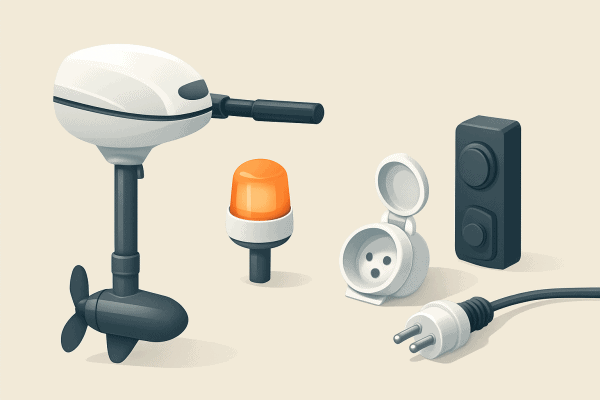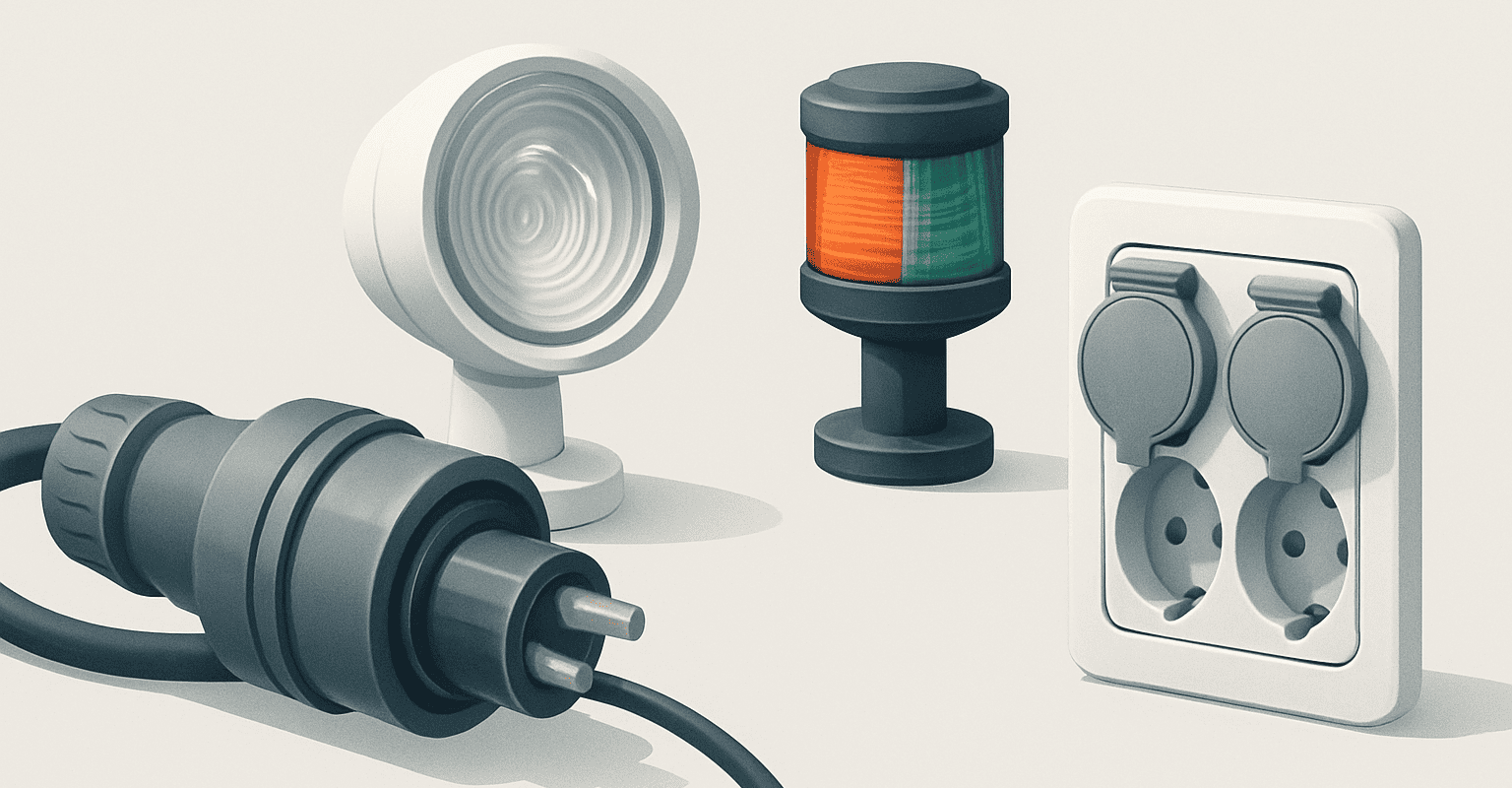
When sea sockets are really needed
In the onboard world, the sea sockets are not an accessory to consider only during outfitting: they are a critical point of the system and deserve constant attention. When talking about external power supply, dock connections, and electrical continuity, the topic often intertwines with lights, headlights, plugs, and sockets, because every component works in a chain and an anomaly in just one point can affect the entire system.
Many problems arise from a superficial assessment. The socket may appear intact on the outside but show signs of wear on the contacts, closure, or seals. In other cases, the defect is not immediately visible: overheating, oxidation, infiltration, or mechanical play can appear gradually and manifest only when the system is stressed.
For this reason, it is useful to distinguish between the mere presence of the component and real reliability over time. A socket installed for years, exposed to humidity, salt, and vibrations, requires regular checks just like the associated connections. If you notice irregularities onboard in the navigation lights, in services connected to the external line, or in points dedicated to plugs and sockets, it is worth checking the connection socket as well and not just the end user.
There are situations where intervention becomes particularly important:
- when the connection feels less secure than usual;
- when the cable tends to move abnormally once inserted;
- when there are signs of moisture or deposits near the connection point;
- when the cover no longer closes properly or the protection is weakened;
- when the system shows intermittent behavior without an obvious cause.
In a nautical context, ignoring these signs means increasing the risk of progressive failures. This is why checking sea sockets should be part of a broader inspection routine, along with cables, connections, and connected devices. A good reference can also be the analysis of areas dedicated to electricity and instrumentation, to have a complete view of the points working together.
Sea socket compatibility: differences between solutions, sizes, and connections
One of the most common mistakes is thinking that one socket is the same as another. In reality, the issue of sea socket compatibility is central because it involves the shape of the connection, coupling geometry, materials, contact point protection, and consistency with the system already present onboard.
When considering a replacement or upgrade, at least three aspects must be taken into account:
Mechanical compatibility
The first check concerns the housing and how the component fits into the existing seat. A forced or roughly adapted installation can compromise stability and sealing. Even if the connection seems to work immediately, vibrations, loosening, or infiltration can appear over time.
If you are not sure about the correspondence between old and new component, check the product sheet dimensions, installation methods, and compatibility indications.
Electrical system compatibility
The socket must be consistent with the rest of the system. This includes not only the power supply point but also cable, connectors, panel, and connected devices. A difference overlooked during selection can result in unstable contacts or irregular operation of sensitive devices, including some lines dedicated to lights and auxiliary services.
When sudden shutdowns, intermittent power, or irregular behavior of beacons, are noticed, it is not always the lighting fixture that is at fault. Sometimes the problem originates upstream, right at the connection point.
Environmental and usage compatibility
Marine conditions put every component under stress. For this reason, the choice should not be based only on the shape of the connection but also on the system's ability to operate in the presence of humidity, salt, and frequent use. A socket installed in a very exposed area may require different characteristics compared to one placed in a more protected area.
In practice, comparing solutions means asking concrete questions:
- is the component suitable for the position where it will be installed;
- does the closure remain effective even after repeated openings;
- do the contacts maintain stability over time;
- is the connection with cable and plug consistent with the existing system;
- can routine maintenance be performed easily.
Those looking for a replacement or an alternative solution often focus only on the external shape. In reality, the correct comparison between marine sockets involves a broader reading: interface, usage conditions, material durability, and connection reliability. To deepen the topic of onboard connections, it may also be useful to consult the section dedicated to connectors and electrical connections.
Mistakes to avoid when choosing or installing marine sockets
Installing and replacing these components requires precision. Even when the replacement seems compatible, incorrect installation can compromise the result. Practically speaking, the most frequent errors are few but recurring.
Underestimating signs of wear
A socket showing discoloration, dull contacts, unstable cover, or imprecise closure should not be left in service without checks. The same applies to a plug that inserts too easily or, conversely, with abnormal friction. These details often indicate progressive deterioration of the connection point.
Forcing only apparent compatibility
Among the most common mistakes is the idea of adapting similar but not truly equivalent components. The fact that a plug fits or that the fastening seems possible does not guarantee a correct match. Only visual compatibility can cause mechanical play, loss of continuity, or greater exposure to moisture.
In case of doubt, the best rule is simple: always compare the component with the existing configuration and check the product sheet useful details for replacement.
Neglecting the inspection of cables and nearby contacts
The socket never works alone. If the cable is stiffened, the coating is marked, or the terminals show oxidation, changing only the connection point may not solve the problem. The same applies when the fault occurs on lines connected to lights, headlights, plugs, and sockets: often the cause is distributed across multiple elements and not in a single component.
Mounting without considering the actual position on board
A choice that seems correct on paper can become inadequate if the component is installed in an area subject to splashes, impacts, or continuous stresses. The position influences accessibility, durability, and ease of maintenance. A socket that is difficult to inspect tends to be checked less often, which increases the risk of overlooked failures.
Ignoring signals that should not be underestimated
There are symptoms that deserve immediate attention:
- presence of residues or oxidation on the contacts;
- unusual odor near the connection;
- power instability when the cable is moved;
- traces of moisture inside the connection point;
- deformations of the seat or cover;
- intermittent operation of connected devices.
When one or more of these signals appear, it is advisable to stop and check the entire group. Continuing to use a compromised connection often means worsening the damage over time.
Periodic maintenance: useful checks before the problem becomes serious
Good maintenance of the sea sockets does not require complex interventions, but consistency. The goal is not only to avoid sudden failure: it is to keep the entire power system reliable and reduce anomalies that can also affect other onboard circuits.
An effective routine should include:
- visual inspection of the socket body and cover;
- checking the condition of the contacts and any presence of oxidation;
- verification of the stability of the fastening;
- inspection of the surrounding area to identify moisture or signs of deposits;
- testing the correct insertion of the plug, without play or forcing;
- checking the behavior of connected devices during use.
Another often overlooked aspect concerns the correlation between the socket and downstream devices. If you notice irregularities on lights and onboard lighting, or on other devices powered by the same line, the check should start right at the connection point. Acting immediately helps avoid confusing diagnoses and unnecessary replacements.
It is also useful to observe the component during seasonal changes or after long periods of inactivity. The marine environment accelerates the aging of materials and surfaces, so a check carried out before resuming use can prevent issues during navigation or at the dock.
Products and categories to consider for a coherent system
When addressing the topic of shore power sockets from a comparative perspective, one should not think about the single isolated piece. The best result is obtained by evaluating the entire onboard ecosystem: socket, plug, cable, protections, light points, and connected accessories. This approach reduces improvised pairings and helps build a neater system that is easier to monitor over time.
The categories to consider, generally, are those related to electrical connections and power distribution onboard. In particular, it can be useful to compare solutions dedicated to:
- external connections and power points;
- components for plugs and sockets coordinated with each other;
- accessories for wiring and connection protection;
- elements for lights and signaling circuits;
- spare parts and components connected to beacons and other sensitive points of the system.
The logic to follow is simple: if one component is worn, it is advisable to check those that work together as well. A new socket connected to old or inconsistent elements may not offer the best possible result. Conversely, a coordinated choice facilitates installation, maintenance, and future inspection.
For those comparing multiple options, the advice is to carefully read the available information and check the product sheet everything related to installation, pairings, and compatibility. This is particularly important when seeking a replacement on existing systems, where available space and onboard configuration can make a difference.
Recommended products


How to navigate between technical comparison and practical choice
In online searches dedicated to sea sockets, users often compare similar solutions with a precise goal: to understand which is best suited for their system without making mistakes during purchase or installation. For this reason, a good comparison does not limit itself to the external appearance but considers real use, connection continuity, and ease of maintenance.
If your focus concerns sea socket compatibility, it is advisable to start with three practical questions:
- does the new solution properly communicate with the components already onboard;
- can the installation be carried out without rough adaptations;
- does the connection point remain easy to inspect and maintain over time.
This approach is also useful as a preventive measure. A more conscious choice today can avoid recurring problems tomorrow, especially on lines involving lights, headlights, plugs, and sockets. The continuity of the system depends on the quality of the whole, not just the individual component.
If you are considering an upgrade or replacement, explore the categories dedicated to electrical connections and onboard components to find the solution most consistent with your system. A careful comparison between sockets, accessories, and compatible systems helps to choose more confidently and keep the system efficient over time.
FAQ
How to understand if a sea water intake needs to be checked or replaced?
The most common signs are less precise closure, contacts with oxidation, presence of moisture, unstable connection, or intermittent power supply. If the component shows obvious wear, it is advisable to also check the cable, plug, and nearby connections.
What does sea compatibility mean?
It means verifying that the socket is consistent with the existing system in terms of mechanical, electrical, and installation aspects. It is not enough for the component to look similar: the seat, connection, and usage conditions must match. In case of doubt, check the product sheet.
Can light and headlight anomalies be due to the connection socket?
Yes, in some cases the problem does not originate from the light point but from the upstream connection. A worn, oxidized, or unstable contact socket can cause irregular power supply and also affect lights, headlights, and other connected services.
Is it correct to replace only the socket if the system has problems?
Not always. The socket must be evaluated together with the plug, cable, terminals, and fastenings. If one of these elements is damaged, changing only the connection point may not definitively solve the problem.
What is the most common mistake when choosing shore power outlets?
The most common mistake is relying on only apparent compatibility, based on shape or external dimensions. A truly correct solution must be compatible with the system, with the intended assembly, and with the environment in which it will be used.