


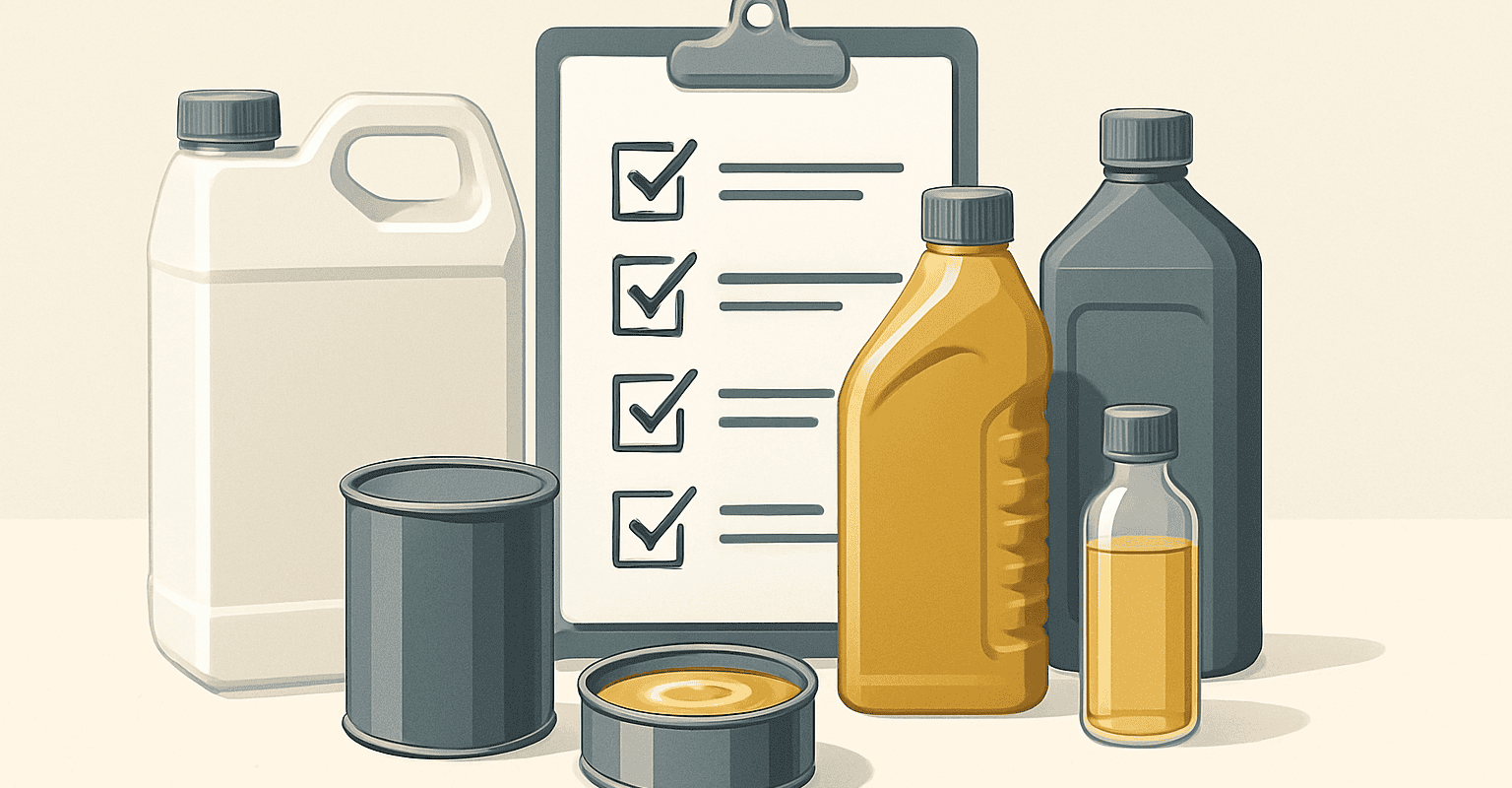
What oils, greases and chemicals are used for in maintenance
When buying online materials for technical assistance, workshop or plant management, the category oils, greases and chemicals requires more attention than it seems. It is not enough to choose an item “similar” to the one already used: a careless selection can slow down work, create incompatibilities with existing components or lead to an order unsuitable for the actual application.
A good oils, greases and chemicals guide starts from a simple principle: every product must be read according to its use, the support on which it will be applied and the operating context. In practice, before adding an item to the cart, it is advisable to clarify three aspects:
- main functionto lubricate, protect, clean, unblock, seal or facilitate maintenance;
- compatibility with materials and components: metals, gaskets, plastics, treated surfaces or moving parts;
- usage methodapplication method, localized intervention, periodic maintenance or use during assembly.
Nel lavoro quotidiano, la scelta corretta aiuta a mantenere continuità operativa e a ridurre errori ripetuti. Per questo, prima di procedere, può essere utile confrontare la documentazione tecnica con le informazioni disponibili nello store e verificare eventuali approfondimenti nella sezione guide tecniche o tra i contenuti dedicati alla manutenzione professionale.
The category indeed includes products used in very different contexts: mechanical maintenance, assembly, component cleaning, protection from external agents and support for workshop operations. Not all items are interchangeable and, especially online, the difference between a correct and an incorrect choice often depends on seemingly secondary details such as format, packaging, intended use or item code.
If the goal is to buy quickly but without mistakes, a method is needed. In the following paragraphs you will find a practical checklist to read product sheets more accurately and reduce the risk of errors related to measurements, codes and compatibility.
Compatibility, measurements and technical checks before ordering
The most important phase of online purchasing is the technical verification. In the case of oils, greases and chemical maintenance, the error does not always come from a completely wrong choice: it often derives from only a partial match between what is really needed and what is ordered.
Check the item code without stopping at the short description
Many purchases are made by reading only the title. This is a risky habit. Two items may seem similar but have different destinations, different packaging or non-equivalent characteristics. The first check to make is therefore on the product code, comparing it with:
- code reported on the material already in use;
- internal technical list or machine manual;
- company order history;
- manufacturer's component instructions, if available.
If the code does not match perfectly, do not assume compatibility: check the product sheet and, if necessary, also compare extended description and recommended applications.
Evaluate the format and packaging based on actual use
In the world of oils, greases, and chemicals, the format matters as much as the content. A technically correct purchase can prove impractical if it is not suitable for the intended mode of use. Before ordering, ask yourself:
- is the product needed for frequent or occasional interventions;
- is the application done at the bench, on the system, or on the go;
- is precise dosage management required;
- is the packaging compatible with the tools already available in the workshop.
This check is especially useful when reordering a known item but in a different format. In many cases, the content may be consistent, while operational convenience changes. Here too, the rule is simple: do not rely solely on the image, but always check the details provided in the datasheet.
Compatibility with materials, surfaces, and components
One of the most common mistakes is thinking that a product intended for maintenance is suitable for any substrate. In reality, compatibility must be carefully verified, especially in the presence of:
- gaskets and seals;
- plastic parts or technical materials;
- painted or treated surfaces;
- components subject to friction, sliding, or continuous contact.
Se stai sostituendo un articolo utilizzato da tempo, verifica se il nuovo codice è indicato come equivalente oppure se appartiene a una linea diversa. Se invece stai introducendo un prodotto per una nuova applicazione, è utile confrontarlo con le informazioni presenti nella sezione ricambi e materiali di consumo e con le eventuali note di utilizzo disponibili nello store.
Usage context: routine maintenance or specific intervention
Another key point concerns the context. Some items are designed for recurring activities, others for targeted operations such as unlocking, cleaning, protection, or assembly support. To choose well, you need to define whether the product is for:
- routine maintenance, with periodic and standardized use;
- corrective intervention, on an already existing problem;
- assembly or installation, before commissioning;
- temporary protection or preservation, during downtime or storage.
This distinction helps to avoid “almost right” orders, which then force a second purchase. A good oils, greases and chemicals guide therefore does not limit itself to the category, but always starts from the concrete situation in which the product will be used.
Typical errors in ordering or installation to avoid
Those who buy online for professional use seek speed, but haste is often the main cause of errors. In the category oils, greases and chemicals, the most frequent mistakes are recurring and almost always preventable with an essential checklist.
Error 1: reordering “from memory” without verifying the code
It is a common situation: you remember the type of product, the color of the packaging or the brand, but not the exact code. The risk is ordering a different variant from the one actually used. To avoid this:
- retrieve a clear photo of the label of the previous product;
- compare the complete code;
- check for any differences in format or intended use.
If a certain reference is missing, it is better to stop for a minute longer and check the product sheet.
Error 2: confusing similar function with identical application
Two products may belong to the same usage family but not be intended for the same operation. For example, an item designed for protection does not necessarily coincide with one designed for lubrication or cleaning. Online this difference is grasped by reading carefully:
- extended description;
- indicated application fields;
- notes on compatible materials;
- suggested usage methods.
Quando la scheda non chiarisce un aspetto, è preferibile non interpretare. In questi casi conviene confrontarsi con le risorse del catalogo, ad esempio nella sezione categorie prodotto o nelle pagine dedicate ai brand disponibili.
Error 3: neglecting the environment of use
A product correctly chosen on paper may not be ideal in the real work context. Indeed, the needs change between internal workshop, field maintenance, quick intervention on the system, or scheduled activity in the department. Before ordering, always ask yourself:
- where the product will be applied;
- who will use it;
- how often;
- if practicality, precision, or speed of application are needed.
This check reduces non-functional purchases and helps choose a solution consistent with the work organization.
Error 4: using the right product in the wrong way
Not all errors occur at the ordering stage. Installation or application can also compromise the result. Among the most common mistakes:
- using the product on unprepared surfaces;
- applying it on unverified materials;
- using quantities or methods inconsistent with the intended use;
- mixing different procedures without preliminary control.
For this reason, online purchasing should always be accompanied by a careful reading of the available information. If an operational detail is unclear, check the product sheet before use.
Products, spare parts, and accessories useful for better online selection
When purchasing in the store, the main category is only part of the process. To make a truly effective order, it is advisable to think systemically: not only the main product but also what may be needed to apply it, manage it, or properly integrate it into maintenance.
This approach is particularly useful for those who deal with oils, greases and chemical maintenance continuously and want to avoid fragmented or incomplete orders.
Match the product to the operational context
Before completing the cart, check if you already have everything needed for correct use. In many cases, it is useful to check for the presence of:
- application or dosing accessories;
- complementary materials for cleaning or surface preparation;
- spare parts related to the maintenance intervention;
- components that are normally replaced together.
This does not mean adding items indiscriminately, but building an order more consistent with the intervention to be performed. If you are planning a broader activity, it may be useful to start from the store’s informational sections and then move on to selecting the materials actually needed.
Use related tabs as a verification tool
Product pages and linked categories are not only for browsing the catalog: they can become a concrete support to check if the choice is complete. Related tabs help to understand if there are accessories, complementary items, or alternative ranges more suitable for the specific case.
When comparing, pay attention to:
- descriptions that refer to similar but not identical applications;
- variants that differ in size or usage method;
- suggested combinations for maintenance, assembly, or cleaning;
- presence of technical notes to read before ordering.
This method is especially useful when the purchase is not repetitive but occasional, or when replacing a material used in the past with an updated solution available in the catalog.
Quick checklist before confirming the cart
To minimize errors, you can use this final control sequence:
- Code verified against the available reference;
- Clear intended use and consistent with the intervention;
- Compatibility checked with materials and components;
- Appropriate format for the mode of use;
- Connected accessories or spare parts already present or to be added;
- Product sheet read in the essential points.
A checklist like this takes only a few minutes but helps avoid returns, delays, and duplicate orders. It is the simplest way to turn a quick search into a truly functional purchase.
Recommended products
Go to the Oils, greases, and chemicals category


 Technical petroleum jelly oil – 1L can – code: L00210 – Cfg

 Technical petroleum jelly grease – 125 ml tube – code: L00100 – Cfg
 Marlin flexy gray enamel 0.5L inflatable boat – code: 65.120.01 – Osculati
How to navigate categories and brands of oils, greases, and chemicals
In the professional store, the choice depends not only on the individual item but also on how you navigate through categories and brands.
For frequent buyers, it can be useful to work on two levels:
- category, to compare product families with the same purpose;
- brand, to maintain consistency with materials already adopted in the company or workshop.
This approach also helps to standardize internal orders, especially when multiple people manage purchases or maintenance. If you want to simplify the selection, explore the category dedicated to oils, greases, and chemical products or check the brands available in the store to find the solution best suited to your operational context.
When you have doubts about code, application, or compatibility, the best criterion remains the same: compare the available information and check the product sheet before completing the order. This way, online purchasing becomes faster, more accurate, and truly useful for daily maintenance.
FAQ
How to avoid coding errors when purchasing oils, fats, and chemicals online?
The safest method is to compare the item code with the reference already used in the workshop, in the manual, or in the order history. Do not stop at the product title: always check the full description, format, and intended use. If a detail is unclear, check the product sheet.
Can I choose a similar product if the one previously used is not available?
Only after verifying that the application, compatibility, and mode of use are truly consistent. A product similar in function is not automatically equivalent. In case of doubt, compare the technical information available in the store and check the product sheet.
What checks to perform before confirming a maintenance order?
It is advisable to check the code, product function, compatibility with materials and components, package format, and the presence of any related accessories or spare parts. A quick checklist before the cart helps reduce errors and incomplete orders.
Why is the product format as important as the type?
Because it affects ease of use, workshop management, and consistency with the intervention to be performed. A correct product but in an unsuitable format can slow down the work or make application less simple. In this case too, it is useful to check the product sheet.
How to understand if an article is suitable for routine maintenance or for a specific intervention?
It is necessary to read the intended use and evaluate the operational context: periodic maintenance, assembly, cleaning, protection, or corrective intervention. Defining the usage scenario first allows for a more precise choice among the different available options.


