


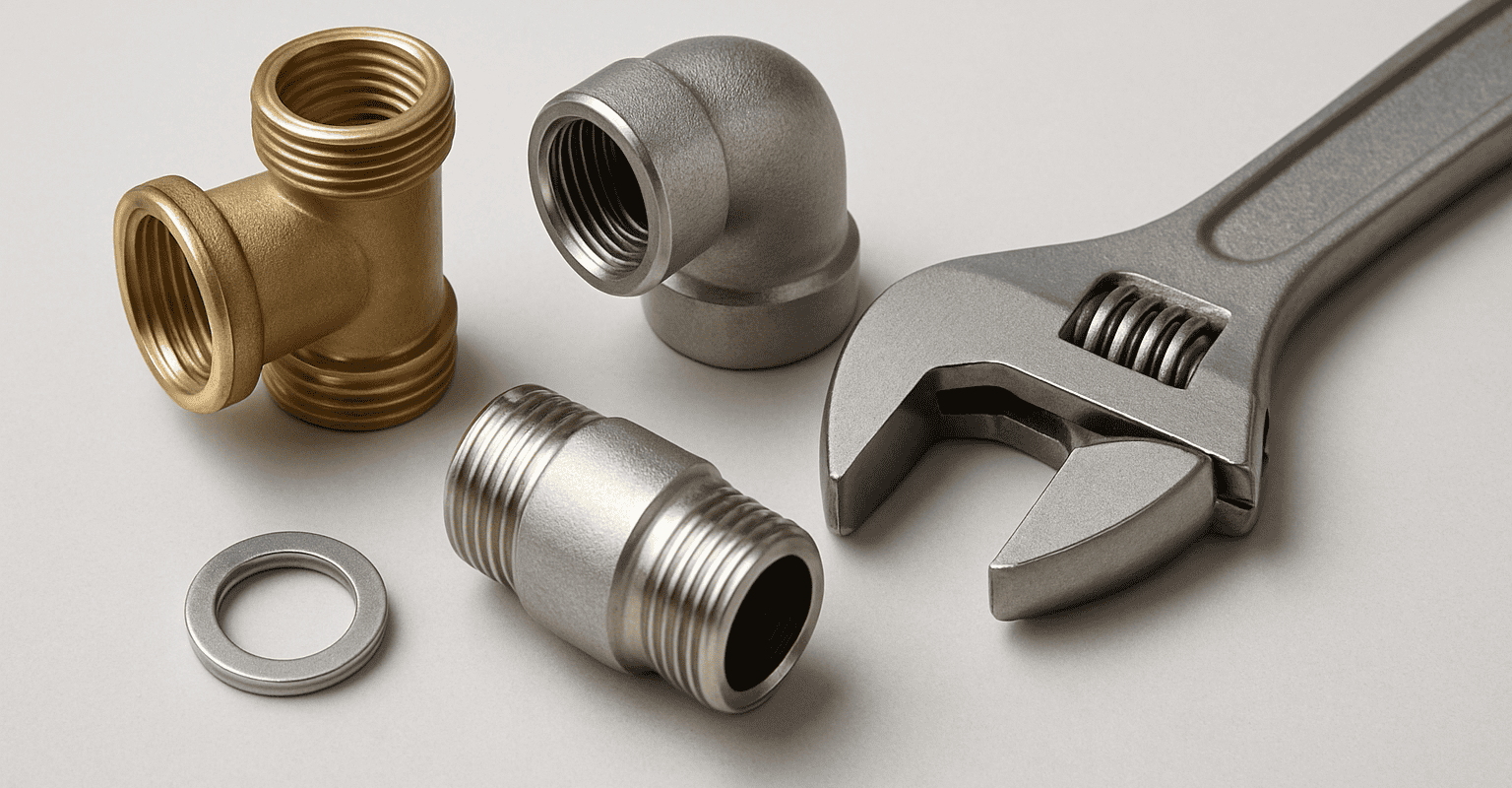
What plumbing and fittings are used for in installation and maintenance work
In the language of construction sites and workshops, talking about hydraulics and fittings means entering the heart of every functional connection between pipes, utilities, distribution components, and points of use. It is not just a set of pieces to join: the correct choice of fitting influences the continuity of flow, ease of assembly, the possibility of future interventions, and the overall stability of the system.
Professionals, installers, and maintenance workers know well that the right product is not identified by looking at a single detail. Instead, a complete evaluation is needed that takes into account material, compatibility, connection geometry, installation method, and application context. A seemingly simple line to complete can become problematic if even one element is overlooked, such as the type of threading or the consistency between fitting and pipe.
In good hydraulics and fittings guide, the first criterion to consider is the actual function of the connection. A fitting can be used to:
- join two sections of piping with equal or different characteristics;
- change direction of the path;
- branch off a line towards another point of the system;
- adapt different connections between components;
- make removable a part of the installation for future interventions;
- simplify maintenance in areas subject to replacement or inspection.
This approach is useful both for those working on new systems and for those intervening on existing systems. In upgrade work, for example, the fitting must not only “fit” into the intended point: it must integrate with what is already present, without creating stresses, improvised adaptations, or inconsistent couplings.
To better navigate among available components and solutions, it can be useful to also consult an overview dedicated to components for hydraulic systems and a section with technical guides for choosing fittings, so as to compare uses and configurations based on the work to be done.
Hydraulics and fittings guide: how professionals assess compatibility
Compatibility is the real starting point. When a professional selects a fitting, they do not think in terms of visual similarity but rather technical matching. Two components may appear compatible and not be at all during assembly. For this reason, preliminary verification is essential.
Materials to coordinate with the rest of the system
The first check concerns the material of the fitting and that of the elements it will work with. In a well-designed system, every pairing must be consistent with the type of pipe, the joining method, and the installation environment. The choice should not be made out of habit, but based on the context.
Before ordering, it is always advisable to verify:
- the pipe material already installed or planned;
- the type of connection required by the component to be connected;
- the presence of intermediate parts such as adapters, gaskets, or transition elements;
- the indications reported in the technical documentation: if a detail is unclear, check the product sheet.
This step is particularly important when working on existing systems, where different materials and installation solutions adopted at different times may coexist.
Measurements, diameters, and connections: where mistakes are most common
One of the most common errors concerns reading measurements. In hydraulics, a fitting must be identified precisely, distinguishing between pipe diameter, connection size, thread type, and body configuration. Even a slight inaccuracy can halt work or force makeshift solutions that are unprofessional.
The most experienced technicians always check:
- nominal diameter of the section to be connected;
- type of attachment, for example male, female, or other expected configurations;
- shape of the fitting, such as straight, angled, branch, or reduction;
- available space for tightening and assembly;
- any necessary accessories to complete the installation.
When working in tight technical spaces, the shape of the fitting matters as much as the measurement. A component correct on paper can be awkward to install if the tool clearance or access direction is not considered.
Technical checks before purchase
A true hydraulics and fittings guide does not just say “choose the right size.” The professional method involves a sequence of checks that is simple but effective:
- identify the point of the system in which the fitting will be installed;
- accurately detect measurements and type of connection;
- check if the connection must be permanent or removable;
- check if spare parts or complementary accessories are required;
- compare all data with the technical description: if in doubt, check the product sheet.
To deepen the criteria for matching connections and components, it can be useful to consult a page dedicated to measurements and compatibility in hydraulic fittings or a collection of solutions for system maintenance.
Compatibility, measurements and technical checks in replacements
If installation on a new system allows for more linear planning, replacement requires even more attention. In these cases, the professional does not choose the fitting only for what it must do, but also for what it must solve without altering the rest of the system.
The most delicate replacements are those where the original component is no longer available or was installed in a non-standard configuration. This is where experience comes into play: it is evaluated whether to maintain the same connection logic or to introduce a more practical adaptation for future maintenance.
Among the most useful checks during replacement are:
- condition of the existing section and integrity of the ends to be connected;
- presence of wear, deformations or residues that may compromise the seal;
- consistency between the new fitting and the elements already installed;
- possibility to make the point more accessible for subsequent interventions.
A professional avoids forcing the assembly just to finish the job quickly. If the fitting requires excessive adaptations, it is probably not the most correct solution. In these cases, it is better to review the configuration and choose a component more suitable for the real context.
Typical errors in ordering or installing hydraulic fittings
Many problems do not arise from the product itself, but from a selection process that is too quick. Those who purchase without a structured check risk receiving incompatible components or realizing the mistake only at the time of assembly. This leads to delays, returns, work stoppages, and additional interventions.
Confusing similar but not equivalent measurements
This is one of the most frequent errors. A measurement read approximately often leads to choosing a fitting that seems correct but does not guarantee a real match. To avoid this, it is always advisable to take measurements directly on the component or pipe, without relying on memory or old site notes.
Neglecting the installation direction and space requirements
Some fittings are correctly chosen dimensionally, but not in relation to the available space. In technical niches, narrow compartments, or points close to other components, installation can become difficult if accessibility is not considered. The professional evaluates in advance not only if the fitting can be installed, but also if it can be tightened, checked, and disassembled in the future.
Not anticipating useful spare parts and accessories
Another typical error is ordering only the main fitting without the elements that complete the connection. Gaskets, adapters, sealing elements, or intermediate fitting parts can be crucial. A complete selection reduces interruptions and makes the work smoother.
Using improvised solutions in maintenance
In hydraulics and fittings maintenance, activities, haste can lead to ineffective compromises. A temporary adaptation, if it becomes permanent, risks complicating the next intervention. Professionals prefer a clean, consistent solution that is easily recognizable even by those who will work on the system later.
For those managing recurring orders or interventions on multiple systems, it is useful to have a stable reference with spare parts and accessories for hydraulic connections, thus simplifying the procurement of compatible components.
Products, spare parts, and useful accessories for a more efficient choice
When talking about assortment, the value is not only in the quantity of items available but in the ability to quickly find what is needed to complete a job consistently. In a category dedicated to hydraulics and fittings, the professional looks for a range that allows managing installation, replacement, and maintenance without resorting to forced combinations.
For this reason, when choosing the supplier or category to consult, some practical aspects matter:
- clarity of technical information to quickly distinguish measurements and connections;
- presence of useful variants to cover different configurations;
- availability of spare parts and accessories linked to the main component;
- navigation organization to effectively filter solutions;
- consultable product sheets to check details before ordering.
In particular, those who often work on scheduled maintenance appreciate well-structured categories, where it is possible to quickly identify families of fittings, compare options, and check if the necessary complementary elements for assembly are present.
A good operating method is to prepare the order starting from the main connection and immediately adding everything needed to complete it. This reduces forgetfulness and time loss on site. Even when the component seems standard, it is worth checking if it requires specific accessories: if the data is not explicit, check the product sheet.
Another useful habit of professionals is to build a small internal selection logic based on three questions:
- is the fitting compatible compatible with what I need to connect?
- is easy to install and maintain in the intended location?
- have I already checked all the necessary accessories to complete the job without surprises?
When the answer is clear for all three points, the probability of error is significantly reduced.
Recommended products
Go to the Hydraulics and fittings category
 Hose holder type Rome M 1"x30 yellow – DVGW – code: 1056F*30 – Maestrini

 1“ Brass Anti-Corrosion F.F.F. ”T" Fitting – CR – DVGW – code: 7130F – Maestrini
 1/2"x3/8" anti-siphon valve in CR anti-corrosion brass – code: *7083D – Maestrini
 O-ring for 3/4" and 1" filters (4412) - Code: 0087-5EF - Maestrini
 90° 1" M-F Elbow in yellow brass – DVGW – code: 0092F – Maestrini


Choose hydraulics and fittings with a professional method
The difference between an improvised choice and a professional choice lies in the method. Experienced technicians do not simply look for a fitting “that fits,” but a component that integrates correctly into the system, simplifies assembly, and also makes future maintenance more orderly. This is the true value of a good hydraulics and fittings maintenance: reducing errors, avoiding unnecessary adaptations, and working continuously.
If you are looking for a reliable selection for installation, replacement, and system completion, explore the dedicated category or delve into the brands available in the store: you will find solutions designed to help you choose more precisely and manage every connection with a technical and practical approach.
FAQ
How to choose the right fitting for a plumbing system?
It is necessary to check the material, type of connection, measurements, shape of the fitting, and compatibility with the rest of the system. If a detail is not clear, check the product sheet.
What checks to do before ordering plumbing fittings?
It is advisable to check the pipe diameter, required fitting, connection configuration, available space for installation, and any necessary accessories or spare parts.
Why is compatibility between fitting and pipe so important?
Because an inconsistent pairing can complicate installation, make the connection unstable, and create problems in subsequent maintenance interventions.
In maintenance, is it better to replace only the damaged fitting?
It depends on the context. In many cases, it is useful to also check the condition of the connected parts and assess whether accessories or complementary elements are needed to properly restore the connection.
What is the most common mistake when choosing fittings?
The most common mistake is confusing similar but not equivalent measurements or fittings. Also neglecting clearances, mounting direction, and necessary accessories can cause problems during installation.


