


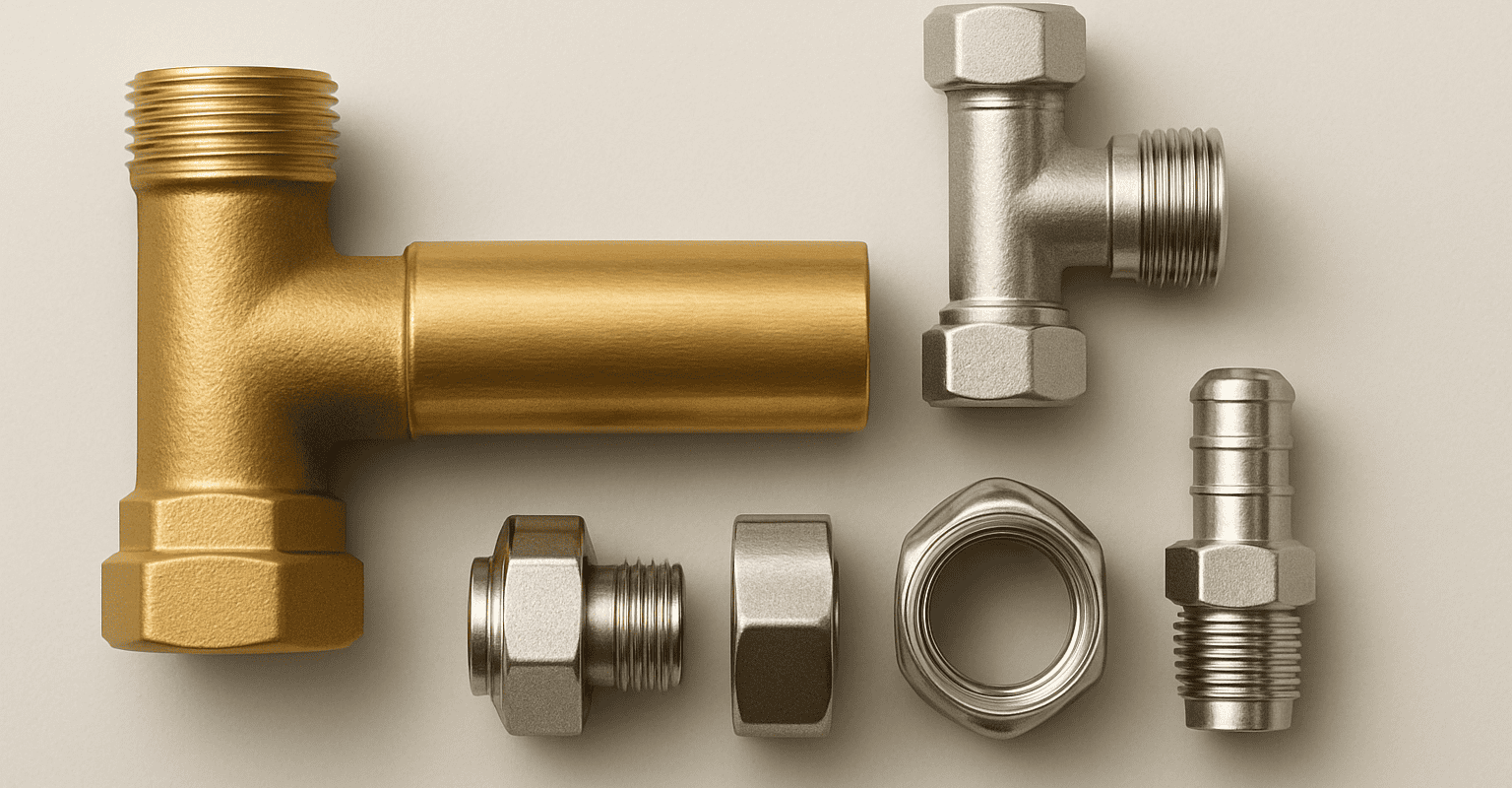
What hydraulics and fittings are used for in nautical and industrial systems
Talking about hydraulics and fittings means entering the heart of many systems where fluid transfer must occur in an orderly, continuous manner suitable for the context of use. In nautical and industrial fields, these components are not just simple connecting elements: they are essential parts for building reliable lines, facilitating maintenance, and making any replacements easier over time.
In a nautical system, the correct choice of pipes, connections, and accessories helps manage circuits intended for water, air, oils, or other technical fluids on board. In the industrial field, the same logic applies to service, distribution, supply, and discharge lines, where operational continuity and ease of intervention make the difference.
A good hydraulics and fittings guide starts from a simple principle: every connection must be consistent with the type of system, the material already installed, and the real assembly needs. It is not enough that two components appear compatible at a glance. It is necessary to verify geometries, fittings, diameters, threads, and intended use.
In practice, fittings are used to:
- connect different line sections;
- adapt diameters or types of connection;
- divert the fluid path;
- simplify assembly, disassembly, and replacement;
- integrate valves, accessories, and control points in the system.
In many cases, the difference between an orderly system and a problematic one depends precisely on these details. A well-designed line reduces corrective interventions, makes the system more readable, and helps avoid improvised adaptations that, over time, can complicate management.
For those considering components for a new assembly or a restoration, it can be useful to also consult the available technical guides, in order to better understand the differences between connections, accessories, and usage methods.
Compatibility, measurements, and technical checks to choose the correct fittings
One of the most delicate aspects when purchasing material for hydraulics and fittings is compatibility. The most common mistake is focusing only on the apparent diameter, neglecting other decisive elements. In reality, a correct choice requires a more complete check, especially if the system already exists and new components must be integrated with previously installed parts.
Check fittings, threads, and geometries
Two fittings may look similar but not be interchangeable. Before ordering, it is advisable to carefully check:
- type of connection;
- presence of threading and its profile;
- shape of the fitting, for example straight, curved or branch;
- sealing system provided;
- compatibility with the pipe or the component to be connected.
If the manufacturer or the technical datasheet indicates specific measurements, it is always advisable to compare them with the part already present on the system. When a detail is unclear, the safest solution is simple: check the product sheet.
Materials and operating environment
In nautical applications, exposure to humidity, saltwater, and variable usage cycles requires particular attention to materials. In industrial settings, the type of fluid, frequency of use, and working environment conditions are very important. For this reason, there is no universally suitable fitting for everything.
Compatibility must always be considered contextually. A component that works well in an internal service line may not be the best choice in an exposed system or in an area subject to frequent maintenance. The pipe material, circuit rigidity, and available space for installation also affect the final choice.
To delve into the differences between connecting components and line accessories, it can be useful to consult the section dedicated to systems for installations and compare solutions based on the type of application.
Practical checks before ordering
A good hydraulics and fittings guide do not stop at theory. Before completing the purchase, it is advisable to perform some practical checks:
- photograph the component to be replaced from multiple angles;
- accurately measure the connection point;
- note the type of system on which it will be installed;
- check if complementary accessories are needed for installation;
- verify if the replacement must integrate with elements already present.
This phase reduces errors and helps immediately identify any incompatibilities. In particular, when working on older nautical systems or industrial lines modified over time, it is common to find non-uniform components. A preliminary check helps avoid incomplete orders or poorly functional combinations.
Typical errors in ordering or installing hydraulics and fittings
Many problems do not arise from the component itself, but from a hasty evaluation before purchase or from installation inconsistent with the system. Knowing the most frequent errors helps improve spare part selection and makes subsequent hydraulics and fittings maintenance.
Choosing “by eye” without technical comparison
One of the most common mistakes is ordering a fitting based solely on visual similarity. In reality, small differences in threading, connection, or sealing seat can make the component unsuitable. Even when installation seems possible, approximate compatibility can cause difficulties during tightening or use.
Neglecting the actual installation space
On many nautical systems, space is limited. The same applies to panels, machines, or industrial lines where the passage of pipes is constrained. For this reason, it is necessary to consider not only the fitting itself but also the space needed to install, orient, or dismantle it in the future.
A component that seems correct on paper can prove inconvenient if it leaves no room for tools or forces the tube into awkward bends. In these cases, it is useful to evaluate alternative configurations in advance, always checking the available details in the product sheet.
Forgetting complementary accessories and spare parts
Another common mistake is ordering only the main fitting without considering the elements needed to complete the job. Depending on the system, seals, adapters, supports, valves, or other interface accessories may be required. Not including them immediately in the order often means interrupting the assembly or having to reschedule the intervention.
For this reason, when planning a replacement, it is advisable to think about the circuit as a whole and not just the single part. A preliminary consultation of related spare parts and accessories can help build a more complete and coherent cart for the work to be done.
Installing without a logic for future maintenance
A well-made system must not only work today but also be manageable tomorrow. Placing fittings and connections in hard-to-reach places, without considering the possibility of disassembly or inspection, complicates any subsequent intervention. This aspect is especially important when talking about hydraulics and fittings maintenance.
A good practice is to already think about future accessibility: where it will be easier to intervene, which parts might require replacement, which connections are best made easily identifiable. In a professional context, this approach saves time and makes the system more orderly.
Products, spare parts, and accessories useful for nautical and industrial systems
When working on technical lines, the choice is not only about the main fitting. Often the result depends on the correct combination between products, spare parts, and useful accessories, selected based on the type of system and the operating logic. The goal is not to fill the cart with generic components but to build a solution consistent with the circuit to be created or restored.
How to navigate categories and components
To choose well, it is useful to start with three questions:
- do I need to create a new line or replace an existing element?
- am I working on a compact nautical system or a more complex industrial line?
- do I need a permanent, adaptable, or easily inspectable connection?
From here, it becomes easier to understand whether union, adaptation, derivation, interception, or completion components are needed. Spare parts should also be viewed in this logic: not as isolated pieces but as parts of a system that must remain consistent over time.
Useful support can also come from insights on technical spare parts and maintenance, especially when working on already running systems and wanting to avoid incompatibilities between old and new.
When it is advisable to replace more than one component
In some cases, the visible problem concerns only one point of the line, but wear or the general configuration suggests a broader intervention. If a connection has been modified multiple times, if subsequent adaptations are present, or if the circuit appears disorganized, it may be useful to consider the coordinated replacement of multiple elements.
This approach is particularly valid in the nautical field, where vibrations, humidity, and limited spaces can stress connections, and in the industrial field, where lines layered over time become harder to manage. A reasoned revision improves the readability of the system and makes future interventions more straightforward.
The role of maintenance in the choice of fittings
The purchasing phase should always take maintenance into account. An effective selection does not only look at immediate compatibility but also at how easily the component can be checked, replaced, or integrated in the future. This is why the hydraulics and fittings maintenance it is not a topic separate from sales: it is part of the initial choice.
A well-designed system allows for more orderly intervention, reduces downtime, and limits improvised adaptations. For this reason, it is useful to prefer components and accessories that make the line clearer, more accessible, and consistent with the existing layout.
If you are comparing multiple solutions, it can be useful to also explore content dedicated to professional applications to identify the type of configuration closest to your real case.
Recommended products
Go to the Hydraulics and fittings category
 Hose holder type Rome M 1"x30 yellow – DVGW – code: 1056F*30 – Maestrini
 O-ring for 3/4" and 1" filters (4412) - Code: 0087-5EF - Maestrini
 90° 1" M-F Elbow in yellow brass – DVGW – code: 0092F – Maestrini
 1“ Brass Anti-Corrosion F.F.F. ”T" Fitting – CR – DVGW – code: 7130F – Maestrini
 1/2"x3/8" anti-siphon valve in CR anti-corrosion brass – code: *7083D – Maestrini
 1" metal-sealed check valve – DVGW – code: 5630F – Maestrini
Support for choice and next steps for your system
Whether you are working on a nautical circuit or an industrial line, choosing well in the world hydraulics and fittings means reducing errors, simplifying assembly, and making maintenance more efficient over time. Explore the dedicated category or the reference brand on Technofluid to compare compatible components, useful accessories, and spare parts suitable for your system, always checking the details in the product sheet before ordering.
FAQ
How to check the compatibility of a fitting with an existing system?
It is advisable to check the attachment, threading, geometry, sealing system, and material of the already installed component. If a detail is unclear, check the product sheet and compare the measurements with the part to be replaced.
Why is it important to also consider maintenance in hydraulic systems and fittings?
Because a connection that is easy to inspect and replace makes the system neater and reduces intervention times. Maintenance should be considered already at the selection stage, not only after installation.
What mistakes are most often made when ordering fittings for nautical or industrial use?
The most common mistakes are choosing the component based only on appearance, not verifying the actual installation space, forgetting complementary accessories, and not considering compatibility with the rest of the line.
When is it useful to replace multiple components of the same circuit instead of just one fitting?
It is a sensible choice when the system has subsequent adaptations, uneven connections, or signs of widespread wear. In these cases, a coordinated revision can make the circuit easier to manage over time.


