


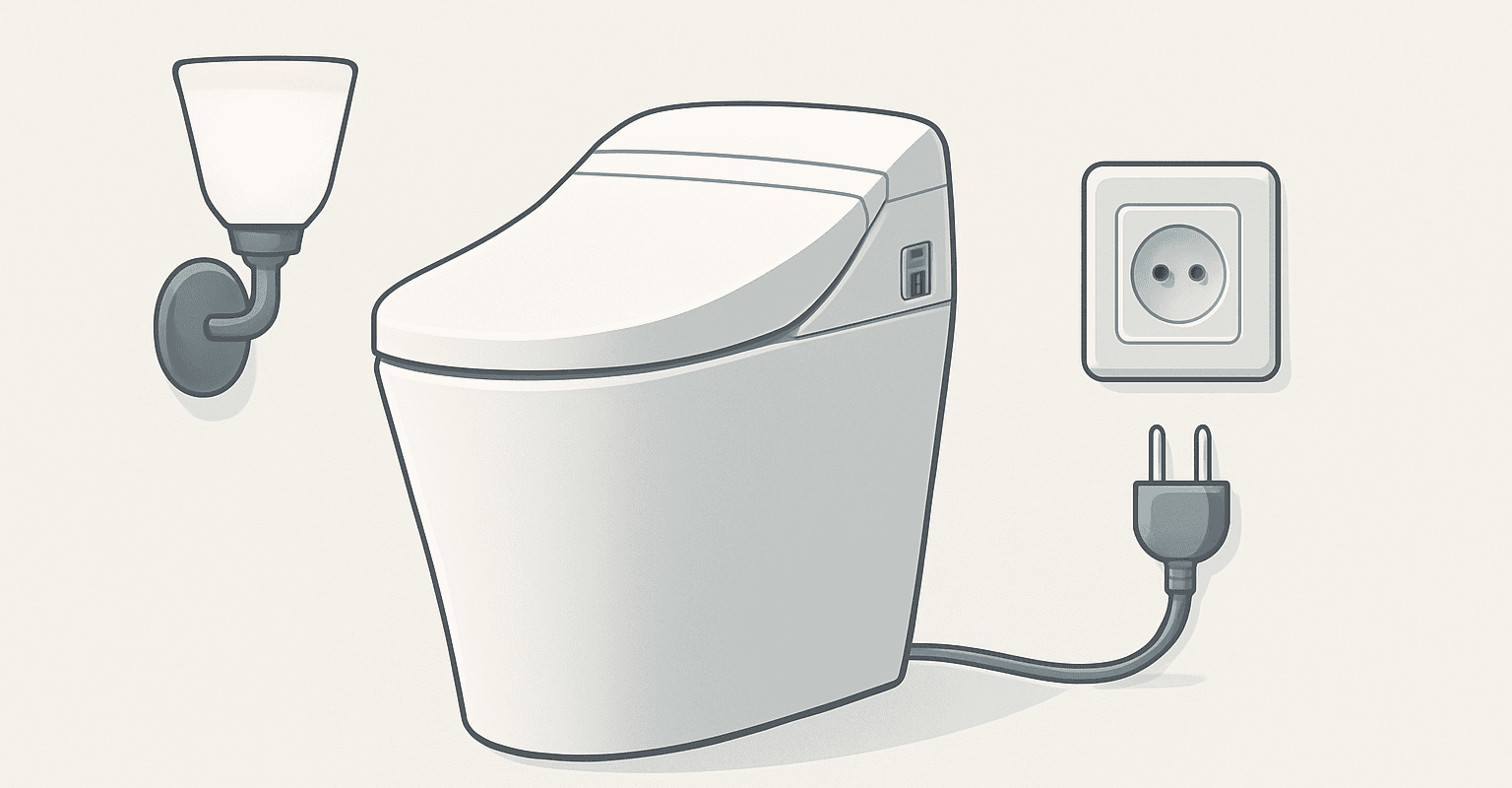
When you really need to understand how an electric toilet works
Understand how an electric toilet works it is not only useful for those considering a purchase: it is often the decisive step to avoid incompatibilities, cumbersome installations, and choices that are not suitable for the real context. In many cases, the doubt arises in environments where traditional drainage is not immediately available or where space requires a more flexible solution. But the point is not just “if it works”: the point is how it integrates with the electrical system and the existing accessories.
In the cluster related to electricity and instrumentation, the issue intertwines with often underestimated elements such as plugs and sockets, service connections, circuit protection, and the presence of nearby utilities. If the bathroom or technical room also includes lights, secondary power points or connected devices, a superficial evaluation can create daily management problems.
For this reason, before ordering, it is advisable to also read related content on electrical connections and system accessories, components for plugs and sockets e solutions for lights and lamps, so as to have a more complete view of the context in which the system will have to operate.
An electric toilet is often considered in situations such as:
- partial renovations, where invasive intervention on the existing system is not desired;
- service rooms, secondary environments or technical spaces with passage constraints;
- installations in mobile or special contexts, where power supply and accessories require particular attention;
- bathrooms with complex layouts, where the positioning of elements does not follow a traditional scheme.
In all these cases, the correct question is not just “do I need it?”, but rather: is it compatible with the system I have, with the available power point, and with the other electrical components present? Here the issue comes into play electric toilet how it works compatibility, that is, the practical verification between system characteristics and real usage conditions.
Another important aspect concerns the surrounding environment. In a room where there are beacons, technical lighting, service outlets or other devices, the arrangement of the connections must be orderly and coherent. It is not enough to have a nearby outlet: it is necessary to understand if the power supply point is suitable, if the cable routing is rational, and if the simultaneous use of multiple devices can complicate management.
In short, to deepen how an electric toilet works means to evaluate the product not as an isolated element, but as part of a larger system. And this is the difference between a purely theoretical choice and a truly functional choice.
Differences between solutions, measurements and electric toilet how it works compatibility
When comparing different solutions, the first mistake is to think that an electric toilet is always interchangeable with any other configuration. In reality, the differences may concern space requirements, connection methods, position of the fittings, and power supply requirements. Even without going into unavailable specifics, it is essential to remember that every correct evaluation starts from the product sheet.
The theme of compatibility develops on multiple levels:
- physical compatibility, that is, available space, position of the bowl, accessibility for installation;
- system compatibility, therefore relationship with drainage, supply, and electrical point;
- usage compatibility, related to frequency of use and type of environment;
- compatibility with nearby accessories, such as lights, lamps, plugs, and sockets already installed in the room.
Dimensions and room layout
The measurement should not be read only as a geometric datum. What matters most is how the system fits into the space. A narrow environment, for example, may require a configuration that allows easy access to connections. If the toilet is installed near equipped walls, technical furniture, or light points, the arrangement must be planned in advance.
In the presence of lights on the wall, switches, sockets or conduits, it is useful to check that the installation does not make daily use uncomfortable. The same applies to rooms where there are beacons or technical lighting fixtures: the positioning must avoid interference with maintenance, cleaning or access to other devices.
Power supply and socket point
One of the most overlooked aspects concerns the electrical connection. Talking about plugs and sockets does not mean stopping at the mere presence of a wall socket. You need to ask if the power supply point is placed practically, if the cable can be managed without makeshift solutions and if the path remains orderly and protected.
Many problems arise precisely here: the focus is on the vase and the electrical context is forgotten. To avoid mistakes, it is advisable to compare the project with the information available in guides on sockets, plugs and connections and with insights on electrical instruments and accessories. If a detail is not clear, the rule remains simple: check the product sheet.
Compatibility with existing systems
The topic electric toilet how it works compatibility becomes central especially when working on existing systems. In these cases, you do not start from scratch: there are constraints, distances, passages and service points that cannot always be easily modified. A system suitable on paper can prove impractical if it requires complex adaptations or conflicts with other elements of the room.
For this reason, it is useful to think with a comparative approach:
- one solution may be more suitable in compact environments;
- another may be simpler where the electrical point is already well positioned;
- some configurations are more convenient if the room also hosts other electrical utilities;
- others require a more careful check of the arrangement of accessories and connections.
Therefore, there is no universal answer. Instead, there is a choice consistent with the context, and this consistency is built by analyzing space, power supply and actual use.
Mistakes to avoid in choice or assembly
In comparing alternatives, the most frequent mistakes do not depend on a single detail, but on an incomplete evaluation. Those seeking information on how an electric toilet works often want to understand if the installation will be simple. The truth is that simplicity almost always depends on the preparation done before ordering.
Ignoring the electrical context of the room
The first mistake is to consider the electric toilet as an isolated element. In reality, it must be placed in an environment where there may already be lights, service outlets, switches, illuminated mirrors, or other devices. If the power point is inconvenient, too far away, or poorly positioned relative to daily use, even a theoretically correct solution becomes impractical.
This is even more true in technical or mobile environments, where beacons and other devices share limited spaces. Messy wiring or improvised connection management can complicate maintenance and cleaning.
Not checking access and maintenance
Another common mistake is to think only about the initial installation. Instead, you need to ask if, once installed, the system will remain accessible. Will there be space to intervene? Will the connections be reachable? Will the outlet remain convenient? If the answer is uncertain, it is better to stop and investigate further first.
A good preliminary check should include:
- sufficient lateral and frontal space;
- access to connections without complex disassembly;
- absence of obstacles created by furniture, technical walls, or accessories;
- checking the position of plugs and sockets relative to the installation point.
Neglecting consistency with other components
Often the problem is not the toilet itself, but its relationship with the rest of the system. If elements for lighting, signaling, or secondary power supply are installed in the same environment, overlaps and irrational passages must be avoided. The reference to lights, headlights, plugs, and sockets is not marginal: it is part of the overall technical evaluation.
For example, a well-organized room must allow intuitive use of all components. If the electric toilet forces moving outlets, makes access to a switch difficult, or interferes with other service points, the solution must be reconsidered.
Purchasing without technical comparison
A very common mistake is choosing based on generic descriptions or images, without comparing useful data. Before ordering, it is advisable to prepare a small checklist:
- where exactly it will be installed;
- which power point will be used;
- which other electrical devices are nearby;
- what accessibility is needed for use and maintenance;
- which details require confirmation in the product sheet.
This approach reduces unforeseen issues and helps to choose more precisely, especially when the existing system is not standard.
Products and categories to consider
Those addressing the topic how an electric toilet works with a truly technical approach should not limit themselves to the main product alone. The correct choice almost always comes from an overall vision that includes accessories, connections, and components related to the installation environment.
The categories to consider, in a coordinated way, are at least these:
- power supply components, with attention to plugs and sockets;
- wiring accessories, useful for orderly management of connections;
- lighting solutions, if the room requires a lighting overhaul;
- technical lights or lighting fixtures, in contexts where operational visibility matters;
- electrical instruments and accessories, to complete the system coherently.
This broader perspective is especially useful in projects where the installation does not take place in a standard bathroom. In technical rooms, secondary environments, or particular configurations, the final result depends greatly on the quality of integration between the various elements.
To better guide you, it may also be useful to consult insights on lights and lamps e solutions for sockets and electrical connections. These contents help to understand whether the system you are evaluating fits well into your setup or if additional checks are required.
Another important point is the selection method. In a serious comparison between alternatives, it is advisable to start with three practical questions:
- Where will it be installed? The context changes everything: space, access, and arrangement of connections.
- With which components will it have to coexist? Lights, lamps, plugs, and sockets influence the practicality of the whole.
- Which details need to be confirmed? If not explicitly indicated, check the product sheet.
This approach avoids rushed purchases and also makes it easier to compare different categories in the catalog. In practice, you are not just choosing a product, but a complete installation that must work well every day.
Recommended products


How to evaluate before ordering without compatibility errors
Before proceeding, it is worth doing one last reasoned check. The focus on electric toilet how it works compatibility is not an SEO detail: it is the heart of the decision. A preliminary check reduces the risk of returns, unforeseen adjustments, and lost time.
Here is a simple but effective method:
- observe the room as a whole, not just the point where the toilet will go;
- identify sockets, switches, lights, and other devices that may affect the installation;
- check access and passages for assembly and maintenance;
- compare the available information with the product sheet;
- evaluate the related categories if the system requires a coordinated update.
If you are looking for a solution suitable for your system, explore the dedicated category and available brands to practically compare configurations, accessories, and related components: starting from a well-organized selection helps to choose more confidently and with less margin of error.
FAQ
Does an electric toilet require special checks on the outlets?
Yes, it is important to check the position, accessibility, and consistency of the power outlet with the installation location. It is not enough that an outlet is present: check the product sheet for the necessary details.
What does electric toilet mean how does it work compatibility?
Indicates the overall check between the chosen system and the real context: available space, connections, existing system, and presence of other components such as lights, headlights, plugs, and sockets.
Can the lights and lamps of the venue affect the choice?
Yes, especially when the venue is compact or technical. The presence of lights, headlights, or other electrical devices can affect passages, accessibility, and the order of connections.
What checks should be done before ordering?
It is advisable to check dimensions, location of the electrical point, access for assembly, presence of other nearby components, and all the information provided in the product sheet.
Is an electric toilet always suitable for any existing system?
No, not always. Compatibility depends on the configuration of the venue and the available connections. For this reason, it is useful to carefully compare the real context with the data provided by the manufacturer.


