


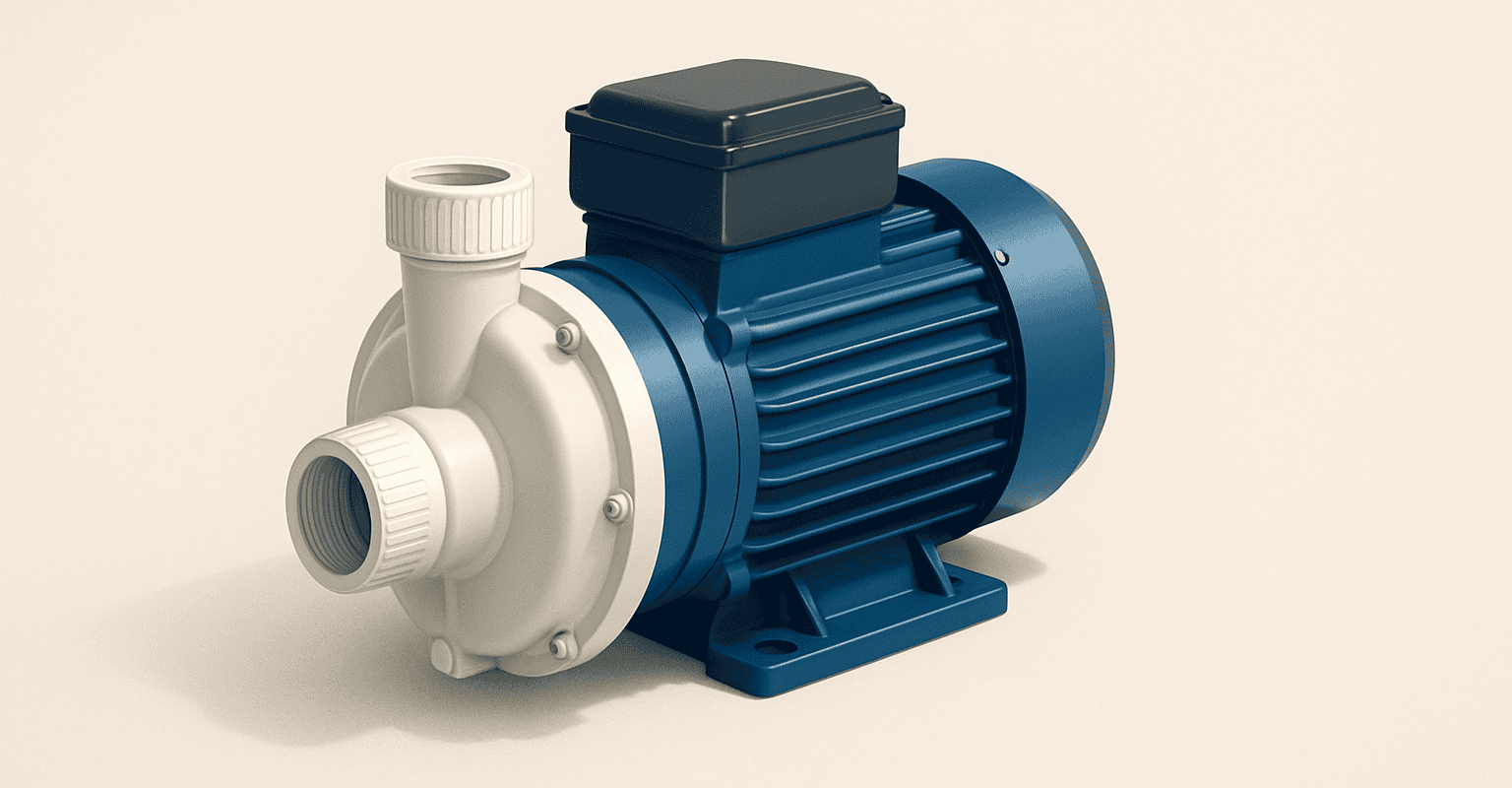
When to really consider the search “self-priming pump price”
Those looking for self-priming pump price often starts from a concrete need: replacing a pump that no longer works reliably, improving fluid management on board, or avoiding priming problems in non-ideal conditions. The point, however, is that price alone is not enough to guide a correct choice. In bilge pumps and service, in fact, the perceived cost may seem like the most immediate criterion, but it becomes misleading if it is not linked to actual use, compatibility, and installation methods.
A self-priming pump is often considered when the circuit does not guarantee an always smooth start or when suction does not occur under constant conditions. In this scenario, comparing only the economic value easily leads to underestimating aspects that have a much greater impact on the system's durability and reliability.
For example, before choosing a solution, it is useful to understand:
- if the pump will work as a service, transfer, or support for on-board management;
- if the treated liquid requires specific materials or configurations;
- if the existing system is already set up for a self-priming pump;
- if the available space allows for correct installation;
- if the circuit has curves, height differences, or sections that can affect priming.
In other words, the price search only makes sense when placed in a precise technical context. This is exactly where many competitors stop at a superficial comparison, while a professional evaluation always starts from the required function and not just the economic range.
If you want to deepen the topic of fluid management in the nautical and light industrial field, it may be useful to also consult the solutions dedicated to on-board pumps or the insights on bilge systems, so as to better frame the pump's role in the overall circuit.
Self-priming pump price and compatibility: the real critical point
Among the most common mistakes is considering the item self-priming pump price compatibility as a secondary detail. In reality, compatibility is often the factor that distinguishes an effective choice from a replacement destined to create recurring problems.
When talking about compatibility, it does not only mean the physical possibility of mounting the pump. You need to check the interaction with the entire system: pipes, fittings, installation position, type of fluid, start-up mode, and frequency of use. An apparently suitable pump can prove to be inefficient or difficult to manage if the circuit is not consistent with its operational characteristics.
Compatibility with the existing system
The first check concerns the system already in place. Many users replace a broken pump by looking for a similar alternative, but without verifying if the old configuration was really correct. This approach leads to repeating the same mistake.
It is advisable to carefully check:
- diameter and type of connections;
- pipe routing and presence of restrictions;
- pump position relative to the suction point;
- accessibility for maintenance and inspection;
- consistency between the required function and the type of pump installed.
If some data is not available, the safest choice is check the product sheet to compare the information with the actual plant layout.
Compatibility with the type of use
Not all applications require the same solution. In bilge pumps and service the usage context changes a lot: a pump intended for occasional use has different needs compared to one that is activated more frequently or under variable conditions.
The right questions to ask are simple but decisive:
- will the pump be used for emptying, transfer, or general service?
- will activation be occasional or recurring?
- does the circuit remain always full or can air enter?
- does the installation environment expose the pump to humidity, vibrations, or dirt?
These assessments also help to correctly interpret the search self-priming pump price: a solution that seems convenient can become unsuitable if it requires continuous interventions or does not integrate well with the operational context.
Materials and liquids handled
Another common mistake is ignoring the relationship between pump materials and the liquid handled. Even without going into unconfirmed technical details, it is essential to know that not all fluids have the same impact on seals, internal components, and system tightness. If the liquid has particular characteristics, it is always advisable check the product sheet to check the declared compatibility.
To better guide you among configurations and related accessories, it can be useful to consult the overview of components for fluid systems e the practical guides to choosing the correct pump.
Differences between solutions, sizes, or compatibility in bilge and service pumps
When comparing available alternatives, many focus on a single characteristic, neglecting the fact that real differences emerge from the combination of multiple factors. The bilge pumps and service they are not distinguished only by shape or size: they differ in operating principle, ability to adapt to the circuit, and ease of management over time.
When comparing multiple solutions, it is useful to think in practical scenarios.
When a compact solution is not the best choice
In tight spaces, there is a tendency to favor a pump with a smaller body. However, a compact solution is not automatically the most suitable. If installing it requires forcing the piping path, creating curves that are too tight, or sacrificing access for maintenance, the initial advantage turns into an operational limitation.
A pump that is difficult to inspect or reach for checks can cause plant downtime, loss of time, and premature replacements. In this sense, dimensional compatibility should be considered together with ease of use.
When measurements really matter
Measurements matter, but not only in terms of external size. They also matter for alignment with connections, correct positioning in the compartment, and mounting stability. A minimal difference can make the use of improvised adaptations necessary, which in a bilge or service system are never a good solution.
To avoid mistakes:
- measure the actual available space, not the estimated one;
- check the fixing points and the orientation of the fittings;
- verify if the pipe passage remains linear;
- make sure there is space left for any future checks.
This approach reduces the risk of purchasing a pump just because the self-priming pump price seems interesting, only to discover later that integration into the system is complex.
Electrical compatibility and operating logic
Another often overlooked aspect concerns consistency with the existing control system. In some cases, the problem does not arise from the pump itself, but from the fact that it is installed in a circuit with activation logics that are not perfectly aligned. If the system includes switches, sensors, or automations, it is always advisable to check in the product sheet how the pump fits into the overall system.
This is especially true when replacing an existing component without reviewing the entire wiring diagram. An apparently simple replacement can cause recurring anomalies if the new pump is treated as an exact copy of the previous one.
Mistakes to avoid when choosing or installing the self-priming pump
Most problems do not arise from obvious defects, but from initial evaluation errors. Here are the most common ones, with a practical approach also useful when comparing with competitors.
Choosing based on price without reading the context
This is the most common mistake. Looking for self-priming pump price is legitimate, but making price the main criterion often leads to overlooking the overall picture. A pump suitable for your system is almost always a more efficient choice than a solution that seems convenient but is poorly aligned with the circuit.
Assuming that “self-priming” solves everything
The term self-priming is sometimes interpreted as a universal guarantee of operation. In reality, even a pump of this type requires correct installation conditions. Unsuitable piping, problematic suction, or careless assembly can compromise the result.
In practice, self-priming does not mean invulnerable to installation errors.
Neglecting the installation position
A pump installed in an inconvenient or inconsistent position with the fluid path tends to generate repeated issues. It is not enough to find a free space: you need to understand if that position really favors operation and maintenance.
Among the signs of an unsuitable position are:
- pipes that are too long or tortuous;
- difficulty accessing for inspection and cleaning;
- presence of points where air can accumulate;
- need for adapters or fittings that are not optimal.
Ignoring routine maintenance
Even in bilge pumps and service, a correct choice loses value if the system is not checked over time. Residues, dirt, loose connections, or wear of accessory components can alter the pump's behavior and make you think the product is faulty, when in reality the problem is in the circuit.
A periodic check of key points helps prevent the most common malfunctions and maintain stable system performance. If you are not sure about the operations to perform, it is always advisable to refer to the instructions provided in the product sheet.
Products and categories to consider for a more reliable system
When evaluating a pump, it is also worth considering the elements that work together with it. A reliable system does not depend only on the pump body, but on the quality of the whole: connections, accessories, circuit configuration, and consistency between the required function and selected components.
For this reason, in addition to the pump, it is useful to consider:
- connection accessories compatible with the circuit;
- components for managing suction and discharge;
- elements that facilitate maintenance and inspection;
- coordinated solutions for bilge and onboard services.
A well-done comparison between categories helps avoid isolated purchases that then require subsequent adaptations. In a professional approach, the choice of the pump is part of a system, not an element disconnected from the rest.
If you want to navigate among related product families, you can explore the categories dedicated to pumping systems e the solutions for compatible accessories and spare parts. This allows you to evaluate the system more comprehensively, especially when the priority is not only to find a pump but to avoid errors that recur over time.
Recommended products


How to avoid recurring problems after installation
Once the right pump is chosen, the job is not finished. Many recurring problems arise in the early stages of use, when small signals are ignored. A thorough initial check helps to immediately understand if the integration into the system is correct.
After installation, pay attention to these aspects:
- absence of leaks at connection points;
- regular operation under expected usage conditions;
- ease of priming and flow continuity;
- accessibility of the pump for future inspections;
- stability of supports and connections.
If anomalies arise, it is better to intervene immediately rather than compensate with temporary solutions. Improvised corrections, especially on pipes and fittings, tend to create new weak points in the system.
For a more informed choice between bilge pumps and service, the advice is always to compare function, compatibility, and system configuration before settling for just self-priming pump price. If you are considering a replacement or upgrade of your system, explore the dedicated category or the reference brand to find the solution most consistent with your system and actual usage conditions.
FAQ
When does it make sense to look for a self-priming pump based on price?
It only makes sense after defining the actual use of the pump, the type of system, and compatibility with pipes and connections. The price is useful in the final comparison, not as the sole selection criterion.
What does it mean to evaluate the compatibility of a self-priming pump?
It means verifying that the pump is consistent with the existing circuit, with the mounting position, with the treated liquid, and with the operating logic of the system. If a detail is not clear, check the product sheet.
Can a self-priming pump solve any suction problem?
No. Even a self-priming pump requires proper installation. Poorly positioned piping, unsuitable fittings, or the presence of air in the circuit can compromise operation.
What are the most common errors in the installation of bilge and service pumps?
The most common mistakes are choosing the pump based only on price, neglecting measurements and connections, installing it in a hard-to-reach position, and not considering routine maintenance of the system.
How to understand if a pump is suitable for an existing system?
It is necessary to check dimensions, fittings, pipe routing, required function, and compatibility with other system components. In case of doubt, it is advisable to compare the available data with the product datasheet.


