


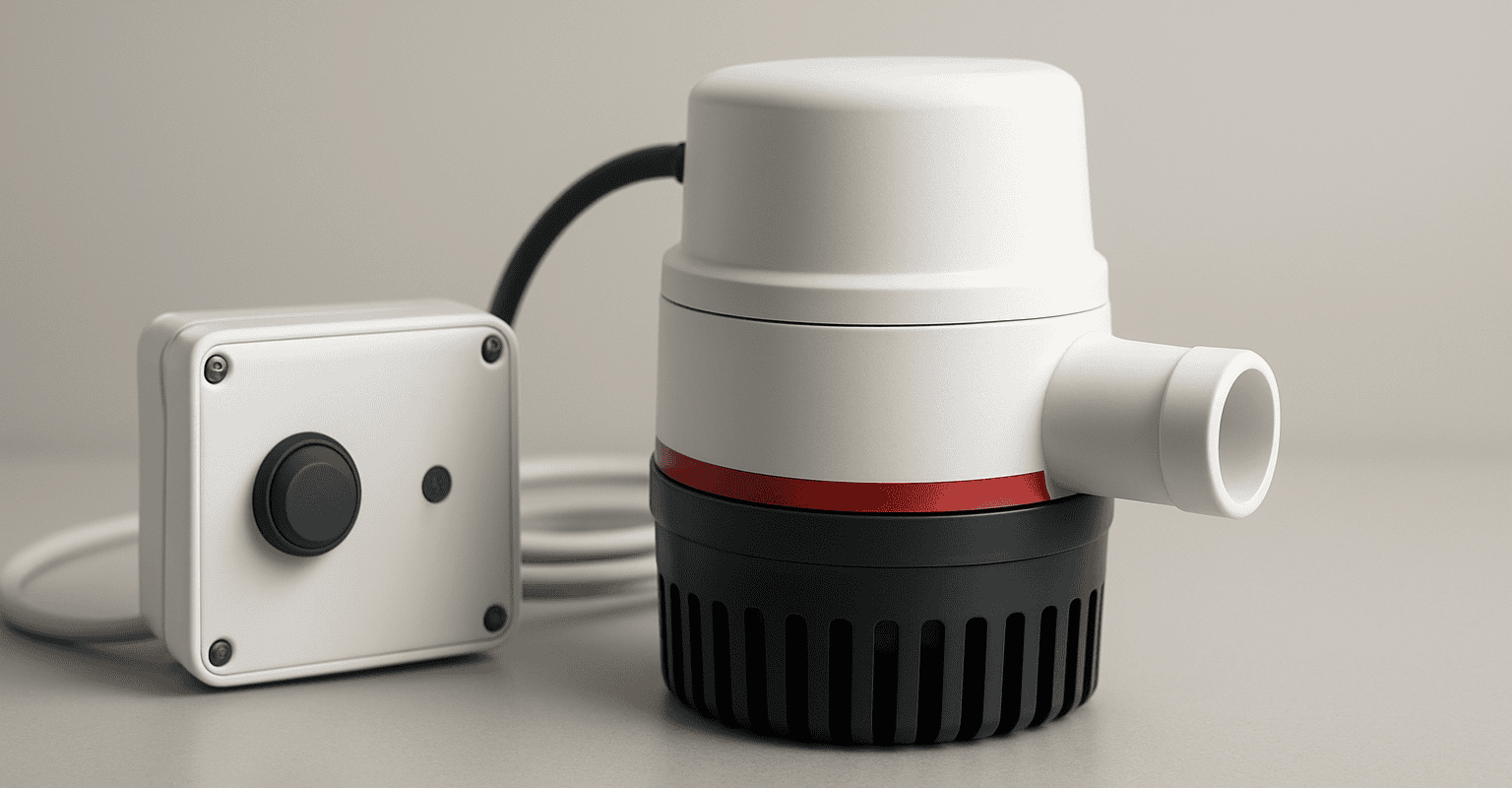
When automatic bilge pumps are really needed
The automatic bilge pumps are not an accessory to consider only in emergencies: they become a concrete choice when you want to manage the water that can accumulate in the bilge more continuously without relying on manual intervention. In a nautical context, even small leaks, condensation, splashes, or washing residues can create a water level over time that needs to be monitored carefully.
The main difference compared to a non-automatic solution is simple: the system activates when it detects the presence of water, according to the logic provided by the model or the pairing with the related control command. This approach is especially useful when the boat remains stationary for varying periods, when you do not want to continuously check the bilge, or when you want a more orderly management of drainage.
Talking about bilge pumps and service however, it means going beyond just water evacuation. In many cases, the right choice comes from an overall assessment: available space, installation methods, accessibility for maintenance, type of liquid to be disposed of, and compatibility with the rest of the onboard system. A well-chosen pump is not only one that activates but one that integrates without creating operational issues.
Situations where automation is particularly useful include:
- boats left in the water for long periods;
- bilge compartments that are hard to access;
- need to reduce frequent manual checks;
- presence of onboard systems that require a more orderly management of residual water;
- configurations where you want to improve service continuity.
If you are comparing different options for drainage, it can be useful to also explore solutions dedicated to the’onboard systems and connected components, so as to evaluate the system as a whole and not as an isolated element.
Another often underestimated aspect concerns the real usage context. No bilge is ever the same: the shape of the compartment changes, the ease of inspection changes, the path of the discharge pipe changes, and even the way water collects changes. For this reason, automatic bilge pumps compatibility should not be seen as a secondary item, but as one of the main selection criteria.
Differences between solutions, sizes, and compatibility of automatic bilge pumps
When comparing models and configurations, the most common mistake is to think that one pump is the same as another. In reality, there are important differences that affect practical performance, ease of installation, and service continuity. The correct comparison starts from three areas: activation type, measurements e compatibility with the system.
Integrated activation or management with separate control
Some solutions come with an integrated activation system, while others require pairing with an external device. This distinction changes the way the installation is designed and also the space needed in the compartment. If you want a more compact configuration, it may make sense to opt for integrated systems; if instead you want greater freedom in component arrangement, a solution with separate control can be more flexible.
At this stage, it is always advisable to check the product sheet:
- activation mode provided;
- need for additional components;
- connection diagram;
- recommended use destination.
Pump dimensions and actual space in the bilge
Dimensions should not be considered only in terms of external bulk. A pump may fit into the compartment but be inconvenient to connect, difficult to inspect, or impractical to remove for cleaning. For this reason, before choosing, it is useful to observe:
- available height at the lowest point of the bilge;
- useful width for positioning;
- space for fittings and pipes;
- accessibility for maintenance and inspection;
- possible interference with other onboard components.
A correct assessment of dimensions reduces the risk of forced installations. If the compartment is narrow or irregular, it is preferable to favor a solution that allows easy assembly and disassembly, without having to intervene on multiple parts of the system each time.
Automatic bilge pumps compatibility: what to really check
The theme of automatic bilge pumps compatibility is central because it involves not only the pump but the entire system. Compatibility means verifying whether the product can work consistently with the existing wiring, the discharge pipe, the installation point, and the intended use.
In practice, before deciding, it is advisable to check:
- diameter and type of pipe connection;
- space needed for the discharge path;
- position of the water collection point;
- presence of other devices already installed in the compartment;
- ease of integration with the onboard electrical system;
- possible need for dedicated accessories.
If you are considering an upgrade of the system, it may be useful to also consult the section dedicated to pumps and related accessories, to understand whether it is worth replacing only the pump or reviewing the entire set of connected components.
A serious comparison between solutions therefore does not limit itself to the automatic function. You need to ask whether that pump will work well in your bilge compartment, with your mounting scheme, and with your level of accessibility. This is where the difference lies between a theoretically correct choice and one truly reliable in daily use.
Mistakes to avoid in choosing or mounting
Many problems attributed to pumps actually stem from a hasty selection or an installation inconsistent with the onboard configuration. Avoiding the most common mistakes helps improve service continuity and reduce subsequent interventions.
Choosing based solely on the idea of “automatic”
The fact that a pump is automatic does not mean it is automatically suitable. Automation is just a function: what matters is how this function fits into the real system. A pump unsuitable for measurements, connections, or compartment position can create more problems than it solves.
Ignoring the actual point where water accumulates
The bilge may have irregular shapes, ribs, uneven levels, or areas where water stagnates differently than imagined. Installing the pump in a convenient but not truly effective spot is one of the most common mistakes. Before installation, observe where the water tends to gather and assess if the chosen placement is really functional.
Neglecting accessibility and maintenance
A pump installed in a hard-to-reach space can become problematic even for simple operations like visual inspection, cleaning, or checking connections. Routine maintenance must be possible without complex disassembly. If the compartment is tight, it’s better to opt for a solution that simplifies access.
Not checking the discharge hose route
The hose is not a minor detail. Too tight curves, awkward passages, or inconsistent fittings can compromise overall operation. Before choosing the pump, verify that the discharge path is compatible with the actual spaces and existing components.
Underestimating integration with the onboard system
When talking about bilge pumps and service, the point is not just to expel water, but to do so harmoniously with the rest of the system. If you are working on an already equipped boat, always consider the whole: wiring, switches, accessories, supports, piping, and the position of nearby components.
For a more complete picture, it may be useful to also consult content dedicated to maintenance of marine systems and fluid handling systems, to avoid incompatibilities between elements purchased at different times.
Products and categories to consider for bilge pumps and service
When comparing alternatives, the best choice almost always comes from a vision based on functional categories, not from a single item taken in isolation. If the goal is to improve bilge management, it’s better to think about everything revolving around the pump.
Areas to consider include:
- automatic bilge pumps for routine drainage management;
- components for connection and installation;
- accessories for operation control;
- elements useful to optimize service and maintenance;
- spare parts or replacements, if provided by the chosen configuration.
This approach is especially useful when you want to avoid a partial purchase. A correct pump but installed with inconsistent accessories can generate a chain of problems: unstable fixing, improvised fittings, inspection difficulties, untidy electrical integration. Conversely, evaluating the system by categories helps build a cleaner and easier-to-manage system over time.
If you are reviewing the overall setup, sections dedicated to fluid hoses and fittings and drainage components can also be useful, to check if the current system is really consistent with the new pump you intend to install.
Another practical criterion is to distinguish between first-time outfitting needs and replacement. In the first case, you have more design freedom; in the second, you must deal with existing constraints. In a replacement, compatibility with spaces and existing connections becomes even more important. In these cases, before proceeding, check the product sheet for installation dimensions, expected connections, and any recommended accessories.
Those comparing different options often look for a quick answer to the question: is it better to keep a basic setup or switch to a more structured solution? The answer depends on three factors:
- how often the boat remains without direct supervision;
- how accessible the bilge compartment is;
- how much you want to reduce manual control interventions.
The more these factors affect actual use, the more it makes sense to opt for a carefully designed configuration, where the pump is not an isolated element but part of a coherent system.
For those who want to explore the available options further, it can be useful to also explore the overview on bilge pump solutions and related components, comparing structure, dimensions, and installation logic based on your technical compartment.
Recommended products


If you are looking for a solution suitable for your system, explore the category dedicated to pumps and bilge components or delve into the available brands: comparing configurations, dimensions, and compatibility is the best way to choose a system truly suited to your boat.
FAQ
When is it advisable to choose automatic bilge pumps instead of a manual solution?
It is convenient when you want to reduce frequent bilge checks and manage water accumulation more continuously. They are particularly useful if the boat remains stationary for variable periods or if the bilge compartment is not easily accessible.
What does it mean to verify the compatibility of automatic bilge pumps?
It means checking that the pump can be properly installed in the available space and that it is compatible with the discharge pipe, connections, electrical diagram, and necessary accessories. For specific technical details, it is always advisable to check the product sheet.
Do the pump dimensions only matter to fit it into the bilge?
No. The measurements are also needed to understand if there will be enough space for connections, piping, fastening, and maintenance. A pump that is only theoretically compatible can become inconvenient to install or check over time.
What are the most common mistakes made when installing an automatic bilge pump?
The most common mistakes are choosing the model without assessing the actual compartment, installing the pump in a spot where water does not really collect, neglecting the path of the drain pipe, and not considering accessibility for cleaning and inspections.
How is the bilge pumps and service theme connected?
The concept of service concerns the pump's ability to integrate well into the onboard system, not just to activate automatically. A correct choice considers drainage, connections, maintenance, and continuity of use together.


