


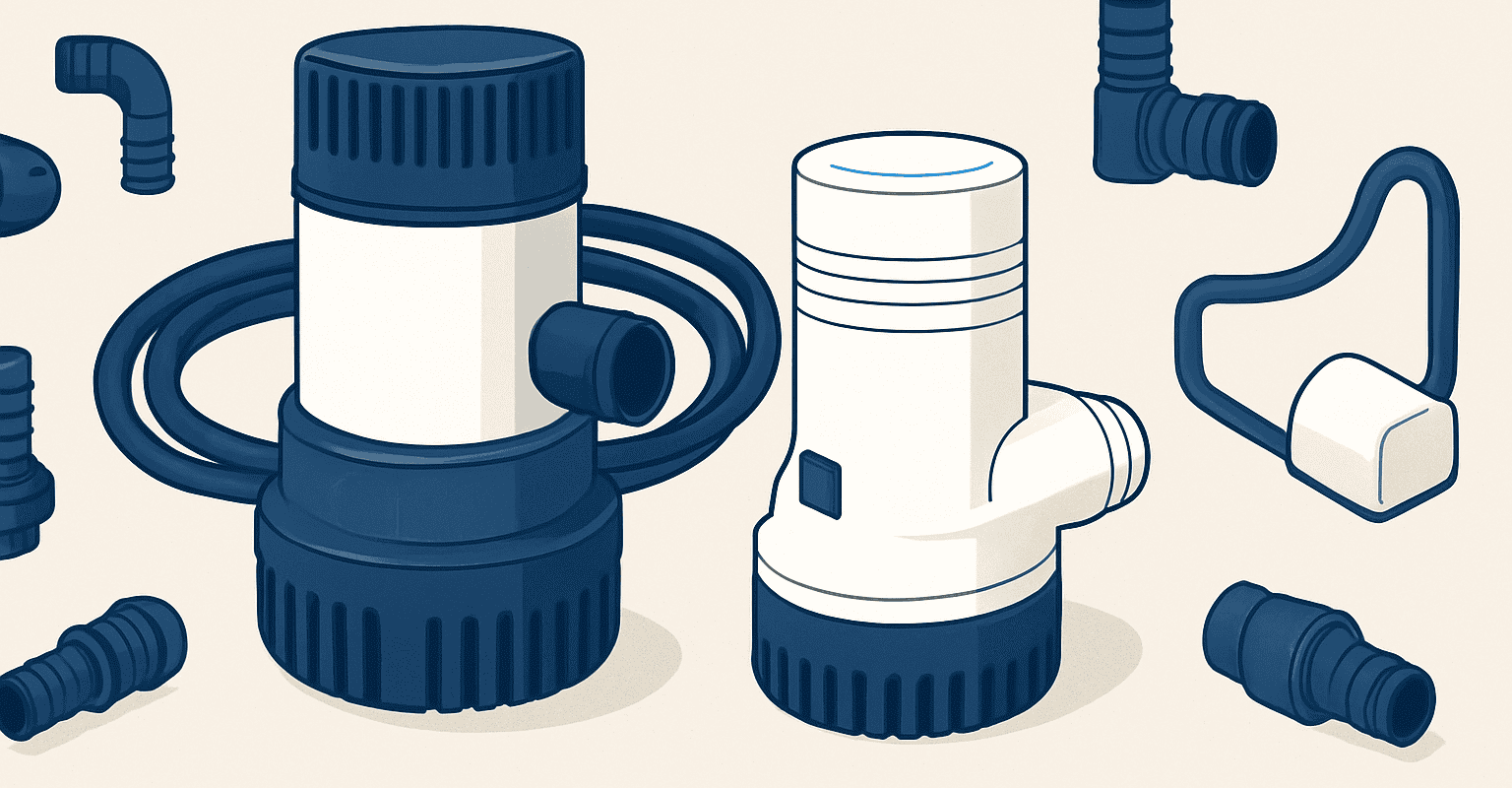
When bilge pumps are really needed
The bilge pumps are not an accessory to consider only when purchasing the boat or the system: they become a decisive choice whenever there is a need to manage water accumulation quickly, continuously, and reliably. In the nautical field, the bilge is the point where infiltrations, condensation, small leaks, or processing residues converge. Neglecting this aspect means exposing yourself to machine downtime, more frequent maintenance, and less controlled management of the onboard environment.
The comparison between the different available solutions should not start only from the shape or size, but from a very concrete question: in what operational context will the pump work? A small recreational unit, a workboat, or a technical compartment with constant humidity require different approaches. Even when the application seems simple, the correct choice depends on factors such as available space, type of liquid to be evacuated, activation mode, and ease of access for maintenance.
Those who search online for information on bilge pumps and service often compare not only the product but also the quality of support before and after the order. This is a key point: a pump suitable on paper can prove impractical if not accompanied by clear instructions on installation, spare parts, compatible accessories, and verification of intended use. For this reason, in addition to the technical data sheet, it is advisable to also evaluate the availability of support content such as technical guides for pumping systems and insights on real applications.
In many cases, the bilge pump is really needed when one or more of these conditions occur:
- recurring presence of water at the bottom of the technical compartment or the boat;
- need for automatic or semi-automatic emptying without continuous operator intervention;
- limited spaces that require compact and easy-to-inspect solutions;
- need to keep the collection area drier to protect nearby components;
- search for a solution that can be integrated with accessories and components already present.
A common mistake is to think that all bilge pumps perform the same function in the same way. In reality, the operating principle, installation configuration, and response to real usage conditions vary. That is why a serious technical comparison must start from the application, not from habit or the simple “one-to-one” replacement of the existing component.
Bilge pumps: differences between solutions, sizes, and compatibility
When comparing different bilge pumps, the theme of compatibility is often more important than the choice of the individual model. The search for compatibility of bilge pumps comes precisely from this: those who need to order a new unit want to avoid connection errors, makeshift adaptations, or incompatibilities with pipes, power supply, supports, and already installed control systems.
Differences between solutions can concern various practical aspects:
Dimensions and installation point
Not all bilges offer the same usable space. In some compartments, it is essential that the pump has a compact structure and a base that allows stable positioning. In other cases, ease of removal for cleaning is most important. Before ordering, it is advisable to check:
- available compartment dimensions;
- useful height for mounting;
- accessibility to connections;
- presence of tight bends or obstacles nearby.
If the detail is not clear, check the product sheet and compare it with the actual installation space.
Connections and interface with the system
A bilge pump may seem compatible at first glance but cause problems during installation if the connections do not match the existing system. The check must be done on multiple levels: fluid outlet, any control accessories, fixing methods, and wiring. Even a minimal difference in configuration may require adapters or unforeseen modifications.
For this reason, in comparative evaluations it is useful to accompany product sheets with resources such as insights on compatibility between pumps and accessories, especially if replacing a pump that has been installed for a long time.
Manual, automatic, or integrated activation
Another element that affects the choice is the activation mode. Some applications favor direct control by the operator; others require more autonomous management. The difference is not only functional but also related to the system: wiring, necessary accessories, and usage logic change. If the goal is to reduce manual interventions, it is important to verify in advance whether the selected solution is prepared for the desired type of control.
Type of liquid and real usage conditions
Not all water present in the bilge is in the same conditions. There may be residues, light impurities, oily traces, or dirt presence that over time affects operational continuity. This does not mean a complex solution is always needed, but the evaluation must be based on the real environment and not an ideal scenario. During comparison, it is useful to ask:
- will the pump operate occasionally or frequently?
- does the collection area tend to get dirty easily?
- Is maintenance simple or does it require awkward disassembly?
- Is a solution needed to facilitate periodic inspection?
These questions help to understand whether the priority is compactness, service convenience, or integration with the rest of the system.
Bilge and service pumps: why support matters as much as the product
When comparing with other suppliers, an often underestimated aspect is the level of assistance available before purchase. The topic bilge pumps and service concerns everything that helps to make the right choice: readable datasheets, consistent images, connection instructions, support in verifying compatibility, and the ability to navigate accessories and spare parts without wasting time.
A well-organized catalog and clear technical support reduce the risk of incorrect orders. For those considering multiple options, it can also be useful to consult content dedicated to evacuation and drainage pumps, to compare related applications and better understand which features really matter in their case.
Mistakes to avoid when choosing and installing bilge pumps
Many problems attributed to the product actually arise from hasty selection or installation that is not consistent with the system. Avoiding the most common mistakes means increasing the overall reliability of the system and reducing corrective interventions after the order.
Replacing the pump without checking actual compatibility
The first mistake is ordering a new pump based only on external appearance or a too generic description. Even if the function seems identical, compatibility of bilge pumps it means carefully checking connections, dimensions, power supply type, control methods, and integration with the existing system. An apparently simple replacement can turn into a longer job than expected if this preliminary check is missing.
Neglecting the discharge hose route
The pump does not work alone: the pipe route affects installation convenience and operational regularity. Unnecessary bends, compressed passages, or improvised connections can complicate flow and make the system less tidy. Before installation, it is advisable to plan the complete route, checking space, fastenings, and accessibility.
Installing in a difficult-to-inspect location
A bilge pump must be able to be checked. If installed in an inconvenient area, every cleaning or inspection operation becomes slower and less likely. Over time, this results in neglected maintenance. It is preferable to choose a position that allows at least easy visual inspection and reasonable access to the main connections.
Ignoring the context of use
Another frequent criticality is evaluating the component without considering the environment in which it will operate. Vibrations, constant humidity, dirt, residues, and usage frequency can greatly change system behavior. A correct choice comes from a concrete analysis of the compartment and operational habits, not from an abstract comparison of commercial descriptions.
Relying only on price or immediate availability
When the need is urgent, the temptation is to choose the first available solution. However, in bilge pumps real convenience does not depend only on order speed but on consistency with the application. A compatible component, easy to install and supported by clear information, reduces downtime and possible returns. In this perspective, it is useful to also consult sections dedicated to spare parts and components for fluid systems to have a more complete view of the system.
Products and categories to consider before ordering
Before confirming the purchase, the comparison should not be limited to the pump alone. In a professional approach, it is advisable to think in terms of system, also evaluating elements that affect installation, maintenance, and continuity of use. This is particularly important for those looking bilge pumps and service with a practical approach, aimed at avoiding incompatibilities and wasting time.
The categories to consider, besides the pump itself, normally include:
- connecting accessories, if necessary to integrate the component into the existing system;
- control or command elements, when the application requires specific management;
- mounting components, useful for a neater and more stable installation;
- spare parts and wear items, to check from a maintenance perspective;
- related solutions for drainage and fluid handling, if the application context is broader than just the bilge.
A well-done comparison also helps to understand if the bilge pump is really the most suitable solution or if the case requires a different approach. For example, in some systems the main problem is not only evacuating the collected water, but doing so consistently with other components already present. In this sense, it can be useful to explore other families of pumps and related accessories to evaluate the whole and not the single isolated piece.
A good method before ordering is to follow this checklist:
- check where the pump will be installed and how much actual space you have available;
- verify the connections of the existing system;
- compare the required activation mode with that provided by the product;
- assess if access for cleaning and maintenance will be easy;
- make sure any necessary accessories are available;
- in case of doubt, check the product sheet.
This approach is especially useful when comparing multiple alternatives in the catalog and you want to avoid a choice based only on brief descriptions or images. In a technical blog focused on comparison, the difference is made precisely by the ability to link the product to its real use.
Recommended products


How to evaluate bilge pumps in a real technical comparison
An effective technical comparison does not just say which solution seems better overall. The correct question is: which bilge pump is more consistent with my context? To answer, you need to combine three levels of analysis.
First level: operational need
It is necessary to understand whether the main objective is occasional water removal, continuous bilge management, or integration into an already structured system. This distinction changes the importance to be given to compactness, accessibility, automation, and maintenance.
Second level: system compatibility
Here the issue comes into play compatibility of bilge pumps. Attention should be paid to connections, available space, required accessories, and consistency with existing components. This is the step that most often prevents purchasing errors.
Third level: quality of service
Finally, the available support must be considered. Clear datasheets, reliable images, technical content, and the ability to navigate related categories are elements that directly affect the quality of the order. For this reason, when talking about bilge pumps and service, the value is not only in the product but in the entire selection process.
If you are evaluating which solution to include in your system, the most useful step is to start from the dedicated category and carefully compare the available options, checking datasheets, compatibility, and related accessories. In this way, you can identify the most suitable bilge pump and navigate more confidently among the brands and related product families.
FAQ
How to check the compatibility of a bilge pump before ordering?
Always check dimensions, connections, activation methods, and configuration of the existing system. If you are replacing an already installed pump, compare the mounting point, pipe route, and existing accessories. If any information is unclear, check the product datasheet.
Are all bilge pumps suitable for the same uses?
No. They vary by configuration, installation method, command management, and adaptability to the operating context. The correct choice depends on the available space, the type of liquid to be drained, and the required maintenance convenience.
What mistakes are most often made when choosing a bilge pump?
The most common mistakes are ordering without checking the actual compatibility, neglecting the discharge path, installing the pump in a hard-to-inspect location, and evaluating the product without considering the actual bilge conditions.
Why is service as important as the product in bilge pumps?
Because a correct choice also depends on the quality of the available information. Clear datasheets, support in checking compatibility, and ease in finding accessories or spare parts help reduce purchase errors and downtime.


