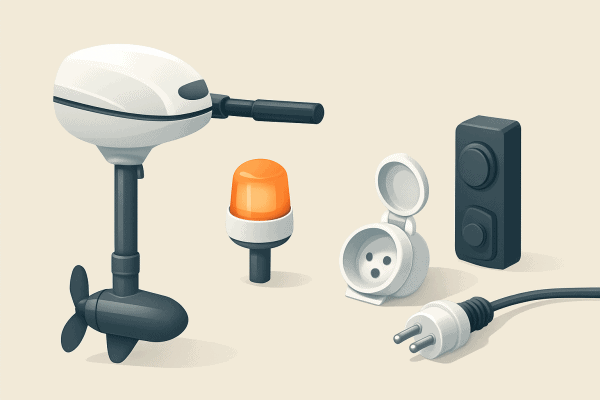
Those looking for a electric motor for inflatables today it does not only evaluate thrust or size. More and more often the choice depends on a less obvious but decisive aspect in real use: integration with lights, headlights, plugs and sockets. In other words, it is not enough to understand if a motor “fits”, but if it communicates well with the onboard electrical system, with the arrangement of connections and with the usage habits of the inflatable.
In 2026 the comparison between solutions has become more technical: connection systems change, accessory management and above all the issue of electric motor for inflatables compatibility. An organized system reduces errors, simplifies installation and makes everything related to navigation, signaling and power supply of onboard services more reliable.
In this guide you will find a practical and comparative approach: not a list of products, but useful criteria to understand what to look at before purchase and before installation.
When an electric motor for inflatables is really needed
Not all inflatables require the same approach. The electric motor for inflatables is particularly interesting when the goal is to have simpler maneuver management, support in certain navigation phases or a tidier onboard electrical setup.
The key point, however, is to understand in which context it will be used. An inflatable used for short trips, controlled movements or activities requiring precision in maneuvers has different needs compared to a vessel equipped with more electrical utilities and onboard accessories.
In practice, the motor must be evaluated together with the whole system:
- navigation lights and courtesy lights present onboard;
- beacons already installed or to be replaced;
- plugs and sockets available for connections;
- any control panels or switches;
- real space for wiring, passages and protected connections.
If the inflatable has a basic system, the choice can be more straightforward. If instead there are more accessories, the issue of compatibility becomes central. This is where many users discover that the real problem is not the motor itself, but the way it fits into the already existing electrical architecture.
To deepen the organization of the onboard system it can be useful to consult the section dedicated to marine electricity e instrumentation accessories, so as to have a more complete view of the system.
Differences between solutions, sizes or compatibility of the electric motor for inflatable boats
When comparing multiple options, the difference is not only in the shape or type of installation. The real question is: how it connects and what it has to coexist with on board? Talking about electric motor for inflatables compatibility means evaluating at least three levels: mechanical, electrical and functional.
Mechanical compatibility: dimensions, supports and position
The first check concerns the available space. a motor may seem suitable on paper but turn out to be inconvenient once installed, especially if it interferes with seats, handrails, lockers or cable passages.
It is advisable to check:
- the intended fixing point;
- the freedom of movement of the motor during use and storage;
- the distance from batteries, panels and connections;
- the ease of access to plugs and sockets.
If a detail is not clear, check the product sheet and compare it with the actual measurements of your inflatable boat.
Electrical compatibility: neat connections and coherent system
This is where much of the choice is made. A well-designed system must not only “turn everything on,” but distribute power cleanly, with accessible and easily controllable connections. The plugs and sockets often underestimated role: they are the point where practicality and reliability meet.
An improvised connection can create operational problems, especially when on the same inflatable boat coexist:
- lights navigation;
- beacons for signaling or towing;
- onboard instruments;
- auxiliary utilities;
- switches and distribution panels.
Electrical compatibility should therefore be understood as the overall coherence. It is not enough for the connector to “fit”: it must be suitable for the environment, the type of use and the frequency with which it will be connected and disconnected.
For those reviewing the connections, it may be useful to consult connection systems for marine installations e solutions for onboard sockets and wiring.
Functional compatibility: lights, lanterns, and service management
Another often overlooked aspect is the behavior of the system when multiple services are active simultaneously. In a well-organized inflatable boat, the engine integrates without complicating the use of other functions. This is especially true for lights e beacons, which must remain easy to manage even when the engine or wiring is updated.
When choosing, ask yourself:
- are the existing lights still easily accessible?
- are the lanterns connected with protected and orderly connections?
- are the sockets positioned logically?
- does the cable routing avoid critical points or exposed areas?
If the answer is uncertain, it is probably necessary to review the overall design before even selecting the engine.
Mistakes to avoid in choice or assembly
Many problems arise not from the chosen product, but from an incomplete assessment of the context. Here are the most common mistakes when installing or replacing a electric motor for inflatables.
Choosing the engine without looking at the existing system
This is the most common mistake. The engine is viewed as an isolated element, ignoring the condition of sockets, plugs, branches, and light points. The result is an installation that requires subsequent adaptations, often untidy.
Before deciding, it is advisable to quickly check:
- existing wiring;
- already occupied connections;
- wear condition of sockets and plugs;
- position of lights and lanterns relative to new cable routes.
Underestimating plugs and sockets
The plugs and sockets they are not secondary accessories. They are elements that affect daily practicality: connecting, disconnecting, inspecting, and protecting contact points must be simple. An inconvenient or exposed socket can become a continuous source of operational annoyances.
When evaluating an installation, consider:
- ease of access;
- protection from splashes and the onboard environment;
- fixing solidity;
- order of incoming and outgoing cables.
Mixing components without a compatibility criterion
Another common mistake is adding different components over time without a common logic. Maybe the engine is correct, but it is inserted into a system where lights, beacons, switches and sockets were chosen at different times, with standards and connections not always consistent.
This does not mean that everything must be replaced, but that each element must be checked as part of a system. If you have doubts about the match between connections and accessories, check the product sheet and always compare the intended type of use.
Neglecting cable routing
A clean assembly does not depend only on the final connection point. The wiring path also matters a lot. Improvised passages, tight curves, or areas difficult to inspect make maintenance more complex and worsen the order on board.
A good criterion is to think of cables as a visible part of the user experience: if the path is clear, protected, and accessible, the system is also easier to manage over time.
Products and categories to consider
When evaluating a complete setup, it is not advisable to stop at the engine alone. The best choice almost always comes from a coordinated selection of connected components and accessories. In this perspective, the topic electric motor for inflatables compatibility extends to all categories that influence daily operation.
Lights and lamps: visibility and system order
lights, pumps, chargers, and instruments may share technical spaces, terminal blocks, cable routes, or inspection areas. e beacons affect both the readability of the system and the distribution of connections. If you are upgrading the engine, it is often the right time to also check the condition of light points, supports, and connections.
A well-organized system allows you to:
- immediately identify any anomalies;
- reduce temporary connections;
- simplify access to maintenance points;
- keep the technical area of the inflatable boat tidier.
For an overview of related components you can consult solutions for nautical lights and lamps.
Plugs, sockets, and connectors: the critical point of practicality
In daily work on board, few elements are as important as plugs and sockets. They are the point where the system becomes truly usable. A well-thought-out connection helps avoid inelegant adaptations and simplifies every subsequent intervention.
When comparing available categories, consider:
- consistency with the rest of the system;
- ease of installation;
- accessibility in case of inspection or replacement;
- logical arrangement in relation to the engine and other services.
Support accessories for a more readable system
In addition to the main connections, accessories that help keep the system organized can also make a difference: cable glands, supports, panels, switches, and distribution components. These are not aesthetic details, but tools to have a clearer and easier to manage configuration.
If you are building or upgrading your onboard setup, it may be useful to also explore accessories for completing the electrical system.
Recommended products


How to choose wisely between real differences and practical use
Among technical sheets, images, and seemingly similar solutions, the risk is focusing on secondary details and losing sight of what really matters. To choose a good electric motor for inflatables, try to follow a simple sequence:
- Observe the actual inflatable boat: spaces, passages, access to connections.
- Map the existing utilities: lights, signals, instruments, sockets.
- Check compatibility between engine and system, not just between engine and support.
- Check the type of connections and the possible order of wiring.
- Evaluate future maintenance: what is easy to install today must remain simple tomorrow as well.
This approach helps avoid hasty purchases and build a more coherent system. In a nautical context, the difference between a valid solution and a truly functional one often lies in the quality of integration, not in the single component alone.
If you are comparing categories and accessories to complete the setup, explore the Technofluid selection dedicated to electricity and instrumentation: you will find solutions for the engine, lights, beacons, plugs and sockets and useful components to build a more organized and compatible onboard system with your inflatable boat.
FAQ
How to check the compatibility of an electric motor for inflatable boats with the onboard system?
Compatibility must be checked on three levels: mounting space, type of electrical connections, and integration with other existing devices. Before purchasing, check the position of batteries, cable routing, available sockets, lights, and already installed headlights. If any detail is unclear, check the product sheet.
Do lights and lanterns really affect the choice of electric motor for inflatable boats?
Yes, because they are part of the same onboard electrical system. When the engine is installed or replaced, the arrangement of lights and headlights can affect cable routing, accessibility to connections, and the order of the system. A coordinated assessment avoids impractical adjustments.
Why are plugs and sockets important in an electric motor system for inflatable boats?
Because they are the most used connection points and the most exposed to operational wear. Suitable plugs and sockets simplify connection, disconnection, and system control. They also help keep wiring organized and reduce problems related to improvised connections.
What mistakes to avoid when assembling an electric motor for inflatable boats?
The most common mistakes are choosing the engine without checking the existing system, underestimating plugs and sockets, adding inconsistent components, and neglecting the cable routing. A correct installation always starts with an overview of the inflatable boat and the existing utilities.
When is it advisable to also review sockets, wiring, and headlights along with the engine?
It is advisable to do this when the system has been modified over time, when the connections are disorganized, or when access to electrical points is inconvenient. Installing the motor is often the best opportunity to also reorganize outlets, wiring, lights, and lamps in a more coherent way.