


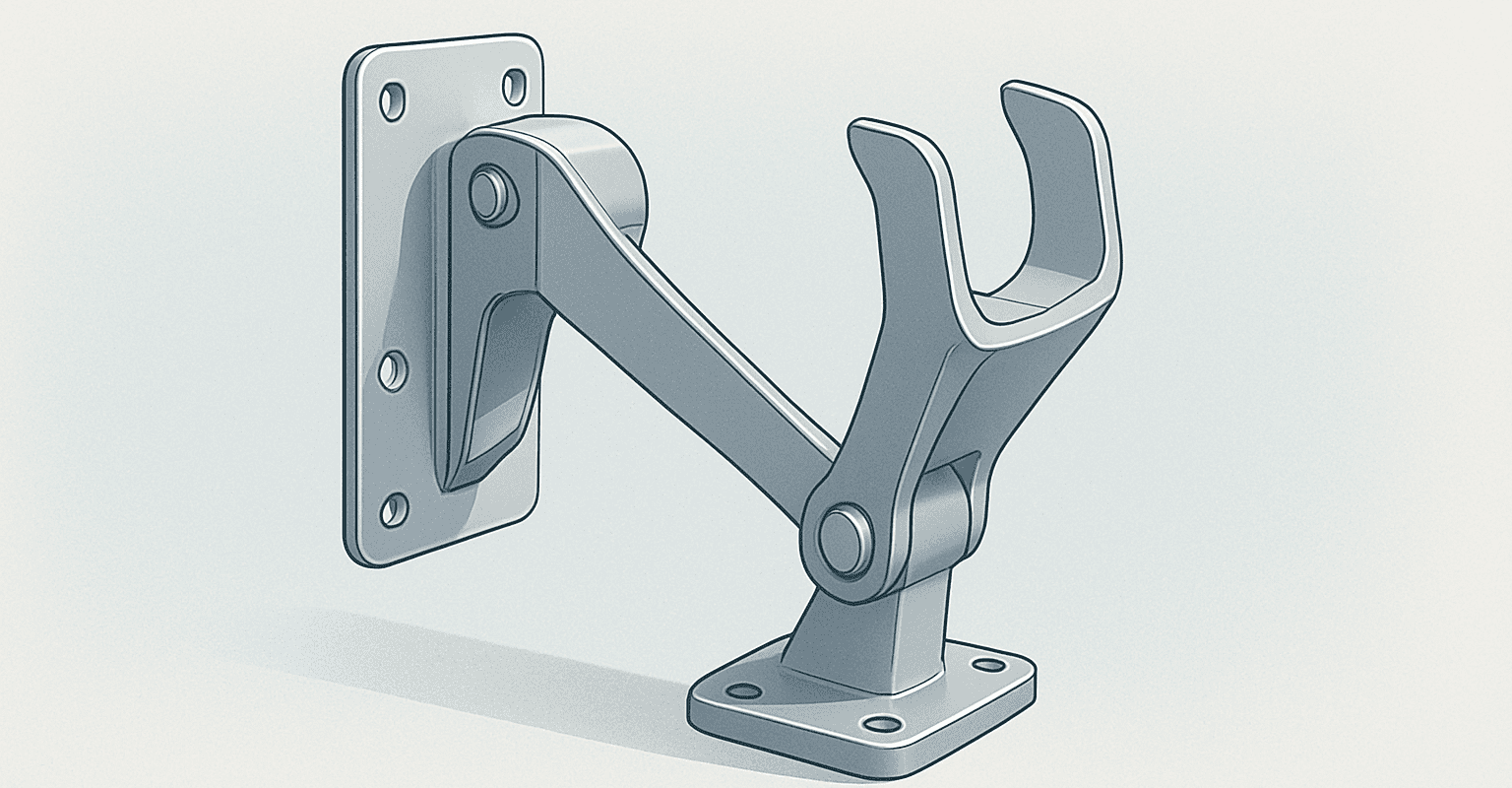
In the context of nautical technical guides, the topic of auxiliary engine support is often approached in an overly simplified way: mounting is discussed, capacity is mentioned, and then the product is immediately considered. In reality, before ordering, it is better to think in terms of actual use, transom geometry, engine dimensions, and interaction with the boat's trim. It is precisely this preliminary analysis that helps avoid choices that are inconsistent with the boat or the type of navigation.
A well-chosen support is not only meant to “hold” a secondary engine. It must allow a functional position, facilitate use when needed, reduce interference with other stern accessories, and maintain an orderly configuration even when the engine is not running. For this reason, the topic of auxiliary engine support compatibility is central: it is not enough that the support can be installed, it must truly be suitable for your operational scenario.
Se stai confrontando diverse soluzioni, può essere utile approfondire anche altre guide tecniche nautiche dedicate agli accessori di poppa, ai sistemi di fissaggio e alla corretta configurazione dell’imbarcazione. Un approccio comparativo permette di selezionare il componente più coerente senza affidarsi a valutazioni generiche.
When auxiliary engine support is really needed
The auxiliary engine support it becomes a sensible choice when the secondary engine is not an occasional accessory, but a concrete part of the onboard setup. This happens, for example, on boats that require backup propulsion, on vessels where the main engine is separated from the auxiliary one, or in configurations where the secondary engine is used for maneuvers, trolling, or controlled movements.
However, its installation is not always the best solution. In some cases, the problem is not “adding a support,” but understanding if the stern really offers useful space for the engine to work correctly. If the auxiliary engine ends up too close to ladders, handrails, swim platforms, or other elements, the support risks becoming an impractical compromise.
Before deciding, consider these aspects:
- frequency of use of the auxiliary engine during the season;
- accessibility of the controls and the fastening area;
- available space on the transom or in the side mounting area;
- interferences with steering, accessories, or covers;
- ease of handling of the engine when it needs to be raised, lowered, or removed.
A typical case where the support is really useful is for users who want to keep the auxiliary engine ready for use without occupying space on deck or in the locker. In this situation, the support allows a stable and dedicated placement. Different is the case of those who use the secondary engine only occasionally: here it may be more important to evaluate the overall practicality of the system, rather than focusing only on the fastening.
Per chi sta organizzando l’assetto della poppa, può essere utile consultare anche contenuti correlati su accessori per il montaggio nautico e soluzioni di installazione, così da leggere il supporto come parte di un insieme e non come elemento isolato.
Differences between solutions, sizes, or compatibility of the auxiliary engine support
When comparing multiple models, the real difference is not only in the shape of the support, but in how it integrates with the boat and engine. The evaluation of auxiliary engine support compatibility requires attention to multiple factors simultaneously. Simply verifying that the support “can be mounted” is often the mistake that leads to an unsatisfactory choice.
Transom geometry and installation point
The first element to observe is the mounting surface. A linear and free transom offers more possibilities. Conversely, an area with curves, reinforcements, steps, or already installed accessories can reduce the effectiveness of the mount or complicate its positioning. Even a few centimeters difference in position can make a big difference in terms of accessibility and engine movement.
It is worth asking:
- is the surface regular enough for a proper attachment?
- is the mount still reachable with the boat in the water?
- does the engine, once installed, have enough space to operate without hitting other parts?
Engine size and actual use
Another decisive point concerns the engine itself. It’s not only the overall size that matters, but also the shape of the shaft, the bulk of the engine head, the position of the handles, and how easily the engine can be tightened or removed. A seemingly compatible mount can prove inconvenient if the clamps are not easily accessible or if the engine, once in position, obstructs other onboard operations.
In a technical comparison, it is useful to distinguish between:
- structural compatibility, physical possibility of mounting;
- functional compatibility, practical ease of use;
- trim compatibility, consistency with the engine’s position relative to navigation and the transom.
This distinction is important because many problems arise not during installation, but during daily use.
Travel, working position, and resting position
Different solutions also differ in how the engine is kept in the working or resting position. In some cases, it is essential that the engine can be placed in a more compact position when not in use; in others, the speed with which it can be returned to operational configuration is more important. The choice depends on the type of boat and how often the auxiliary engine is actually used.
Here the correct question is not “which is the best mount overall?”, but “which is the most suitable mount for my configuration?”. If you have doubts about dimensions, spacing, or fastening methods, check the product sheet and always compare the mount with the available space on board.
Per un’analisi più completa, può essere utile consultare anche una guida alla compatibilità degli accessori nautici o contenuti dedicati all’installazione su poppa, così da valutare insieme supporti, staffe e componenti complementari.
Mistakes to avoid in choice or assembly
Many problems related to auxiliary engine support do not depend on the quality of the component, but on an incomplete initial assessment. In a technical comparison between solutions, the most common mistakes are almost always the same and concern the mounting context more than the mount itself.
Choosing based on appearance and not installation
A mount may seem suitable when viewed in photos, but prove impractical once positioned on the boat. The typical mistake is to evaluate only the design or general structure without verifying the real compatibility with the transom. Before ordering, it is advisable to measure the usable space and consider obstacles present in the mounting area.
Ignoring moving obstructions
Another common mistake is to check the engine only when stationary. In reality, you need to consider the entire range of the system: resting position, operating position, engine tilt, and access to fastening points. If the engine comes into contact with other elements during movement, the mount risks becoming uncomfortable or unusable.
Neglecting onboard ergonomics
From a practical point of view, a proper mount should allow simple and repeatable operations. If blocking or unblocking the engine requires assuming uncomfortable positions, working in tight spaces, or removing other accessories, the chosen solution may not be the most suitable. This aspect is especially important on compact boats, where every centimeter of the stern has a specific function.
Not considering the mount as part of the stern system
The mount does not work alone. It interacts with brackets, mounting surfaces, nearby accessories, and the overall boat configuration. For this reason, it is useful to think in terms of a system, checking whether the installation requires additional components or if the fastening area needs a more careful evaluation. If some details are unclear, check the product sheet.
Among the most common mistakes to avoid:
- mounting the mount too close to already present accessories;
- not checking the accessibility of the engine clamps;
- underestimating the engine's bulk when not in use;
- choosing a solution without verifying the actual fastening surface;
- considering only the initial installation and not the practicality over time.
Chi desidera approfondire queste verifiche può consultare anche contenuti dedicati a staffe e sistemi di fissaggio nautici, utili per capire come impostare correttamente il lavoro prima di procedere all’ordine.
Products and categories to consider
In research aimed at comparison, it is useful not to stop at the mount alone, but also to observe related categories that can influence the final result. This approach is typical of the best nautical technical guides, because it helps avoid isolated purchases that are inconsistent with the actual installation.
When analyzing the available solutions, consider in parallel:
- auxiliary engine mounts, in various mounting configurations;
- fastening components for proper installation on the stern;
- complementary accessories useful for improving practicality and order onboard;
- structural or interface elements to be checked according to the boat;
- spare parts or compatible components, if provided by the chosen system.
This category-based reading is particularly useful when the goal is not only to mount the auxiliary engine but to do so cleanly, accessibly, and consistently with the intended use. In many cases, in fact, the difference between a satisfactory solution and a less practical one depends more on integration details than on the support itself.
Se stai confrontando più opzioni, può essere utile consultare anche una selezione di componenti nautici per la poppa e accessori correlati, così da verificare se il supporto scelto si inserisce bene nel tuo assetto complessivo.
A good method is to prepare a short checklist before ordering:
- where the support will be installed;
- what space remains around the engine;
- how to access the fastening points;
- if the engine can be moved without obstacles;
- which nearby accessories might interfere;
- if complementary components are needed to complete the installation.
This step also helps make the comparison between technical sheets more effective. If a measurement, a fastening method, or a usage feature is not clearly stated, check the product sheet before proceeding.
Recommended products

 10" Wound Wire Cartridge 20 micron – code: 10MP20 – Idromar
 Brush with spring - code: SGM45 - Gianneschi Pumps and Blowers
 Stainless steel clamps Norma 12–22 mm – code: FAI0012022 – Toscogomma



How to choose with a technical and comparative approach
Those looking for a auxiliary engine support with a comparative intent usually does not want a generic description but a reliable selection criterion. The best way to orient yourself is to start with three simple questions: where it will be mounted, how it will be used, and what constraints the boat imposes.
A support can be correct on paper but ineffective in practice if it does not take the context into account. For this reason, in the nautical technical guides, the choice should always follow a concrete logic:
- first the boat is evaluated;
- then the auxiliary engine is analyzed;
- finally the available solutions are compared based on real compatibility.
This order avoids purchasing a component just because it is widespread or visually convincing. The real difference is made by the consistency between support, available space, and intended use. If your goal is to find a reliable and well-integrated solution, explore the dedicated category or the reference brand and carefully compare the sheets to identify the support best suited to your stern configuration.
FAQ
How to check the compatibility of an auxiliary engine mount with my boat?
Compatibility must be assessed considering the mounting surface, available space at the stern, engine dimensions, and accessibility of the fastening points. It is not enough that the bracket can be installed: it must also be practical to use. If some details are unclear, check the product sheet.
Should the auxiliary engine mount be chosen based on the engine or the boat?
It must be chosen based on both. The boat defines the mounting constraints and available space, while the engine determines dimensions, tightening methods, and ease of use. A correct choice arises from the comparison between these two elements.
What mistakes are most often made before ordering?
The most common mistakes are not correctly measuring the mounting area, ignoring interferences with stern accessories, considering only theoretical compatibility, and not checking the ease of use of the engine once installed.
Should related accessories or components also be considered?
Yes, because the support works within a larger system. Depending on the boat's configuration, fastening components, finishing accessories, or other elements may be useful to consider along with the main support.
When is an auxiliary engine mount really useful?
It is useful when the auxiliary engine is used regularly or must remain ready for use in a dedicated position. If the use is very occasional, it is advisable to carefully consider whether the support really represents the most practical solution.


