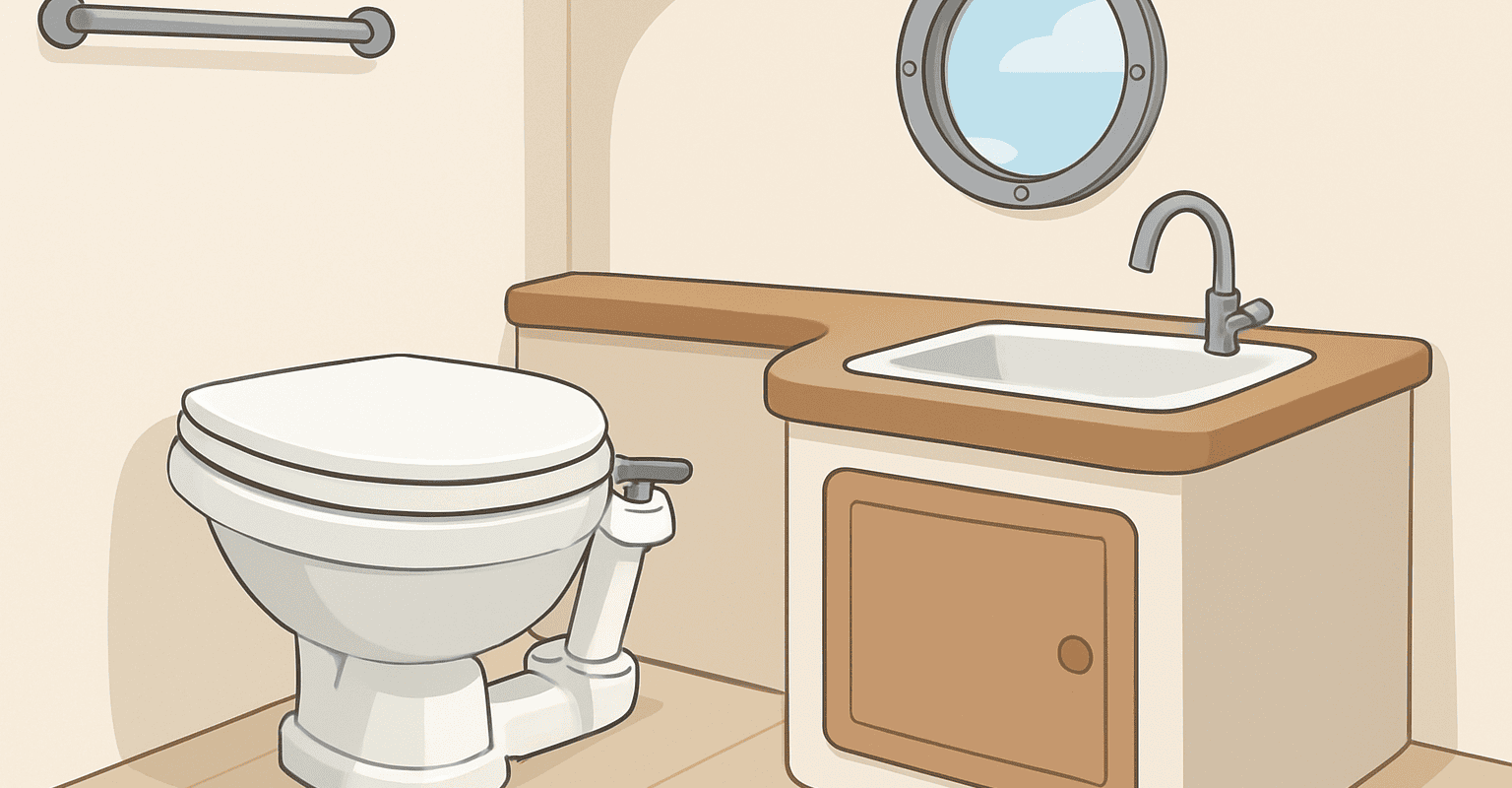
Understand how the bathroom works on a boat it is one of the most important steps when designing a new layout, updating an existing system, or considering the replacement of worn components. In the nautical field, the bathroom is not just a simple accessory: it is a system composed of a toilet, discharge, supply, possible maceration, tank, and ventilation passages that must work coherently with the available spaces and the configuration of the boat.
For this reason, in nautical technical guides the topic is often addressed in a comparative way: there is no solution valid for every boat, because layouts, volumes, location of the toilet room, pipe routes, and ease of access for maintenance vary. A well-chosen system always comes from a precise evaluation of space, actual use, and compatibility among the various elements.
Se stai cercando una panoramica concreta e non teorica, questa guida ti aiuta a leggere le differenze tra le principali soluzioni, a capire cosa controllare prima dell’acquisto e a evitare gli errori più comuni in fase di scelta o montaggio. Per approfondire altri temi collegati puoi consultare anche le guide tecniche, i sistemi idraulici di bordo e gli accessori per impianti nautici.
When you really need to understand how the bathroom works on a boat
The question how the bathroom works on a boat does not arise only when you need to buy a new toilet. It often becomes central in at least four operational situations.
- Bathroom room refit: when replacing an outdated system, it is necessary to verify if the new system can use the same passages and connection points.
- Recurring discharge problems: backflows, persistent odors, irregular emptying, or priming difficulties may depend on an inconsistent configuration.
- Space optimization: on boats with limited volumes, even a few centimeters affect door openings, access to fittings, and ease of cleaning.
- Technology change: switching from a manual solution to a different configuration always requires checking the supply line and discharge management.
In all these cases, the point is not just to choose a component, but to understand how the entire circuit works. The on-board bathroom, in fact, works correctly only if every part is sized and positioned coherently with the rest of the system.
Another often underestimated aspect concerns frequency of use. A boat used occasionally can tolerate different settings compared to a boat used continuously. The more frequent the use, the more decisive become ease of maintenance, accessibility of connections, and quality of flow. In practice, the right choice depends not only on the bathroom itself, but on how the boat is used.
In nautical technical guides focused on comparing solutions, this is the first criterion: start from the real context, not just the shape of the bowl or the type of control. If the space is tight, if the piping passage is mandatory, or if the tank is placed in a particular position, the answer changes substantially.
Differences between solutions, measurements, or compatibility of the bathroom on the boat
To choose well, you need to distinguish three levels: type of operation, dimensions and sizes, system compatibility. This is where the research “how the bathroom works on the boat compatibility” becomes really useful, because it draws attention to aspects that affect more than just aesthetics.
Type of operation: what really changes
The different available solutions can vary in activation mode, flush management, and discharge system. Practically, this affects:
- ease of use on board;
- number and position of connections;
- ease of routine maintenance;
- integration with the rest of the system.
When comparing two systems, don’t stop at the general description. Check in the product sheet if the model requires particular configurations for supply or discharge and if additional components are needed for proper installation.
Bathroom measurements on the boat: width is not the only thing that matters
One of the most common mistakes is measuring only the floor footprint. In reality, to correctly install an onboard bathroom you also need to consider:
- overall height and useful space above the bowl;
- actual depth, including fittings and rear curves;
- lateral bulk of connections;
- space for maintenance and access to fastening points;
- interferences with doors, bulkheads, furniture, or steps.
In many bathroom spaces the problem is not fitting the component in, but being able to connect it without forced bends in the pipes. A poorly positioned fitting or a curve that is too tight can compromise functionality over time. For this reason, measurements should always be read together with the pipe route and the position of existing passages.
System compatibility: the point that decides the choice
The compatibility is often the real dividing line between a simple replacement and a complex intervention. When talking about how the boat bathroom works compatibility, the main checks concern:
- diameter and position of the connections;
- orientation of inlet and outlet;
- presence of tank or dedicated line;
- available space for valves, siphons, and fittings;
- consistency with the already installed system.
If you are replacing an existing system, always compare the new layout with the one already on board. Even a minimal difference in the orientation of the connections can require significant modifications to the pipe routing. If the data is not explicit, check the product sheet.
Può essere utile approfondire anche tubi e raccordi per impianti nautici e pompe e sistemi di scarico, perché spesso la buona riuscita del montaggio dipende più da questi elementi che dal vaso in sé.
Mistakes to avoid in choice or assembly
A boat bathroom may seem like a simple system, but in practice it concentrates many critical points. The most common mistakes do not always emerge immediately: they often appear after the first uses, when the circuit works under real conditions.
Choosing without a complete survey of the compartment
Measuring approximately is the first mistake. A complete survey of the room, passages, and useful dimensions is needed. It is not enough to know if the bathroom “fits”: you need to understand if there is space left to tighten clamps, inspect fittings, and perform maintenance.
Ignoring the pipe route
Pipes should not be considered a secondary detail. Too tight curves, compressed sections, or non-linear routes can complicate flow and increase the risk of problems. During replacement, check if the new setup really replicates the old route or if adaptations are required.
Neglecting accessibility
A system that is difficult to reach is a system harder to keep efficient. If to access a connection you have to remove panels or work in very tight spaces, even ordinary maintenance becomes less practical. The best choice is almost always the one that allows quick access to sensitive points.
Evaluating only the toilet and not the system
Many comparisons between solutions stop at the visible element. In reality, the boat bathroom works well when the toilet, pipes, fittings, discharge, and tank management are designed as a whole. If a single element is incompatible, the entire system suffers.
Underestimating future maintenance
An apparently convenient choice at the time of purchase can prove impractical over time. Before deciding, always ask yourself:
- are the connections accessible?
- are the parts subject to inspection accessible?
- does the layout allow interventions without complex disassembly?
- is the configuration consistent with the actual use of the boat?
These questions help avoid installations that seem correct on paper but become uncomfortable or unreliable in daily use.
Products and categories to consider for the boat bathroom
When analyzing how the bathroom works on a boat, it is useful to think in terms of functional categories rather than isolated single components. This approach, typical of the best nautical technical guides, allows building a coherent and easier-to-manage system.
The bathroom group and basic components
The first level concerns the main body of the system and its related connections. At this stage, it is important to check:
- actual dimensions;
- position of the fittings;
- orientation of fittings;
- useful space for installation and maintenance.
If the toilet room is compact, even the shape of the base and the position of the connections can make a difference. Do not limit yourself to the front view: always observe the component in relation to the compartment where it will be installed.
Tubes, fittings, and connecting accessories
A decisive part of compatibility depends on tubes and fittings. These are elements often reused, but this choice is not always the most suitable. If the old system had issues, it is advisable to check if the existing connections are still consistent with the new configuration.
Per una visione più ampia puoi consultare anche le soluzioni per accessori e ricambi nautici, utili quando l’obiettivo non è solo sostituire il bagno, ma migliorare l’intero circuito.
Discharge systems and system management
The bathroom's behavior depends greatly on how the discharge is managed. At this stage, the linearity of the path, ease of inspection, and consistency among the various system elements matter. If the existing system has been modified over time with successive adaptations, it may be useful to reconsider the entire configuration instead of limiting yourself to a punctual replacement.
A correct technical approach always involves a comprehensive check: space, connections, accessibility, and compatibility must be considered together. Only in this way can you avoid solving an apparent problem by creating new issues downstream.
Recommended products

 10" Wound Wire Cartridge 20 micron – code: 10MP20 – Idromar
 Stainless steel clamps Norma 12–22 mm – code: FAI0012022 – Toscogomma
 Brush with spring - code: SGM45 - Gianneschi Pumps and Blowers



How to navigate between technical comparison and final choice
Among competitor-driven searches, those looking for information on the onboard bathroom almost always want to compare similar solutions and understand which is best suited to their case. The best method is to start with an essential checklist:
- compartment measurements accurately detected;
- photos of existing connections;
- pipe routing and critical points;
- space available for maintenance;
- type of boat usage.
With this information, it becomes easier to compare options concretely, without stopping at generic descriptions. In particular, if your doubt concerns how the bathroom works on the boat compatibility, the priority is to verify that the new setup is truly integrable into the existing system, not just that the component has suitable dimensions.
If you want to explore the solutions available for your system, check out the Technofluid selection dedicated to bathroom systems, connections, and nautical accessories: it is the fastest way to compare useful categories and identify the configuration best suited to your boat.
FAQ
How does the bathroom on a boat work in a simple way?
The boat toilet works as an integrated system composed of a bowl, supply, discharge, fittings, and, depending on the configuration, a possible tank. Proper functioning depends on the consistency between these elements, the routing of the pipes, and the space available for installation and maintenance.
What measurements should be checked before choosing a boat bathroom?
It is not enough to measure the base of the vase. It is important to check height, actual depth, fitting clearance, side space, access to connections, and interference with doors, bulkheads, or furniture. If any information is unclear, check the product sheet.
What does compatibility mean for a boat bathroom?
Compatibility concerns the match between the new system and the existing onboard installation. The position and orientation of the attachments, the routing of the pipes, space for fittings, and consistency with the exhaust configuration must be checked. Even small differences can require significant modifications.
What is the most common mistake in replacing the onboard bathroom?
The most common mistake is choosing the new component considering only the visible bulk, without analyzing connections, accessibility, and the routing of the pipes. In many cases, the problem is not the positioning of the tank, but the real possibility of installing and maintaining it practically.
When is it better to review the entire system instead of just replacing the bathroom?
It is advisable to evaluate the entire system when there are recurring drainage problems, persistent odors, difficult-to-access connections, or layered adaptations over time. In these situations, a simple replacement may not solve the real cause of the problem.