


What carabiners/shackles/swivels are for and when it is advisable to check them
I carabiners/shackles/swivels they are connecting components used when it is necessary to join, hold, orient, or make a mechanical assembly subject to traction, movement, or rotation more manageable. In many operational contexts, they become small but decisive elements: if chosen poorly or installed improperly, they can cause abnormal play, friction, maneuvering difficulties, or premature wear of the assembly.
A good carabiners/shackles/swivels guide it starts from a simple principle: it is not enough for the component to “fit” into the connection point. It must be compatible with the system in which it operates, with the actual dimensions, and with the type of movement required. A static connection, for example, has different needs compared to a point that must rotate or compensate for torsions.
In practice, these components are often checked when the following are noticed:
- difficulty in hooking or unhooking;
- irregular rotation or blocked;
- excessive play between parts;
- signs of wear on pins, seats, or contact points;
- visible deformations or no longer precise closures;
- improvised fittings with other inconsistent accessories.
The check is especially important when the component works together with other elements such as terminals, ropes, chains, eye bolts, quick couplings, or connecting fittings. If the assembly is not balanced, the problem rarely remains isolated: it tends to transfer to the weakest point of the system.
Per approfondire i criteri di scelta dei collegamenti e degli accessori abbinati, può essere utile consultare la sezione dedicata alle guide tecniche oppure le categorie di componenti correlati.
When a simple visual check is not enough
A quick inspection is useful but not always sufficient. If a shackle seems to close correctly but the pin works off-axis, or if a swivel rotates only freely and locks under load, the problem may depend on the real compatibility of the application. In these cases, it is advisable to verify the complete assembly and not just the single piece.
Another common mistake is to consider interchangeable components that perform similar but not identical functions. The carabiner prioritizes quick hooking, the shackle offers a different connection geometry, the swivel is designed to manage rotation. Replacing one with another without evaluating the context can create immediate operational criticalities.
Compatibility, measurements, and technical checks of carabiners/shackles/swivels
The most delicate phase is almost never the assembly itself, but the preliminary compatibility check. In a proper activity of carabiners/shackles/swivels maintenance, the first step is to check that the component is suitable for the connection point, the required movement, and the accessories already present.
The most useful checks concern:
- effective passage diameter;
- shape of the attachment and geometry of the anchoring point;
- available space for opening, closing, or rotation;
- presence of misaligned loads or twists;
- interferences with other nearby components;
- materials and finishes compatible with the environment of use.
When talking about measurements, the typical mistake is to stop at the nominal size. In reality, the overall shape of the component also matters: an internal clearance that is too small, a bulky head, or a pin that interferes with the terminal can make assembly possible only in appearance.
How to make a quick diagnosis before ordering
Before replacing a component, it is advisable to observe the behavior of the assembly in operation. A quick diagnosis can start with three questions:
- Should the connection remain fixed or should it rotate?
- Is the load distributed axially or does it tend to shift laterally?
- Does the attachment point have enough space to work without rubbing?
If the answer to the first question is “should rotate,” a swivel may be more consistent than a rigid connection. If instead the system operates with obvious misalignment, the problem might not be the worn component but the initial choice of the interface.
When you have doubts about measurements, attachments, or configurations, the best criterion is always the same: check the product sheet and compare the data with the actual installation point, not with a visual estimate.
Components to check together with the connection
During the technical inspection, it is useful to also check the adjacent parts, because often the defect originates there. In particular, it is advisable to observe:
- deformed eyelets, slots, and terminals;
- contact points with signs of abrasion;
- threads that do not close cleanly;
- ovalized or worn seats;
- elements that generate continuous torsion;
- couplings between different materials exposed to aggressive environments.
Per chi lavora spesso con sistemi di collegamento e movimentazione, può essere utile consultare anche gli approfondimenti sui componenti di connessione e le soluzioni per assemblaggi e ricambi.
Typical errors in ordering or installation
Many problems arise even before use, that is, during the selection or ordering phase. A carabiners/shackles/swivels guide truly useful guide should help recognize the most common mistakes, so they can be avoided immediately.
Confusing the hooking function with the rotation function
One of the most frequent mistakes is using a simple connecting component in a place where torsion compensation is needed. In this situation, the system tends to load poorly, the movement becomes irregular, and wear concentrates in unexpected areas.
If the problem you observe is a blocked or intermittent rotation, simply replacing the worn part with an identical one is not always enough: it may be necessary to review the function of the connection.
Choosing the size just “by eye”
Another recurring mistake is relying solely on visual impression. A component may seem compatible but work with insufficient clearance, with the pin too close to the seat, or with an opening not adequate for the actual assembly. The result is a forced connection, less smooth and more prone to wear.
To reduce this risk, it is advisable to measure the hooking point and compare it with the available data. If any information is unclear, check the product sheet.
Installing with unfavorable orientation
Even a correct component can cause problems if mounted incorrectly. An unfavorable orientation can cause:
- lateral thrust on the pin;
- continuous rubbing against the support;
- limitation of opening or rotation;
- closure not perfectly accessible for inspections.
Whenever possible, the component should operate in a clean configuration, without accidental contact points and without forced fits due to the bulk of nearby elements.
Ignoring initial wear signals
In practice, the first signs are often underestimated: a less smooth closure, slight play, a rotation that does not remain constant. Intervening at this stage is much easier than waiting for obvious degradation of the coupling.
In a carabiners/shackles/swivels maintenance, program, it is advisable to record at least periodic visual inspections and check if the component shows changes compared to normal usage conditions.
Useful products, spare parts, and accessories to consider
When an anomaly arises, the temptation is to replace only the apparently defective part. In reality, to restore a reliable connection, it is often more useful to consider the whole of products, spare parts, and useful accessories that can improve compatibility, assembly, and operational lifespan.
Among the elements to consider are:
- closure point spare parts, if provided by the configuration;
- interface accessories to avoid play or misalignments;
- compatible terminals with the connection geometry;
- orientable components when the system requires freedom of movement;
- matched fastening parts to be checked together with the main component.
The best choice always depends on the use case. If the problem is inconvenient opening, the access geometry needs to be reviewed. If the problem is torsion, a component capable of handling it is needed. If the defect is excessive play, the coupled terminal must also be checked, not just the connection.
A correct approach consists of evaluating the component from three perspectives:
- actual function in the plant or assembly;
- compatibility with existing components;
- ease of inspection and maintenance over time.
Questa logica aiuta a evitare sostituzioni ripetute e a selezionare accessori coerenti con l’uso previsto. Per orientarti tra soluzioni compatibili e parti collegate, puoi consultare le pagine dedicate ai ricambi e agli accessori.
Quick checklist before replacement
Before proceeding with a new order, check these points:
- the current component works in the correct function;
- the measured dimensions correspond to the actual mounting point;
- there are no deformations on the coupled parts;
- the installation orientation is appropriate;
- the usage environment requires specific materials or finishes;
- any matched accessories are compatible.
If even one of these aspects remains uncertain, it is preferable to stop and double-check. Careful selection reduces lost time, avoidable returns, and problems during installation.
Recommended products
Go to the Carabiners/Shackles/Swivels category
 Twisted stainless steel shackle microcast mm 5 – code: 08.856.05 – Osculati
 Galvanized steel omega shackle 25 mm – code: 0123425 – Motomarine
 Stainless steel swivel cricket/cricket wire pin d.10 – code: 01.439.02 – Osculati
 Microcast stainless steel twisted shackle 8 mm - Code: 08.856.08 - Osculati
 Stainless steel shackle for 10mm anchors – code: 01.080.10 – Osculati
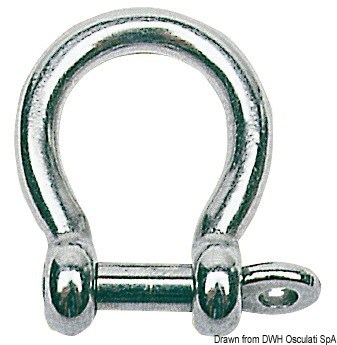 Stainless steel cetra shackle d 16 mm – code: 08.421.16 – Osculati
 Stainless steel recessed hinge pin d. 8 – code: 01.080.08 – Osculati
 Stainless steel D shackle 8 mm wide – code: 08.325.08 – Osculati
How to set up effective maintenance for carabiners/shackles/swivels
The carabiners/shackles/swivels maintenance does not have to be complex to be useful. The goal is to catch early signals indicating loss of functionality or incompatibility with the system.
An essential routine can include:
- visual inspection checking for deformations, wear, and signs of rubbing;
- checking the closure and ease of operation;
- checking rotation, if present, without abnormal sticking;
- inspection of mating parts to identify ovalizations or play;
- cleaning the connection point when dirt or residues hinder movement.
The frequency of checks depends on the intensity of use, the environment, and the criticality of the connection. In contexts with humidity, dust, residues, or frequent movements, the inspection should be more thorough. If you notice a change in the component's behavior, do not wait for the next check: immediately verify the source of the problem.
One last often overlooked aspect concerns internal traceability of replacements. Even without complex procedures, noting when a component was changed and why helps understand if the problem is normal wear or incorrect choice of connection.
If you are considering a replacement or want to find the most suitable solution among connections, spare parts, and compatible accessories, explore the dedicated category or consult the brand pages of the store: you will find useful references to select components consistent with your use and simplify the next order.
FAQ
How to understand if the problem concerns the carabiner, the shackle, or the swivel and not the connected component?
Observe the complete system. If you notice play, friction, or irregular rotations, also check terminals, slots, pins, and contact points. Often the visible defect on the connection depends on deformations or incompatibilities of the mating part.
When is it better to replace a component instead of continuing to use it?
If there are deformations, imprecise closures, obvious wear, blocks in rotation, or signs of abnormal rubbing, it is advisable to stop and check for replacement. If you have doubts about the correct features, check the product sheet.
Is it correct to choose the size by comparing it only with the component already installed?
Not always. The existing component may have been chosen roughly or work under non-optimal conditions. It is better to detect the actual installation point, check the dimensions, and compare the technical data available on the product sheet.
What is the most common mistake during installation?
One of the most common mistakes is mounting the joint with an unfavorable orientation, creating lateral forces, interferences, or limitations in opening and rotation. Even a correct component can malfunction if installed in an unsuitable position.
Does the maintenance of carabiners/shackles/swivels require complex inspections?
No, in most cases regular and targeted checks are enough: visual inspection, closure check, movement fluidity, and condition of mating parts. The important thing is to intervene at the first signs of wear or incompatibility.


