


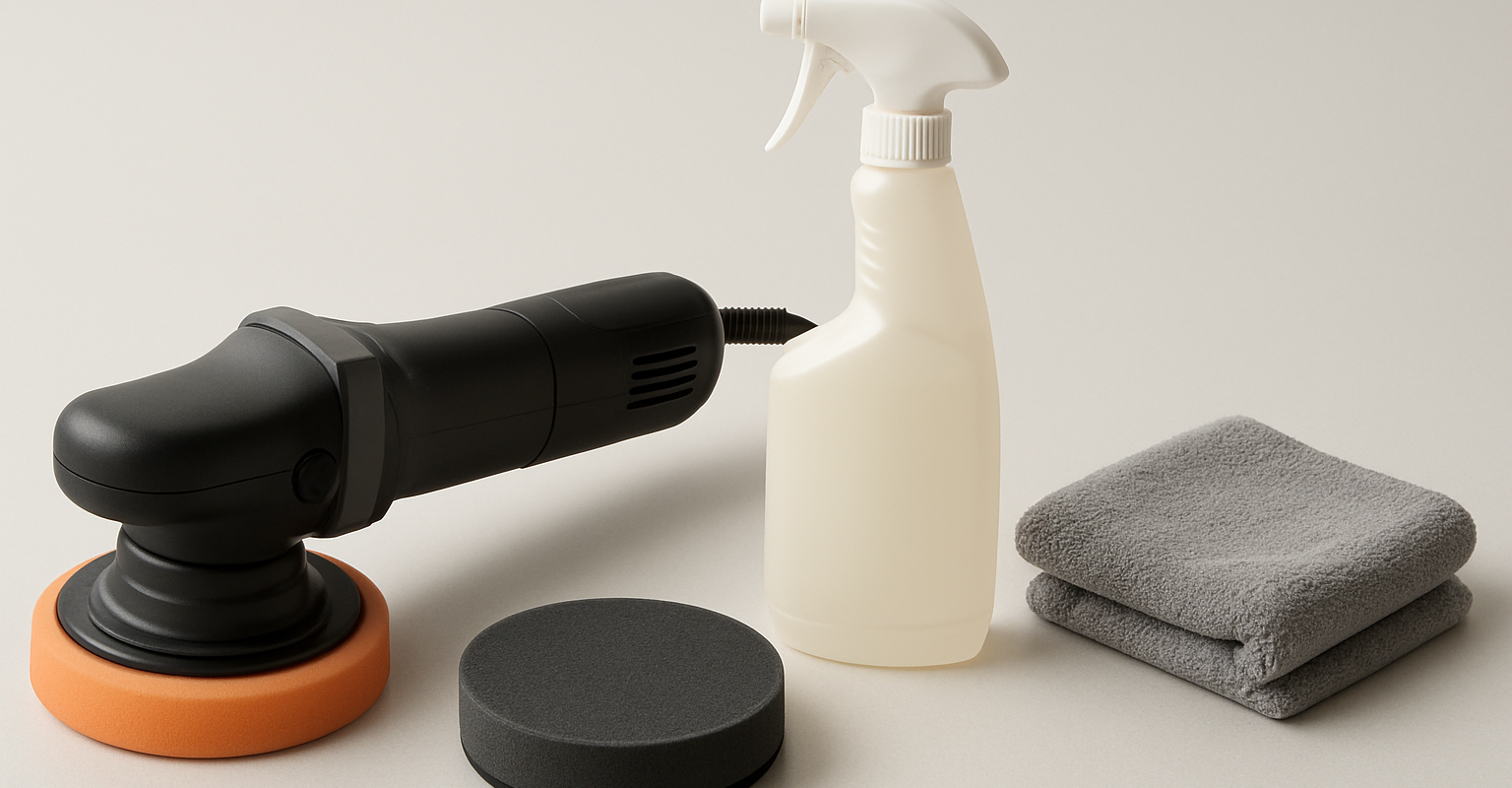
What polishing and cleaning are for in different usage contexts
Talking about polishing and cleaning means addressing two needs that, in many professional environments, go hand in hand: on one side removing residues, halos, dirt, and deposits; on the other restoring a uniform and well-kept appearance of surfaces. It's not just about aesthetics. A proper treatment routine also helps maintain a more orderly workflow, reduce contaminant buildup, and make ordinary maintenance easier.
In a polishing and cleaning guide well structured, the first step is to distinguish between three levels of use:
- Entry-level solutions, suitable for occasional use, slightly compromised surfaces, and light finishing activities.
- Professional solutions, designed for more frequent use, with greater operational continuity and the need for consistent results.
- Heavy-duty solutions, recommended when dirt, residues, or working conditions require more robust tools and accessories and a more intensive process management.
The correct choice depends on the material to be treated, the frequency of use, the type of dirt, and the required finishing level. A delicate surface, for example, does not require the same approach as a support exposed to stubborn residues or repeated processing cycles.
If your goal is to navigate between categories and applications, it may be helpful to also consult the available technical guides, to better frame differences, compatibility, and associable accessories.
When an entry level solution is enough
Entry-level solutions are often the right choice for those who need to perform simple, non-continuous interventions on surfaces that do not present particular criticalities. In these cases, practicality counts most: easy-to-handle tools, essential accessories, and a quick learning curve.
This level is suitable when:
- cleaning is light or maintenance;
- polishing is more for refreshing than correcting;
- interventions are occasional;
- working on limited areas or on materials that are not particularly stressed.
The limit of these solutions emerges when the workload increases or when the required result must be more uniform and repeatable. In that case, moving to a professional range often becomes the most efficient choice.
When it is worth moving up a level
Professional solutions represent the balance point for many operational realities. They offer greater continuity of use, better adaptability to different contexts, and more reliable management of polishing and cleaning maintenance. They are ideal for those who work regularly and want to reduce errors, downtime, and uneven results.
Heavy-duty configurations, on the other hand, come into play when the environment is more demanding: stubborn residues, highly exposed surfaces, intensive cycles, or the need for dedicated accessories. In these cases, it is not enough to “clean better”: a coherent system is needed, with compatible components and a careful evaluation of the material to be treated.
Compatibility, sizes, and technical checks to choose well
One of the most common mistakes when selecting polishing and cleaning items is focusing only on the category, without checking the actual compatibility with the application. surface, intensity of use, compatible accessories e operating methods.
Before purchasing or integrating into an existing process, it is advisable to check:
- the type of material being worked on;
- the presence of delicate or sensitive finishes;
- compatibility with supports, tools, or accessories already in use;
- the intended use specified by the manufacturer;
- the usage and maintenance instructions provided in the technical documentation.
When a detail is not immediately clear, the best rule is simple: check the product sheet. This is especially true for attachments, diameters, supports, usage methods, and recommended or discouraged materials.
Different surfaces require different approaches
Not all surfaces react the same way to a polishing or cleaning procedure. Smooth, porous, painted, metallic, or composite materials may require different accessories and steps. A solution suitable for a resistant surface could be too aggressive on a more delicate support.
For this reason, a good polishing and cleaning guide does not just distinguish between product levels but encourages evaluating the real context of use. If you work on heterogeneous materials, it may be useful to opt for more versatile systems or to provide dedicated accessories for each phase.
To delve deeper into the topic of choice by material and application, you can also consult professional maintenance solutions and compare the families of items best suited to your operational flow.
Measurements, attachments, and configurations: what to check
When it comes to compatibility, measurements matter. Even without entering unconfirmed specifics, it is essential to verify that the chosen system is consistent with the equipment already present. An incompatible accessory can cause improper assemblies, premature wear, or simply a result not aligned with expectations.
Before proceeding, always check:
- attachment or connection interface;
- format of the accessory or support;
- declared intended use;
- any usage limits indicated by the manufacturer;
- need for spare parts or complementary components.
If you are considering an upgrade from entry level to professional or heavy duty, this step is even more important: the category jump only makes sense if the entire system remains consistent.
Typical errors in ordering or installation in polishing and cleaning
Many problems do not arise from the product itself, but from a hasty choice or an unchecked installation. In practice, the most frequent errors repeat with some regularity and can compromise both the quality of the work and the durability of the accessories.
Choosing based on habit rather than application
A common mistake is always buying the same type of solution just because “it has always worked.” In reality, different surfaces, different dirt, and different usage frequencies require different approaches. An entry-level solution may be suitable for light activities but become limiting in a continuous professional context. Similarly, a heavy-duty configuration is not automatically the best if the work requires control, precision, and delicacy.
Neglecting routine maintenance
La polishing and cleaning maintenance this does not only concern the intervention on the surface but also the care of the tools and accessories used. Accumulated residues, worn components, or no longer efficient supports can worsen the final result and make the treatment less uniform.
A good routine includes:
- visual inspection before and after use;
- cleaning of accessories according to the provided instructions;
- timely replacement of consumable components;
- compatibility check after each configuration change.
For those managing recurring processes, it may be useful to also integrate into the process compatible accessories and spare parts, thus avoiding interruptions and maintaining consistent operational quality.
Quick assembly without preliminary checks
Another typical mistake is proceeding with assembly without checking that all elements are correctly matched. Even when the component seems to “fit,” this does not mean it is suitable for the intended use. In case of doubts about attachments, supports, or materials, it is always preferable to stop and check the product sheet.
This approach reduces the risk of wrong purchases, avoidable returns, and operational downtime. It also helps build a more organized equipment, especially when working with multiple surfaces or in different departments.
Products, spare parts, and accessories useful for a more effective choice
In a store-driven logic, the value is not only in identifying a category but in building a sensible combination between main products, spare parts, and accessories. Polishing and cleaning work better when every element of the system is designed for the real context of use.
Those starting from an entry-level solution often tend to consider only the main component. In a professional context, however, it is advisable to think from the start about everything that may be needed over time: supports, spare parts, accessories for different surfaces, and components useful for routine maintenance.
The advantages of this approach are concrete:
- greater operational continuity;
- lower risk of downtime due to wear or incompatibility;
- more organized management of replacements;
- better adaptation to different processes.
If you want to compare connected product families, you can also explore the selection of cleaning and finishing components and evaluate which accessories best complete your setup.
How to move from entry level to professional without mistakes
Upgrading to a higher-level solution should not happen just because the catalog offers a wider range. It makes sense to do so when needs change: more frequency, more surfaces to treat, more work continuity, or greater attention to uniformity of the result.
To choose wisely, ask yourself:
- how often polishing and cleaning are performed;
- if the treated material is always the same or varies;
- if spare parts are regularly needed;
- if the current accessory shows limits over time or in effectiveness;
- if the process requires more structured maintenance.
These questions help to understand whether to stay with an essential solution, move up to a professional range, or opt for a heavy-duty configuration.
When accessories really make the difference
In many applications, the result depends less on the general category and more on the correct matching with accessories. A well-configured system allows adapting the work to the surface, the operational phase, and the required finishing level. Even in this case, however, it is essential to avoid improvised combinations: every component must be compatible with the whole.
For those who want a broader overview of the options available in the store, it can be useful to consult the categories related to maintenance systems and compare solutions based on actual use, not just the brief description.
Recommended products
the brand pages with maintenance and finishing lines


Choosing the polishing and cleaning solution best suited to your work
An effective choice always arises from a balance between surface, frequency of use, compatibility, and maintenance needs. Entry-level solutions are useful for simple and occasional uses; professional ones better meet continuous needs; heavy-duty configurations become relevant when the context is more demanding and requires greater system robustness. If you want to identify the category or brand best suited to your operational flow, explore the store sections dedicated to polishing and cleaning and compare product sheets to build a coherent, complete, and ready-to-use configuration.
FAQ
How to understand if a polishing and cleaning solution is entry level, professional, or heavy duty?
The distinction mainly depends on frequency of use, type of surface, work intensity, and operational continuity needs. Entry-level solutions are suitable for light and occasional uses, professional ones for regular uses, while heavy-duty are more indicated for demanding contexts. In case of doubt, check the product sheet.
What checks to make before ordering polishing and cleaning accessories?
It is advisable to check the material to be treated, compatibility with supports and attachments already in use, intended use, and manufacturer’s instructions. If you are integrating the component into an existing system, check all relevant technical details in the product sheet.
Does the maintenance of accessories affect the final result?
Yes, very much. Proper polishing and cleaning maintenance helps maintain consistent results, reduces uneven wear, and limits problems caused by residues or worn components. It is useful to regularly check and clean accessories and replace worn ones when necessary.
Is it possible to use the same configuration on different surfaces?
Not always. Different surfaces may require specific accessories or operating modes. Using the same setup on different materials without checks can lead to inconsistent results or unsuitable treatment. The best choice is to always check the declared compatibility.
When is it convenient to switch from a basic solution to a professional one?
The switch makes sense when the frequency of use increases, the variety of surfaces to be treated, or the need to achieve more consistent results. If a basic solution shows limits in operational continuity or maintenance management, a professional range may be more suitable.


