


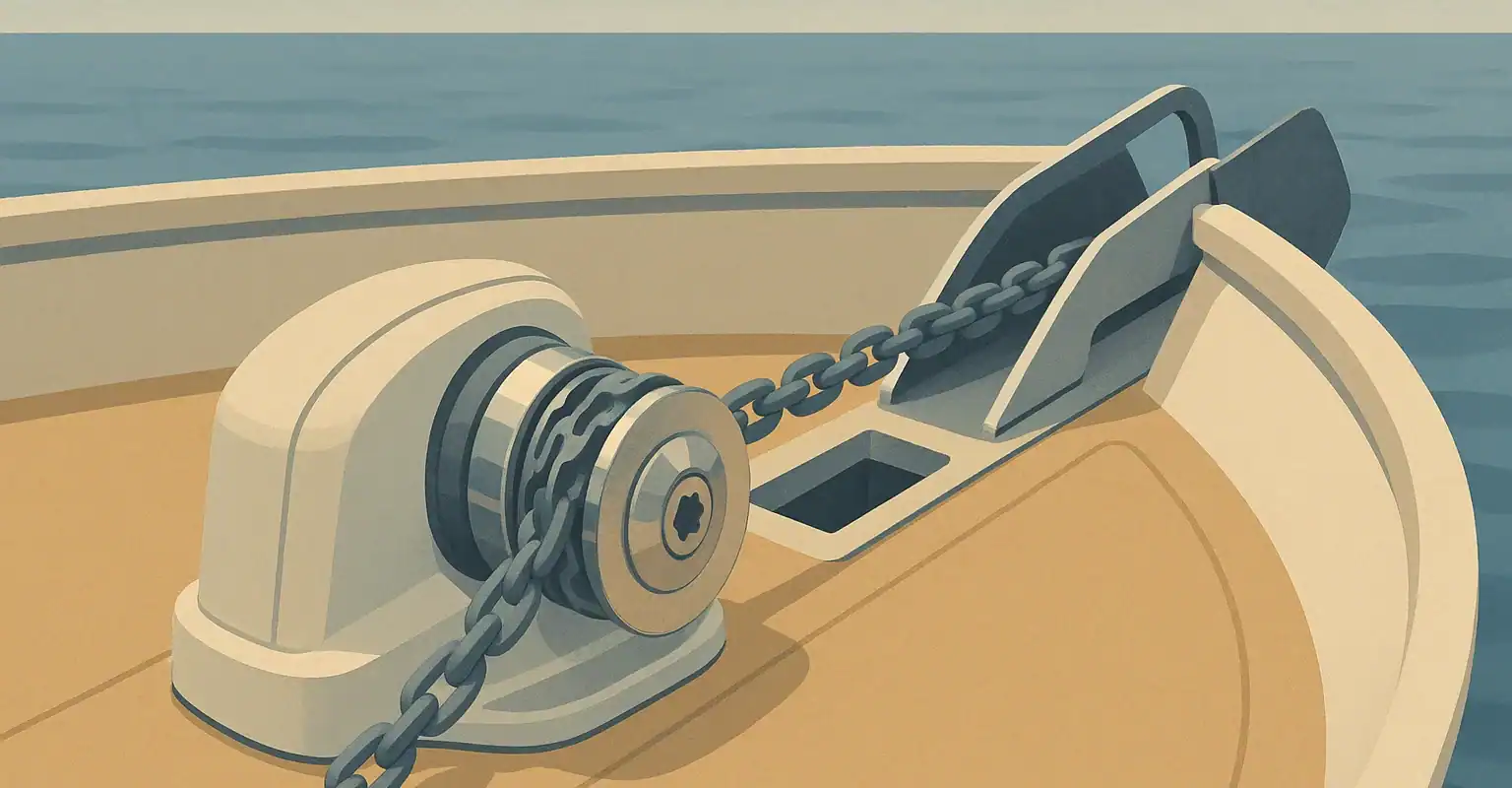
Choosing an electric anchor winch is never a one-size-fits-all matter: it is a technical sizing that starts from the weight of the boat, goes through the length of the chain, and often ends up being wrong precisely at the most trivial point, the coupling between the sprocket and the chain. Those who work in the shipyard know this well: most assistance requests for these winches arise from a mechanical compatibility error, not an electrical failure. Let's see how to set the choice correctly, from the motor to maintenance.
How an electric anchor winch works
An electric anchor winch consists of three functional elements that must work in balance with each other: the electric motor (12V or 24V), the epicyclic or worm gear reducer, and the sprocket, the toothed pulley that engages the chain links, transforming rotation into linear traction.
Motor, reducer, and sprocket
The motor provides the torque, the reducer multiplies it by reducing the rotational speed, and the sprocket transfers it to the chain. On this system, as on any marine winch the critical factor is not so much the installed electrical power as the ability to develop pull under continuous load, with the hull drifting and putting the chain under jerky tension, not constant traction.
The sprocket is the element that must be chosen with the most care because it is specific for a certain pitch and diameter of chain: it is not a universal component, and this is the first point to which we will return.
Anchor winch power: the nominal pull rule
The most frequent question that arrives at the shipyard is “how many watts do I need?” The correct answer does not start from the motor power but from the required nominal pull, expressed in kg or daN, which must be proportional to the combined weight of the anchor and the immersed chain.
The practical rule adopted by manufacturers is simple:
- the nominal pull of the winch must be at least 3 times the total weight of the anchor plus the length of chain normally used underwater;
- the maximum pull (peak, for a few seconds) must guarantee an additional margin to overcome the initial inertia and the stuck seabed;
- the electrical power of the motor, consequently, must be chosen based on the required pull and not vice versa.
For a rigid inflatable boat or a cabin boat up to 6-7 meters, with an 8-10 kg anchor and 8 mm chain, an anchor winch in the 700W range like the Quick DP2 P 712 windlass offers an adequate margin without oversizing the onboard electrical system.
On heavier boats, between 9 and 12 meters, where the anchor exceeds 15-20 kg and the chain goes up to 10 mm, the power jump becomes necessary: a model like the Quick DP3 1512D vertical anchor winch, at 1500W, guarantees the required pull margin even in rough sea conditions or muddy seabeds.
Common mistake to avoid
Undersizing the power to contain electrical consumption is the most costly mistake in the long term: the motor always works at the limit, heats up, and the lifespan of brushes and bearings drastically reduces after a few years of seasonal use.
Calibrated sprocket and chain: the most common mistake
If there is one point where 90% of wrong purchases concentrate, it is here: the sprocket is not interchangeable between chains from different manufacturers or standards, even with the same nominal diameter.
Chains calibrated for nautical use mainly follow two standards:
- ISO 4565, widespread in Europe and used by most Italian shipyards;
- DIN 766, German standard with slightly different ring geometry, not always compatible with sprockets calibrated to ISO 4565.
The most common diameters for small and medium boating are:
- 6 mm – dinghies and boats up to 5-6 meters, light anchors;
- 8 mm – cabin cruisers and sailboats up to 8-9 meters;
- 10 mm – motorboats and sailboats between 9 and 13 meters, with anchors over 15 kg.
Before ordering a winch, or even just a replacement chain, it is essential to check the technical sheet of the sprocket already installed: a half-millimeter error in pitch causes slipping, chain jumps, and accelerated wear of both the chain and the mechanical component. Those who deal with mooring and anchoring equipment know that this check must always be done before purchase, not after.
Cable sizing and circuit breaker
Anchor winch motors, especially at startup, draw very high currents, even 4-5 times higher than the continuous operating rate. This requires precise system choices:
- cable section: must be calculated based on the actual length of the battery-winch path, not just the nominal current, to avoid voltage drops that reduce motor torque precisely when it is most needed;
- circuit breaker or fuse: sized to tolerate the startup peak without tripping, but capable of intervening in case of prolonged mechanical blockage;
- dedicated battery: when possible, a service battery separate from the engine battery avoids voltage drops that also compromise onboard electronics during maneuvering.
An undersized wiring system is the most common cause of winches that “seem weak” despite having the correct power on paper.
Control: control panel, remote control, deck foot switch
The choice of control affects the safety and convenience of solo maneuvering. The most common options are:
- fixed bow control panel, economical but requires the operator to be onboard near the winch;
- foot control on the bow cockpit, useful for those maneuvering with hands occupied by the line;
- radio remote control, convenient on medium-large boats where the helmsman must manage both anchor and engine simultaneously;
- helm control, which integrates the anchor winch function into the main control panel, as in the case of Quick windlass deck command, designed for those steering from the helm who want to keep the maneuver in sight without moving to the bow.
Maintenance: fresh water and sacrificial anode
The lifespan of an electric windlass largely depends on regular care, often neglected because the component works “out of sight” at the bow.
The essential operations to schedule at the end of the season are:
- rinsing the gypsy, chain, and chain locker with fresh water to remove salt and sediments that accelerate corrosion;
- checking and replacing the sacrificial anode, a critical component for cathodic protection in saline environments like those in Sicily and the Mediterranean in general;
- checking the tightness of the grease fittings and the motor shaft seal, a typical point of infiltration;
- visual inspection of the gypsy wear, especially if the chain shows signs of elongation or ring deformation.
A chain, according to the classic definition also reported by the Treccani dictionary, works under cyclic tension and not continuous: it is precisely this intermittent stress regime that, if the gypsy is not properly calibrated, causes the fastest and most unpredictable wear.
Frequently asked questions about the electric windlass
What power should a windlass have for a 6-meter inflatable boat?
For an inflatable boat of this size, with an anchor between 6 and 10 kg and a 6-8 mm chain, a model in the 500-700W range is generally sufficient, provided the electrical system is properly sized for cables and circuit breaker.
Can I install a different gypsy from the original on my winch?
No, not without verifying compatibility of pitch, diameter, and reference standard (ISO 4565 or DIN 766). A non-compliant gypsy causes chain slippage and accelerated wear of both the component and the chain itself.
How long should the chain be relative to the anchoring depth?
The classic rule indicates a ratio of at least 3:1 between chain paid out and water depth under normal conditions, increasing to 5:1 or more with strong wind or weak seabed.
How often should the sacrificial anode of the windlass be checked?
It is good practice to inspect it at least once per season, or more frequently if the boat remains in water all year in a high salinity environment, replacing it when consumption exceeds 50% of the original volume.
Is a dedicated battery needed for the electric windlass?
It is not mandatory, but strongly recommended on medium-large boats: a separate service battery prevents voltage drops during motor startup that could interfere with onboard electronics or other active electrical services during maneuvering.


