


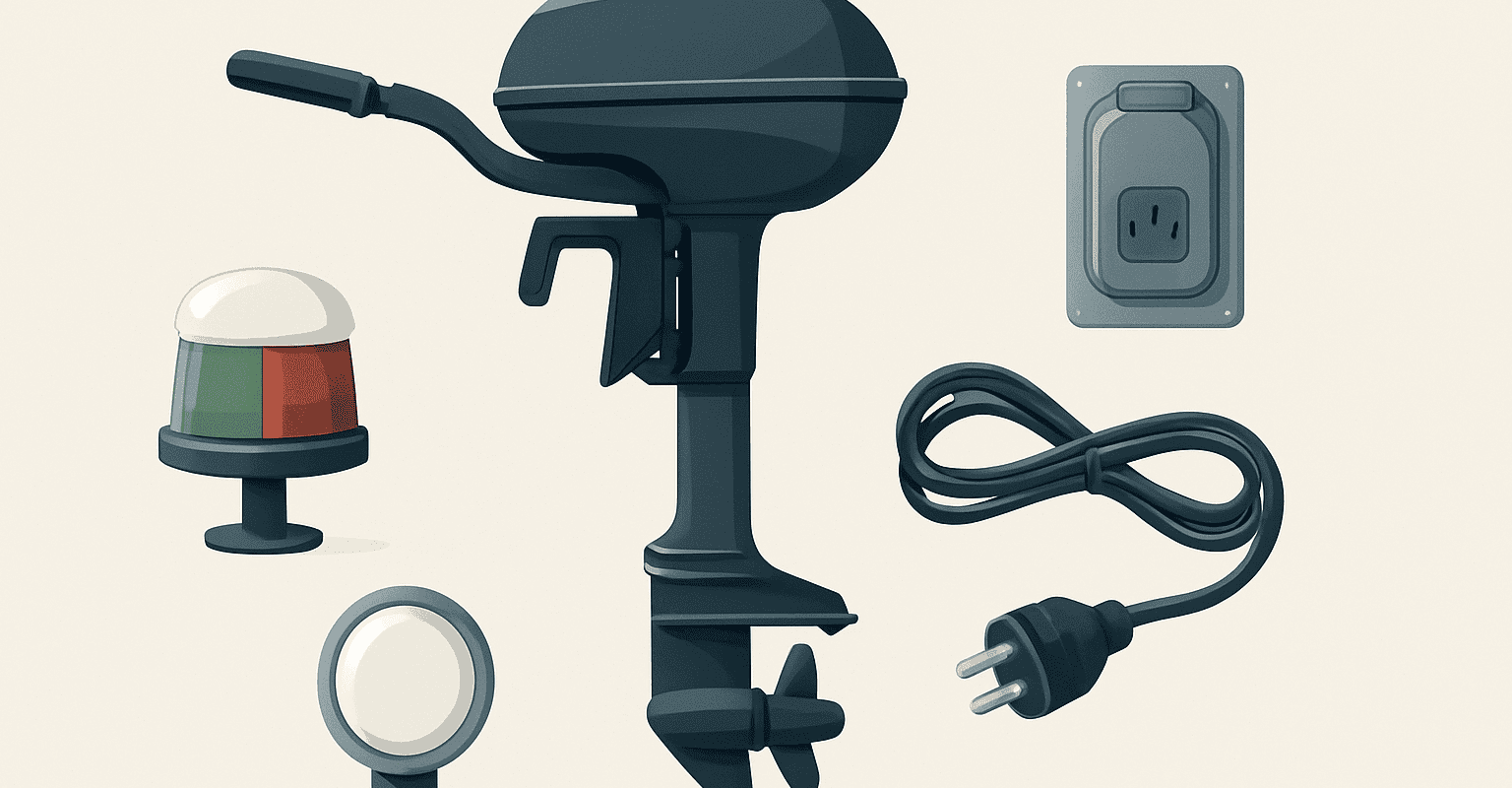
When you really need the electric boat motor
Talking about electric boat motor only as an alternative to the main propulsion is limiting. In many cases, the choice arises from very practical needs: more controlled maneuvers, silent movements, simpler management of onboard power consumption, and integration with the existing electrical system. The critical point, however, is that the motor never works alone. It interacts with lights, beacons, wiring, plugs and sockets, batteries and control instruments.
This is exactly where the most frequent mistakes arise. There is a tendency to evaluate the motor as an isolated component, while onboard every electrical element influences reliability, safety of use, and continuity of operation. An orderly and coherent system avoids anomalies that, at first, seem small: a socket that heats up, a light that flickers irregularly, a voltage drop during startup, or a connection that loosens with vibrations.
If you are setting up or upgrading the system, it can be useful to also explore the topic of onboard electrical components, so as to evaluate the engine in the correct context and not only based on thrust or installation form.
The electric motor really becomes the right choice when:
- precise management of maneuvers in tight spaces is needed;
- you want to reduce noise and vibrations perceived onboard;
- the electrical system is already set up or can be organized coherently;
- you want an orderly distribution of loads between utilities and propulsion;
- attention is paid to the compatibility between connections, power supply, and accessories.
In practice, the real dividing line is not just “do I need an electric motor?”, but rather: is my system ready to make it work well together with lights, lamps, sockets, and connections?
Electric boat motor compatibility: what to check before buying
Research on electric boat motor compatibility is often the smartest starting point. Many recurring problems actually stem from an incomplete assessment of the connections and components already onboard. Before choosing, it is advisable to check some essential aspects in the product sheet and compare them with the actual system.
Electrical compatibility with batteries and onboard distribution
The first check concerns the consistency between motor, batteries, cable sections, and distribution points. An electric motor can only operate correctly if the power supply arrives steadily and without abnormal losses. If the system has been expanded over time, it is common to find improvised connections, non-uniform terminals, or lines shared with other sensitive utilities.
When the engine, navigation lights, running lights, instruments, and auxiliary sockets coexist on the same network, a poorly organized design can cause:
- noticeable voltage drops on multiple devices;
- flickering of the lights during the use of other loads;
- overheating at undersized connection points;
- false contacts that are difficult to identify;
- premature wear of plugs and sockets subjected to frequent insertions.
To reduce these risks, it is useful to also check the layout of the panel and connections. On this topic, an overview dedicated to wiring, connections, and electrical accessories can help.
Mechanical compatibility and mounting position
Another common mistake is focusing only on the electrical part, neglecting the physical installation. The position of the engine affects cable routing, socket protection, and the ease with which connections can be inspected. If a plug is mounted in an area exposed to splashes, impacts, or continuous cable bending, the issue is not “if” it will occur, but “when”.
Check therefore:
- available space for the cable bending radius;
- accessibility of plugs and sockets for insertion and disconnection;
- distance from lights, switches, and other sensitive components;
- protection of contact points from moisture and mechanical stress;
- consistency between supports, brackets, and the mounting area.
Compatibility with lights, lamps, plugs, and sockets
The focus on lights, headlights, plugs, and sockets is not secondary: it is one of the most underestimated issues. In many installations, the engine is added to a system originally designed for other devices. The result is a network that holds up on paper but shows limitations in daily use. A socket not suitable for the type of load or a lamp connected to an already stressed line can cause intermittent malfunctions, the hardest to diagnose.
If you are upgrading the system, it can be useful to also compare solutions dedicated to lights and lamps for the boat, so as to maintain consistency between power supply, connections, and points of use.
Mistakes to avoid when choosing or installing the electric boat engine
The most costly mistakes do not always depend on the engine itself. They often arise from details considered minor during selection or installation. Here are the most frequent, with a practical approach.
Choosing the engine without reading the existing system
The first mistake is buying the engine and only afterwards wondering how to actually connect it. Every boat has a technical history: subsequent modifications, added utilities, replaced connections, adapted lines. Without reading the real system, the risk is creating an unbalanced system.
How to avoid it: before purchase, map the utilities already present, identify the dedicated lines and check the connection and installation requirements in the product sheet.
Using plugs and sockets not consistent with the application
An apparently simple connection can become the weak point of the entire system. Plugs and sockets installed without criteria, worn out or not suitable for the marine environment are among the most common causes of interruptions, overheating and false contacts. The problem worsens when the engine is frequently connected and disconnected, perhaps in the presence of humidity or salt residues.
How to avoid it: choose connections suitable for the intended use, periodically check the condition of the contacts and do not underestimate the tightening of the terminals. If in doubt, check the intended use of the component in the product sheet.
Neglecting the quality of light and lantern connections
Many users notice the problem only after installing the engine: less stable lanterns, lights that dim under certain conditions, switches that seem to operate irregularly. In reality, the defect was often already present but becomes evident when a new load is added to the system.
How to avoid it: check junctions, terminal blocks, ground returns and the general condition of the light connections. A lantern that works “almost always” is already a signal not to ignore.
Routing cables through inconvenient or stressed areas
A well-chosen cable but poorly laid quickly loses reliability. Too tight bends, rubbing, crushing points and passages near moving components are among the most common causes of progressive failures. The same applies to sockets installed in hard-to-reach positions: difficulty of use often leads to forcing and premature wear.
How to avoid it: plan the cable route before final assembly and always leave accessible the points that require inspection or maintenance.
Confusing an engine problem with a system problem
When something doesn’t work, the engine is often immediately blamed. In reality, many defects depend on unstable power supply, oxidized connectors, loose sockets or lines improperly shared with other utilities. This leads to unnecessary replacements and wasted time.
How to avoid it: before attributing the fault to the engine, check the entire chain: power source, line, connections, switches, plugs, sockets and the condition of connected utilities.
Recurring problems with lights, lanterns, plugs and sockets: how to recognize them immediately
A well-organized system communicates problems before complete failure. Knowing how to read the symptoms is essential to intervene in time and limit discomfort on board.
Lights that change intensity during engine use
If the lights vary in intensity when the engine starts, there is likely a critical issue in the electrical distribution or connections. It does not always mean a serious fault, but it is a clear signal of a system to check.
The most common causes are:
- shared lines without effective separation of utilities;
- connections with abnormal resistance;
- plugs or terminals not perfectly tightened;
- wiring that is outdated or modified multiple times.
Intermittent or unreliable lights
I beacons that work sporadically are almost never a problem to postpone. In a nautical environment, intermittency is often linked to oxidation, vibrations, or mechanically unstable contacts. If the defect appears after the installation of the electric motor, it is not necessarily the motor's fault: it may have simply revealed a pre-existing weakness.
Plugs and sockets that loosen or heat up
Among the signals not to ignore are loose insertion, the feeling of mechanical play, or abnormal heating near the connection. In these cases, you need to stop and immediately check the connection status. Continuing to use an unstable socket means increasing the risk of repeated failures and loss of reliability of the entire system.
For a broader view of the available solutions, it can be useful to also consult a section dedicated to nautical plugs, sockets, and connectors.
Products and categories to consider for a more reliable system
When evaluating a electric boat motor, it is not enough to compare just one category. A comprehensive view is needed because reliability comes from the integration of multiple elements. The categories to consider are those that directly affect the continuity of the connection, onboard visibility, and ease of maintenance.
In particular, it is advisable to pay attention to:
- components for electrical distribution and line control;
- lights and signals compatible with the system layout;
- plugs and sockets designed for frequent connections or exposed environments;
- connection accessories useful for keeping wiring organized;
- support elements for clean and inspectable installations.
The advantage of thinking in categories is simple: it avoids disconnected purchases and builds a coherent system, easier to control over time. If you are comparing multiple solutions, it may be useful to also explore instrumentation and accessories for system management, so as to complete the picture before the final choice.
Another often overlooked aspect is future maintenance. A well-designed system is not only one that works today but one that you can easily check tomorrow. Accessible connections, organized cable routes, and coherent components reduce diagnosis times and make it easier to intervene when an anomaly appears.
Recommended products

 10" Wound Wire Cartridge 20 micron – code: 10MP20 – Idromar
 Stainless steel clamps Norma 12–22 mm – code: FAI0012022 – Toscogomma
 Brush with spring - code: SGM45 - Gianneschi Pumps and Blowers



How to avoid problems over time with the electric boat motor
Prevention is much more effective than intervening after a failure. In the case of the electric boat motor, the difference is made by simple but regular checks, especially at the contact points between the motor and the rest of the system.
Here is a useful routine:
- periodically inspect plugs, sockets, and terminals;
- check that the lights maintain stable operation;
- verify that cables do not show crushing or abrasion;
- observe any changes in the behavior of the lights during engine use;
- keep the wiring paths organized to facilitate any subsequent checks.
An orderly approach also helps distinguish real problems from false alarms. If the engine seems to lose continuity, but at the same time you notice instability in lights or headlights, it is likely that the fault is upstream, in the distribution or connections, not in the engine itself.
If you want to improve the reliability of the system and choose components that are consistent with each other, explore the category dedicated to electricity and instrumentation or delve into the available brands: it is the most practical way to find solutions compatible with your onboard configuration.
FAQ
How to check the compatibility of an electric motor for boats with the existing system?
It is advisable to check the power supply, line distribution, wiring condition, type of connections, and the presence of already connected devices such as lights and headlights. If any information is unclear, check the product sheet.
Why can the onboard lights become unstable after installing the electric motor?
Usually the problem does not depend solely on the engine, but on weak connections, shared lines, or inadequate sockets. Adding the engine can highlight a defect already present in the system.
Do shafts and sockets really affect the reliability of the electric boat motor?
Yes. They are among the most critical points of the system because they undergo repeated insertions, vibrations, and humidity. An unstable contact can cause interruptions, overheating, and false faults attributed to the motor.
What are the signals not to ignore in the headlights and onboard lights?
Intermittency, intensity variations, irregular ignitions, and inconsistent operation are signals to check immediately. They often indicate connection problems, oxidation, or suboptimal electrical distribution.
How to avoid mistakes when choosing the electric motor for boats?
Before purchasing, analyze the actual system, check the connection points, verify compatibility with plugs and sockets already present, and also consider integration with lights, headlights, and onboard electrical accessories.


