


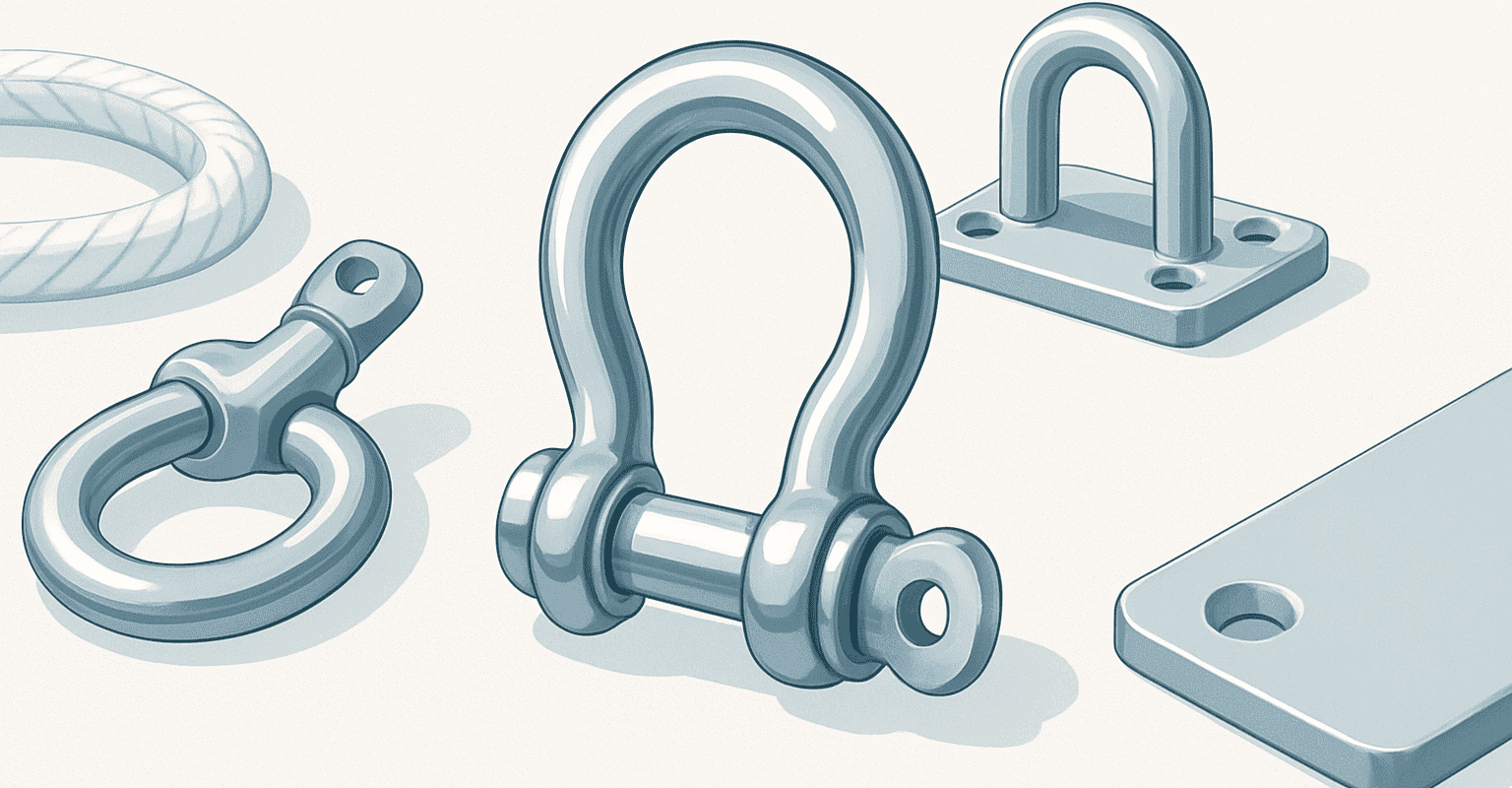
When nautical hardware shackles are really needed
In deck work, routine maintenance, and the most exposed fittings, the nautical hardware shackles are not just simple connecting accessories. They are components that affect the continuity of a maneuver, ease of assembly, and the correct interface between different elements such as ropes, chains, eye bolts, cleats, blocks, and anchor points. For this reason, a choice made only “by eye” often leads to incompatibilities, premature wear, or poorly functional assemblies.
The first point to clarify is the context of use. A shackle used on deck to connect movable accessories has different requirements compared to one used in a more static point of the equipment. Indeed, the frequency of opening, ease of inspection, exposure to salt and dirt, as well as the type of load transmitted by the system, change. In a well-structured nautical technical guide the correct question is not only “which shackle to choose?”, but above all “with which other element must it work?”.
In practice, the cases where it is necessary to carefully evaluate this hardware are mainly these:
- connections between components with differently shaped eyes;
- points where periodic opening is required for inspection or replacement;
- pairings between metal and textile parts;
- installations where the size of the connection influences movement;
- situations where the correct orientation of the pin prevents twisting or rubbing.
A common mistake is to consider the shackle as a neutral element. In reality, its geometry changes how the load is distributed and how the components align. If, for example, the connection works off-axis or in a confined space, a seemingly compatible shape can become difficult to assemble or unstable over time. That is why, among the best nautical technical guides, the truly useful ones are always oriented to the real application and not just to the description of the piece.
To delve deeper into the topic of onboard fittings, it can be useful to also consult the technical guides dedicated to hardware, along with content on deck accessories and connections, so as to evaluate the shackle within the system and not as an isolated part.
Differences between solutions, sizes, or compatibility in nautical hardware shackles
When comparing different nautical hardware shackles, the difference is not only about size. The real discriminant is the compatibility with the fixing point and the connected component. In other words, the central issue is not to find a “bigger” or “stronger” shackle, but to find one that works consistently with the geometries, thicknesses, and freedom of movement required by the installation.
Body shape and working space
The shape of the shackle affects the available internal width and how the connection settles under stress. When there are wide eyes or elements that need to move with a certain degree of freedom, a solution with a more generous internal volume can facilitate proper alignment. Conversely, in areas where space must be contained, a more compact shape may be more suitable.
From this arises one of the most searched topics online: nautical hardware shackles compatibility. Real compatibility is not only verified by comparing the nominal size, but by observing:
- diameter and shape of the eye to be connected;
- thickness of the anchoring point;
- need for rotation or articulation of the connection;
- available space for insertion and closing of the pin;
- possible contacts with other nearby parts.
Pin, closure, and ease of intervention
Another technical aspect concerns the closing system. In some applications, it is important to be able to open and close the connection quickly during maintenance or equipment adjustment. In others, stability of the assembly over time and reduction of the risk of unintentional loosening are more important. The correct choice therefore depends on the accessibility level of the point and the frequency of expected interventions.
If the shackle is in an easily reachable area, convenience can have greater weight. If instead it is installed in a less convenient spot or subject to vibrations and continuous movements, it is advisable to carefully evaluate the type of closure and the behavior of the assembly during use. For specific construction details, check the product sheet.
Compatibility between materials and the marine environment
In onboard hardware, the material should not be considered only in aesthetic terms. What matters is how it behaves in the marine environment and how it interacts with other system components. A shackle mounted together with chains, deck accessories, or different attachments must also be evaluated for continuity of use and consistency with the rest of the setup.
This point is often underestimated in quick searches, but in the nautical technical guides more complete ones it is central: compatibility is not only mechanical, it is also functional. A theoretically correct connection can become impractical if it traps dirt, is difficult to inspect, or performs poorly in the presence of repeated movements.
How to truly read a measurement
When comparing solutions, the measurement should not be interpreted as an isolated datum. It is necessary to understand which part of the shackle it refers to and how that dimension affects the actual assembly. Two items apparently close in size can behave very differently if internal clearance, body bulk, or pin proportion change.
For this reason, when analyzing the topic nautical hardware shackles compatibility, it is always advisable to start from the component to be connected and not from the shackle itself. First, the shape and space of the attachment point are measured, then it is verified whether the shackle allows a clean assembly, without forcing and without abnormal contacts. If doubt remains, check the product sheet and compare the technical drawing with the real application.
Mistakes to avoid in choice or assembly
Many problems do not arise from a defect in the component, but from an inaccurate selection or an assembly carried out without considering the system's behavior. In the case of nautical hardware shackles, the most frequent errors are repetitive and often avoidable with a preliminary check of a few minutes.
Choosing based solely on visual similarity
One of the most common mistakes is replacing an existing shackle with a “similar” one, without verifying if the new element maintains the same useful geometry at the working point. Onboard, a few millimeters of difference can change the load orientation or the freedom of movement of the connection. The result is a coupling that physically fits in place but works poorly.
Ignoring the working direction
A correctly dimensioned shackle can still be inadequate if the load direction is not consistent with its configuration. When the system tends to work off-axis, the connection can lose smoothness or create unwanted contact points. In these cases, it is useful to observe the behavior of the assembly not only when stationary but also during the movement of the equipment.
Neglecting accessibility and maintenance
Another common mistake is positioning the shackle so that the pin remains difficult to reach. This complicates periodic checks and makes any subsequent interventions more uncomfortable. In an environment like the nautical one, where preventive maintenance is very important, ease of access is a technical criterion, not a secondary detail.
Before assembly, it is advisable to check:
- if the pin can be inserted and removed without disassembling other parts;
- if the shackle maintains sufficient freedom of movement;
- if there are edges or surfaces that can cause friction;
- if the connection remains inspectable even after installation;
- if the assembly remains neat and consistent with the onboard layout.
Using the shackle as a universal adapter
When two components are not perfectly compatible, there is sometimes a tendency to use the shackle as a compensating element. It is an apparently practical solution, but not always correct. If the connection is used to “force” the union between parts designed for different geometries, the system can only work in appearance. Over time, misalignments, friction, or opening difficulties emerge.
For this reason, the best nautical technical guides insist on a simple principle: the shackle must complete a well-thought-out connection, not correct a wrong coupling.
Products and categories to consider
Those seeking information with a comparative intent often do not just want to understand how a shackle is made, but also which categories to consider together before ordering. This approach is correct because the nautical hardware shackles are rarely chosen alone: they must be read in relation to the other components of the connection.
The categories to compare, generally, are those that define the attachment system and its behavior over time. These include fastening elements, anchor points, deck accessories, and components that transfer load or allow adjustment and movement. If you are building or upgrading a rigging setup, it can be useful to consult the section dedicated to nautical hardware, along with insights on anchors and connections and guides for choosing deck accessories.
When comparing categories, try to think in this way:
- starting point: where the shackle is fixed and with what geometry;
- connected element: what it must accommodate and with what freedom of movement;
- frequency of usethe connection will be opened often or will remain stable for a long time;
- operating environment: how exposed, wet, dirty or difficult to control the point is;
- accessibility: how easy it is to work on the pin during maintenance.
This method reduces inconsistent purchases and also helps to better read the technical data sheets. For example, if you are comparing multiple solutions and one seems suitable only in terms of size, but not in terms of bulk or orientation, the risk of incompatibility remains high. To truly evaluate the issue nautical hardware shackles compatibility, it is always best to observe the complete system.
A useful step before confirming the order is to compare the shackle with the component already installed or with a photographic survey of the mounting point. Even without complex data, this practical check allows you to understand if the pin will have enough space, if the shackle body will rotate correctly, and if the connection will remain clean and inspectable.
If you are gathering information for a more informed choice, it can also help to consult other nautical technical guides on the blog dedicated to installation, compatibility, and selection of onboard hardware.
Recommended products

 10" Wound Wire Cartridge 20 micron – code: 10MP20 – Idromar
 Brush with spring - code: SGM45 - Gianneschi Pumps and Blowers
 Stainless steel clamps Norma 12–22 mm – code: FAI0012022 – Toscogomma


Before ordering: the technical check that avoids mistakes
Before proceeding with the purchase, give a final check to the truly decisive points. Verify the shape of the attachment, the available space for installation, the type of movement required, and the ease of access to the pin. In case of doubts about measurements, materials, or configuration, the most correct choice is always a: check the product sheet. If you are comparing multiple solutions, orient yourself towards the category or brand that offers continuity of range and clear technical information, so as to build a coherent and reliable connection with the rest of the nautical hardware.
FAQ
How to check the compatibility of nautical hardware crickets with an existing attachment point?
It is advisable to check the shape and thickness of the eyelet, available space to insert the pin, required freedom of movement, and possible interference with nearby parts. If doubts remain, check the product sheet.
Does the size or the shape of the cricket matter more in nautical choice?
Both, but the shape greatly affects the actual compatibility. An apparently correct measurement may not be enough if the body of the cricket does not fit the eyelet, the direction of work, or the available space.
Is it correct to use a jumper to adapt two poorly compatible components?
Generally no. The cricket should complete an already coherent connection, not compensate for incorrect geometries. Forcing the coupling can create misalignments, friction, or assembly difficulties.
What checks to make before ordering nautical hardware crickets online?
It is useful to check the fixing point, the size of the connection, the type of closure, the accessibility of the pin, and the consistency with the other components of the system or equipment. For technical details, check the product sheet.
Why do nautical technical guides often talk about the system and not just the shackle?
Because the shackle always works together with other elements such as attachments, ropes, chains, or deck accessories. The correct choice depends on the behavior of the assembly, not on the single component considered alone.


