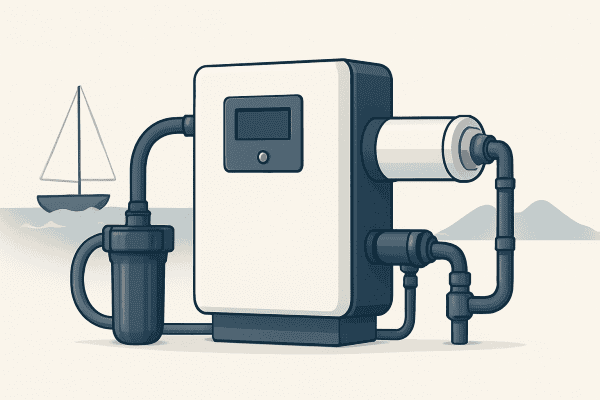
On-Board Water Treatment - Desalinators and Potabilisers for Autonomous Sailing
To sail independently you must ensure the quality and safety of water on board: knowing the operation, maintenance and limitations of desalinators and drinking water treatment plants is essential. This article guides you through the technical choices, capacity criteria and the prevention of microbiological risks so that your system will guarantee reliable drinking water during all crossings.
Importance of Drinking Water in Navigation
The availability of drinking water on board has a direct impact on the safety, health and operational capacity of your boat: you and your crew might normally consume between 50 and 80 litres per person per day for drinking, cooking and hygiene; on prolonged voyages or in emergency situations this figure can go up or, in the case of rationing, down to 20-30 L/pers./day. For a 14-day crossing with 6 people, for example, you would need over 5,000 litres if you do not optimise consumption and refills, so planning capacity and tanks is crucial.
Furthermore, water quality affects on-board health: you must monitor conductivity/TDS and microbiology before considering water safe; well-maintained systems such as reverse osmosis reduce contamination risks, while relying on limited supplies or disposable bottles increases exposure to poor hygiene and logistical costs. Water resilience is an integral part of your unit's safety plan.
Need for sustainable supply
You have to design a supply that combines storage capacity, on-board production (desalinators/watermakers) and rainwater collection: for example, a 1,500 L usable tank makes sense for a crew of 4 on weekly cruises and avoids having to depend exclusively on port calls. Provide a safety reserve (at least 30-50% of estimated consumption) and redundancy-two different sources (tanks + watermaker + rain collection) drastically reduce the risk of running out of water.
You also have to consider the energy balance: watermakers on small boats typically deliver between 10 and 60 L/hour and require power ranging from a few hundred watts to a few kilowatts for commercial systems, so integrating solar panels, batteries and intelligent shift management optimises consumption and allows you to sail independently for longer by reducing generator usage.
Environmental impacts of poor resource management
If you do not manage your supply correctly, the environmental impact is direct: you contribute plastic to the sea when you prefer bottled water instead of a functioning watermaker - a single crossing with disposable bottles can generate tens of kilograms of avoidable plastic waste. Furthermore, the inefficient use of energy to produce water increases the unit's CO2 emissions, especially if you frequently rely on diesel generators to recharge batteries or run high-powered equipment.
Proper disposal of process effluents is essential: saline concentrate (brine) discharged in roadsteads or harbours can alter local salinity and surface temperature, with negative effects on marine phanerogams and benthic communities in restricted areas. In sensitive areas such as coral reefs or poorly traded bays, concentrated discharges can reduce biodiversity and compromise key fish and invertebrate habitats.
To reduce your impact, you can take concrete measures-choose low-consumption, low-waste watermakers, dump brine on board in motion to promote dilution, use rainwater harvesting systems and reduce the use of disposable bottles: switching to on-board production and efficient tank management can reduce water-related plastic waste by more than 90% and significantly decrease the fuel dedicated to water supply.
Desalinators: Operation and Types
You can distinguish desalinators into two main families: membrane desalinators (reverse osmosis) and thermal desalinators (MED/MSF), with hybrid solutions for specific cases. In on-board practices, the choice depends on concrete factors: space and weight of the installation, availability of electricity or waste heat, and the required capacity - recreational vessels typically range from 10 to 1,500 L/day, while commercial ship installations may reach hundreds of m3/day or more.
From an operational point of view, reverse osmosis requires high pressures (for seawater about 55-70 bar) and good pre-treatment to protect membranes; thermal systems make use of evaporation and condensation and are often supplemented by engine exhaust heat. As for compliance and management, you have to consider energy consumption (modern reverse osmosis: ~3-6 kWh/m3 without energy recovery), flow rate, recovery efficiency (about 30-50% for seawater RO) and saline effluent management requirements.
Reverse Osmosis Desalinators
In your RO system, seawater is forced through semi-permeable membranes that retain salts and contaminants; this involves high-pressure pumps, pre-treatment filters (sediment and carbon), anti-scalant dosing, and pressure and quality control systems. On standard marine units, membranes typically last 2-5 years depending on feed water quality and cleaning frequency, while proper pre-treatment and periodic chemical cleaning (CIP) can drastically reduce downtime.
In addition, energy recovery devices are often installed on larger plants, which can reduce power consumption by up to 40-60%, bringing requirements to competitive values for large-scale production. You must also provide a brine discharge system with adequate flow rate and concentration: for example, with 40% recovery on 1 m3 of seawater you get ~0.4 m3 of fresh water and 0.6 m3 of brine to handle.
Thermal Desalinators
Thermal desalinators (MSF, MED) separate water and salt by evaporation and subsequent condensation; they are less sensitive to changes in salinity and turbidity and can utilise low/medium temperature heat from the engine system or dedicated generators. On merchant ships and large vessels, these technologies achieve outputs of tens to hundreds of m3/day, exploiting thermal efficiency and multi-stage (e.g. multi-effect MED) to optimise steam consumption.
For your recreational vessel, however, weight, bulk and the need for a consistent heat source make the thermal solution impractical compared to RO. The materials in contact with steam and brine (titanium, duplex steels) and the scaling and corrosion control systems significantly affect initial and maintenance costs.
In addition, you can integrate a MED with the engine cooling circuit: using service water at 70-110 °C to feed the effects results in continuous production without increasing fuel consumption; however, you must plan blowdown procedures to avoid saline concentrations and set up antiscalant dosages and inspection routines for the heat exchanger bundles, because preventive maintenance is crucial to maintain yield and system life.
Potabilisers: Technologies and Solutions
Chemical Purification Systems
If you choose chemical dosing systems on board, consider chlorine and chlorine dioxide for continuous water treatment: the practical goal is to maintain a free chlorine residual of between 0.2-0.5 mg/L for in-tank storage, while shock treatments require doses of 2-5 mg/L with contact time of about 30 minutes at room temperature to inactivate bacteria and many viruses. In addition, iodine or chlorine tablets for 1-10 L batches can be used in remote navigation; standard iodine tablets typically contain 5-8 mg of iodine per tablet and require 30-60 minutes of contact time.
Also consider ion exchange resins to remove heavy metals and improve taste: commercial cartridges for marine use have varying capacities, typically 1,000-5,000 L before regeneration or replacement depending on initial quality. Finally, integrate neutralisation systems (e.g. sodium thiosulphate) downstream if you use chlorine to avoid overdosing in the tank and monitor with DPD kits or strips to ensure residuals and compliance with IMO/WHO guidelines.
Filtration and UV Treatment
To obtain microbiologically safe water on board, combine mechanical pre-filtration (5-50 µm sediment), activated carbon for odours and organic compounds, and a 0.2-0.5 µm final membrane to retain bacteria; if you need removal of viruses and finer particles, consider ultrafiltration (0.01-0.1 µm pore size) or reverse osmosis for fresh water produced by the desalinator. Bear in mind that turbidity must be <1 NTU before UV irradiation: higher values drastically reduce effectiveness due to shadowing effect.
When combining filtration with UV treatment, aim for nominal UV doses of 30-40 mJ/cm² to ensure reliable inactivation of bacteria and viruses; select a unit whose nominal flow rate covers the output of your desalinator (e.g. a 150 L/h watermaker requires UV with a flow rate of ≥2.5 L/min and adequate lamp). Many 12 V/24 V marine systems consume between 8-40 W and offer flow rates of 1 to 10 L/min; always assess the pressure drop and the ideal position downstream of the filter stages and upstream of the storage tank.
For maintenance and reliability: replace the UV lamp every 9-12 months (approximately 9,000-12,000 hours), clean the quartz sleeve quarterly or whenever turbidity increases, and integrate a UV intensity sensor where possible. Remember that UV leaves no disinfectant residue, so if you store water in tanks for long periods, it is best to maintain a low chemical residue (≈0.2 mg/L) or provide periodic microbiological regeneration and MPN checks to avoid bacterial regrowth.
Choosing the Right System for Your Boat
You must first evaluate the navigation profile: if you sail non-stop ocean crossings you will need a reverse osmosis desalinator with continuous capacity and monitoring systems, while for coastal cruises a more compact or portable watermaker may suffice. Consider concrete data: commercial units range from 60 to 300 L/h, weigh between 30 and 120 kg and consume between 0.5 and 3 kW; furthermore, installation requires space for the pump unit, suction lines and a buffer tank. For a practical comparison and solutions already installed on board you can consult real examples such as Sail without limits: turn salt water into drinkable water with an Urania Marine desalinator, showing typical configurations and measured consumption.
Also evaluate certifications and technical characteristics: salt rejection >99%, water recovery, presence of automatic antifouling washes and pre-filtration systems (5 µm or less) to protect the membrane. If you have power limitations on board, prefer low-power models or those with dedicated inverters; alternatively, plan operating times (e.g. 2-4 hours/day) to balance production and energy consumption without overloading the generator.
Sizing and Capacity
Calculate real needs from consumption: for essential use (drinking, cooking, minimal hygiene) consider 40-80 L/person/day; if you include showers and washing more generous contexts, use 120-200 L/person/day. For example, if you are 4 people and estimate 150 L/day, a system that provides 150-200 L/day is adequate; in practice many desalinators are rated in L/h, so a 100 L/h unit operating 2 hours per day provides 200 L per day.
Choose the buffer tank according to autonomy: a tank equal to at least 1-2 times daily consumption avoids stress on the system and gives you reserves for possible breakdowns. In addition, take losses and the quality of the local seawater into account (temperature and turbidity influence actual output): in warm, clean water you can achieve 10-20% more output than in cold or turbid conditions.
Maintenance and Costs
Plan for regular maintenance: prefilter change every 1-3 months depending on turbidity, membrane check and descaling at least once a year or when TDS rises above 5% from nominal value, membrane replacement every 3-5 years. Average costs: a 100 L/h system can cost €3,000-€8,000 installed; annual consumables (prefilters, cleaning products, UV lamps) can range between €100 and €600; membrane replacement ranges between €400 and €1,500 depending on the model.
To plan your budget, calculate a maintenance item equal to 5-10% of the initial annual cost and plan for a complete technical inspection every 12 months (check high-pressure pump, valves and seals). Finally, keep an operating log with operating hours and TDS values: this allows you to anticipate replacements and optimise costs by avoiding emergency interventions at sea.
Regulations and Safety Standards for Consumer Water
International Regulations
When navigating, you must refer to international guidelines such as the WHO Guidelines for Drinking-water Quality and the updated European Directive 2020/2184: both impose key parameters (E. coli absent in 100 ml, turbidity preferably <1 NTU, nitrate <50 mg/L, lead <10 µg/L) that your on-board system must meet in order to consider drinking water safe. In addition, US standards under the Safe Drinking Water Act and NSF/ANSI regulations provide practical operating limits for on-board treatment systems, while IMO recommendations and classification society requirements (DNV, Lloyd's Register) define construction and maintenance safety aspects for equipment installed on ships.
For operational compliance, documented monitoring procedures must be in place: periodic microbiological analyses (at least monthly for E. coli/coliforms), quarterly chemical checks for metals and sulphates, and certified annual inspections for membranes and tanks. In practice, many vessels operating in sensitive areas have adopted stricter protocols, performing weekly sampling during long cruises and recording data for national health inspections or port certificates.
Certifications and Quality Testing
When selecting desalinators or watermakers, check markings and certifications such as CE for Europe and NSF/ANSI 61 (material compatibility), 42 (chlorine and sediment removal) and 53 (specific contaminant reduction). Also, request certificates from marine classification societies (e.g. DNV GL Type Approval) confirming the unit's suitability for marine use and resistance to corrosion and vibration typical of boats.
When testing you should demand real tests: microbiological tests (0 CFU/100 ml for E. coli), HPC (target values 99% for RO), and conductivity/permeate measurements (typically <500 µS/cm after RO for drinking water). Testing documents provided by the manufacturer must include challenge protocols and accredited laboratory reports (ISO/IEC 17025).
For more operational details, please also ask for the maintenance plan and sanitisation procedures: these should include frequency of chemical membrane washes (e.g. every 3-6 months depending on feed quality), tank chlorination/dechlorination protocols and free chlorine residual control log (0.2-0.5 mg/L at the recommended point of use). These elements are often decisive for obtaining and maintaining operating certifications and for passing port inspections or health audits.
The Future of On-Board Water Management
The solutions you are already evaluating will rapidly evolve towards integrated systems where desalination, recycling and monitoring talk to each other in real time: quality sensors (TP, turbidity, ORP) connected to intelligent managers allow automatic intervention and reduce waste by 20-30%. Furthermore, the miniaturisation of membrane modules and the adoption of variable energy pumps are lowering the specific consumption of mobile RO plants to levels comparable to large plants, in the order of 3-4 kWh/m3 on units with energy recovery.
In the next decade you will also see a wider spread of modular plug-and-play solutions: forward osmosis units for pre-concentration, electrodialysis for brackish water and disinfection with low-power UV-LEDs that reduce the need for chlorine and chemical maintenance. These technologies will make it easier for you to scale capacity on board according to the number of people and type of navigation.
Technological Innovations
There is a transition towards membranes with graphene anti-fouling coatings and hybrid polymers that increase service life by 30-50% compared to traditional membranes; in practice, the frequency of clean-in-place is reduced and running costs drop. In addition, energy recovery systems (ERDs) integrated in marine ROs have been shown to reduce energy consumption from typical values of 6-8 kWh/m3 to 3-4 kWh/m3 on small-to-medium sized units, making desalination more compatible with on-board electrical systems.
In parallel, the Internet of Things (IoT) applied to water gives you complete remote control: it can send alarms on the status of membranes, schedule preventive maintenance and optimise delivery based on actual load. Real-world cases on workboats show reductions in downtime by 40% and overall water savings greater than 25% thanks to automated decision-making systems.
Sustainability and Autonomy
To increase the sustainability of your vessel, integrate solar panels, wind generators and storage systems to power desalinators; under optimal conditions, a 4-6 kW solar system combined with a battery bank can reduce fuel consumption for water production by up to 50% during coastal voyages. In addition, rainwater harvesting and grey water recycling for non-potable uses can cover up to 10-20% and 40-60% of requirements respectively, depending on the size and use of the vessel.
If you optimise your plumbing system with flow reducers, recovery showers and consumption monitoring systems, it is realistic to reduce your daily per capita consumption from 150-200 litres to 60-80 litres without a significant impact on comfort. This reduction allows you to plan longer crossings in full autonomy and reduce dependence on water bunkers in ports.
In addition, strategies such as the use of biodegradables and the use of EPD-certified components reduce the environmental impact in the lifecycle of equipment; for example, replacing corrosive detergents with low-temperature cleaning schedules and biofilm-control additives can extend the life of membranes and reduce the chemical footprint of on-board management.
Resources to evaluate the onboard system
To learn more about the water system and evaluate the project with Technofluid, you can consult these resources: