Those who live on a boat know that water on board is never a minor detail: shower, kitchen, sink, everything depends on a system that must guarantee constant pressure without shocks or sudden drops. The silent heart of this balance is the pressure switch, the small component that decides when the pump must turn on and when it must stop. When it works well, you don't even notice it exists. When it breaks or goes out of adjustment, however, the autoclave becomes a daily problem: it starts and stops continuously, does not provide sufficient pressure, or stops starting altogether.
In this article, we focus exclusively on the pressure switch, without retracing the general operation of the autoclave which we have already covered in other in-depth articles. The goal is to understand how to adjust it correctly, what are the signs of an imminent failure, and when it is better to replace it rather than insist on calibration.
What the pressure switch is and its role in the onboard water system
The pressure switch It is an electromechanical switch sensitive to fluid pressure. In a boat's water system, it is connected in line between the pump and the tank or accumulator, and its task is to:
- start the pump when the pressure falls below a minimum threshold (cut-in pressure);
- stop the pump when the pressure reaches the maximum set value (cut-out pressure);
- protect the system from overpressure that could damage pipes, fittings, and appliances.
It is a simple but delicate mechanical component: inside, a diaphragm or piston moves in response to water pressure, activating an electric micro switch. Over time, vibrations, lime deposits, and oxidation of contacts can compromise its accuracy.
How it works: cut-in and cut-out pressure
Each pressure switch operates between two adjustable thresholds, which together define the so-called differential:
- cut-in pressure: the minimum value reached at which the pump reactivates;
- cut-out pressure: the maximum value reached at which the pump deactivates.
Typical operating range on a boat
In recreational marine systems, the most common values range between 1.5 and 2.5 bar for cut-in and 2.8-3.5 bar for cut-out, but the correct calibration depends on the pump model, the presence of an accumulator, and the appliances installed on board. A too narrow differential causes the pump to work in very short and frequent cycles, leading to premature motor wear; a too wide differential instead generates a pressure oscillation noticeable to the user, with the shower switching from a strong jet to a weak one within a few seconds.
How to adjust the autoclave pressure switch
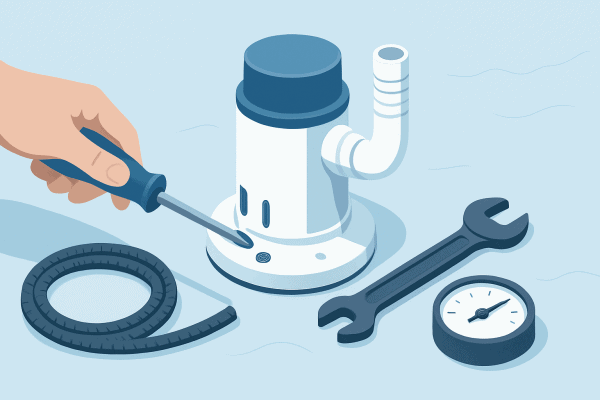
Adjustment screws: differential and calibration
Most mechanical pressure switches have two distinct screws:
- a larger screw, which adjusts the general intervention value (raises or lowers both cut-in and cut-out together);
- a smaller screw, which adjusts the differential, that is, the distance between the two thresholds.
Turning the main screw clockwise generally increases the cut-out pressure; turning the differential screw narrows or widens the range between cut-in and cut-out without changing the maximum point.
Step-by-step procedure with the pressure gauge
For reliable adjustment, a reference pressure gauge is always needed, preferably digital, temporarily installed downstream of the pump:
- turn off the system and release the residual pressure by opening a tap;
- remove the pressure switch cover, locating the two adjustment screws;
- turn the system back on and observe at what pressure the pump starts (engagement);
- let the pump reach the disengagement and note the maximum value;
- if the values do not match the desired ones, make small increments (a quarter turn at a time) on the main screw to shift the range;
- then adjust the differential by acting on the smaller screw, checking that the gap between engagement and disengagement remains consistent with the manufacturer's specifications;
- repeat the test by opening and closing a user several times, checking that the values remain stable in subsequent cycles.
It is good practice never to exceed the maximum pressure indicated by the pump and accumulator manufacturer, to avoid mechanical stress on downstream components.
Symptoms of a faulty pressure switch
When the pressure switch loses accuracy, the signs are quite recognizable and are often mistaken for problems with the pump itself.
The pump starts and stops continuously
If the pump cycles every few seconds even with taps closed, the pressure switch may have worn contacts or a diaphragm that no longer holds calibration. In some cases, the problem is related to an air-depleted accumulator rather than the pressure switch itself, so diagnosis should always be cross-checked.
The autoclave that does not start
An autoclave that does not start despite water demand may be due to:
- oxidized or burnt electrical contacts inside the pressure switch;
- diaphragm blocked by limescale deposits;
- broken wiring or corroded connector;
- engagement calibration set too low, almost unreachable during discharge.
The pressure that never rises
If the pump runs but the pressure remains low, the pressure switch may interrupt the cycle too early due to incorrect disengagement calibration, or the problem is upstream (clogged filter, faulty non-return valve, leak in the system).
Other signs not to be underestimated
- clicking noise absent or irregular when opening taps;
- pressure visibly fluctuates on the gauge even with constant consumption;
- pressure switch overheating to the touch after a few minutes of operation.
Diagnostic check with the pressure gauge
Before replacing any component, it is always advisable to install a control pressure gauge and compare the actual values with the expected ones. If the pump starts and stops at pressures different from those set, or if the values change randomly from one cycle to another, the pressure switch almost certainly needs to be replaced: an unstable calibration indicates an internal mechanical failure that no adjustment can definitively correct.
Adjust or replace? When replacement is convenient
Adjustment makes sense when the pressure switch responds consistently but the values are not those desired for the system. It is better to replace it when:
- the electrical contacts show signs of burning or visible oxidation;
- the calibration does not remain stable after adjustment;
- the body of the pressure switch shows leaks or internal lime scale deposits;
- the component has already been in use for several years in a saline environment, a condition that accelerates corrosion.
Before proceeding with a replacement, it is worth also evaluating the general condition of the pump, because a new pressure switch mounted on an already worn pump unit can only temporarily mask the problem. On this aspect, it may be useful to consult our guide on autoclave pump prices, which analyzes the most common errors and recurring problems in nautical systems, useful to understand whether a targeted intervention or a more complete overhaul is convenient.
Models of pressure tanks and integrated pressure switches
Many modern pressure tanks for nautical use already integrate a factory-calibrated pressure switch, reducing the risk of manual adjustment errors. This is the case, for example, of the’Ecoinox 1/15 C.E pressure tank, designed for small-sized boats, and the more powerful version Ecoinox 2/15 C.E pressure tank, suitable for systems with higher flow demand. In both cases, the pressure switch is sized to work in tandem with the integrated accumulator, reducing the frequency of start cycles and extending the pump's useful life.
Frequently asked questions about the pressure switch of the pressure tank
What is the difference between mechanical and electronic pressure switches?
The mechanical pressure switch uses a membrane and a microswitch manually adjustable with screws; the electronic one uses a pressure sensor and a board that electronically manages the cut-in and cut-out thresholds, often with greater precision and less maintenance, but at a higher cost.
How often should the pressure switch of a boat pressure tank be checked?
In a marine environment, exposed to humidity and salt, a visual and functional check is recommended at least once a year, before the start of the season, verifying the cut-in and cut-out values with a pressure gauge.
Can I adjust the pressure switch without a pressure gauge?
It is not recommended: without a reliable measuring instrument, there is a risk of setting pressures too high for the system or too low for comfortable use, as well as not being able to verify the stability of the calibration over time.
Can a faulty pressure switch cause damage to other components?
Yes. Incorrect calibration or contact failure can lead to overpressures that stress pipes and fittings, or to excessively frequent start cycles that prematurely wear out the pump motor.
Is it always advisable to replace the pressure switch with one identical to the previous one?
Generally yes, to maintain compatibility with the calibration values specified by the pump manufacturer; in case of an upgrade to an electronic model, it is still necessary to check electrical and mechanical compatibility with the existing system.
If after checking with the pressure gauge the pressure switch shows unstable values or visibly damaged contacts, it makes no sense to insist with repeated adjustments: it is better to schedule replacement before the onboard water system becomes unreliable just when it is needed most.