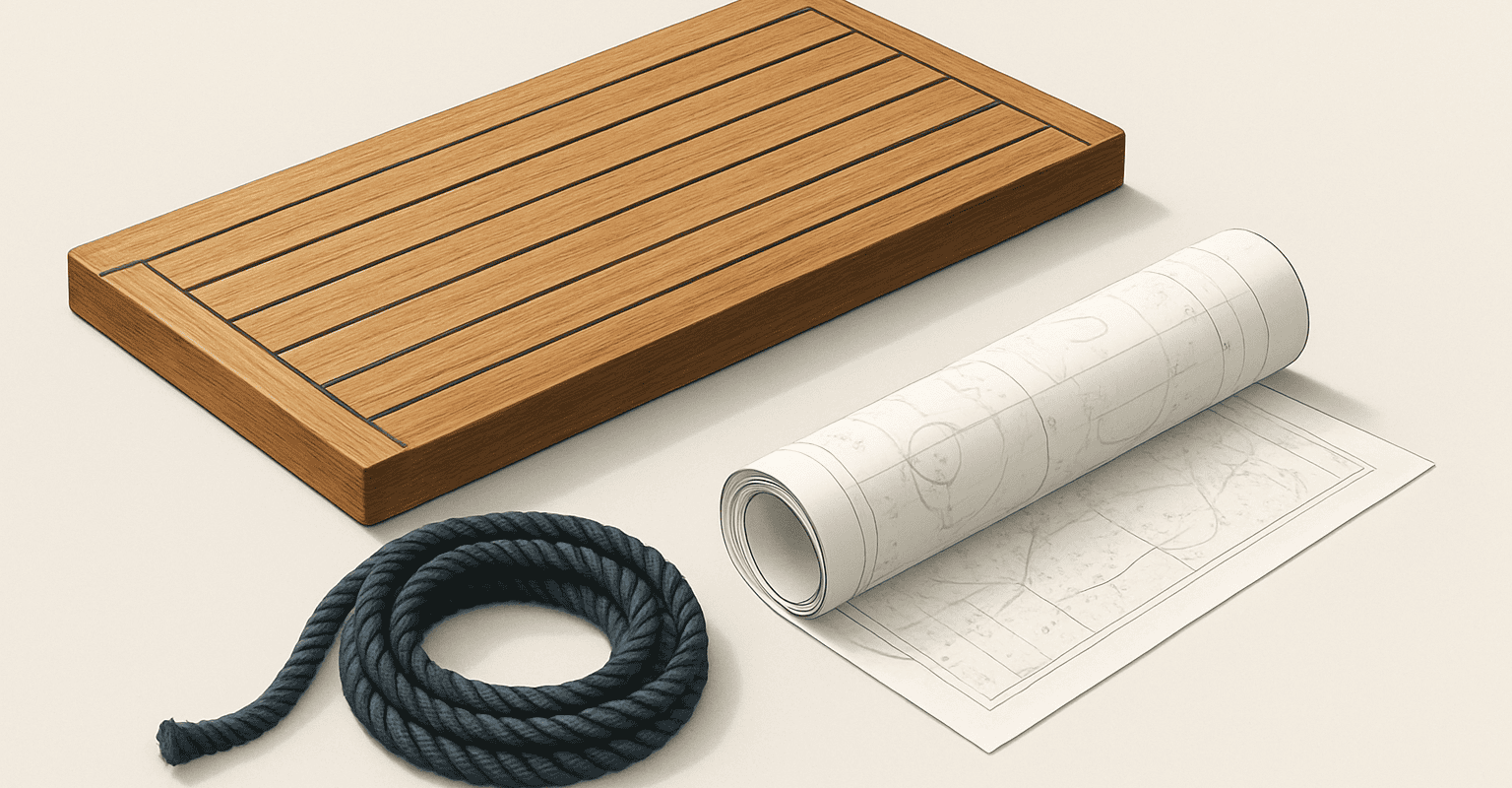
When to really consider the topic of nautical teak prices
Talking about nautical teak prices usefully means going beyond the simple comparison between seemingly similar solutions. In the nautical field, in fact, the perceived cost of a teak covering or component depends not only on the material but especially on compatibility, intended use, installation support and planned maintenance.. This is where many choices become wrong: items designed for different applications are compared, or only aesthetics are evaluated without considering the real onboard context.
A technical guide is precisely to avoid this mistake. If you are looking for information on nautical technical guides dedicated to teak, the correct starting point is to ask where the material will be installed and under what operating conditions it will have to coexist. Deck, swim platform, steps, side decks and accessory surfaces do not always require the same approach.
In practice, price comparison only makes sense when you put truly comparable elements on the same level:
- same nautical destination;
- same type of support on which to apply or mount the material;
- same level of exposure to sun, water and foot traffic;
- same installation logic, therefore laying, adaptation or replacement;
- same finishing requirement and visual continuity with the rest of the boat.
Those looking for nautical teak prices compatibility often already understands that the real problem is not finding “the cheapest solution,” but avoiding a purchase that then requires modifications, adaptations or corrective interventions. In this sense, it is always advisable to carefully read the technical information and, if a detail is not specified, check the product sheet.
To better navigate materials, accessories, and edge surfaces, it can be helpful to also explore other nautical technical guides dedicated to choosing components most exposed to wear and external agents.
Differences between solutions, measurements and nautical teak prices compatibility
One of the most underestimated aspects concerns the word compatibility. In the nautical sector, it is not enough for an element to “fit” in a generic sense: it must be consistent with the structure, the fastening method and daily use. When comparing different teak options, the real difference emerges from some precise technical factors.
Compatibility with the installation surface
The first check concerns the support. A flat and regular surface does not pose the same problems as a curved, rounded, or flexible area. If the teak or related system is applied to an area that is not perfectly compatible, the result can be aesthetically disappointing and functionally unstable.
Before purchasing always evaluate:
- support material;
- possible presence of old residues or layers;
- degree of flatness;
- need for preventive preparation;
- possibility of trimming or adaptation.
Many comparisons on nautical teak prices become misleading precisely because they do not consider the work needed to make the base compatible.
Differences between nominal sizes and useful sizes
Another common mistake is to stop at the declared size without evaluating the effective useful size for your project. In boating, few details can change a lot: edges, radii, joints, interruptions, technical passages, and drainage points often make a more accurate adaptation necessary than expected.
When comparing different solutions, ask yourself if the indicated dimensions are suitable for your actual installation area. If the information is not clear, check the product sheet. This step is essential to avoid purchases that are formally correct but poorly suited to the geometry of the boat.
Aesthetic compatibility and continuity with the deck
In nautical teak, the technical and visual components go hand in hand. A solution may seem valid in isolation but be inconsistent with the rest of the deck or with elements already on board. Tones, surface finish, line orientation, and connection with existing profiles affect the final perception of the work.
For this reason, talking about nautical teak prices compatibility also means evaluating whether the new insertion will maintain credible continuity with the context. A non-harmonized material may force you to redo other parts or intervene in areas that were initially not planned.
Accessories and related materials
Often teak does not work alone. The success of the intervention also depends on adhesives, sealants, cleaners, primers, or compatible finishing accessories. Even in this case, price comparison makes sense only if the system as a whole is considered. An apparently convenient component may require specific additional products or more complex preparation.
If you are planning a complete intervention, it can be useful to also consult an overview of deck materials and nautical finishes, to understand which elements must interact correctly with each other.
Mistakes to avoid when choosing or installing nautical teak
The most common critical issues almost never arise from the material itself, but from an initial evaluation that is too quick. In a competitor-driven logic, the real advantage is not to imitate a solution seen elsewhere, but to understand if that solution is suitable for your boat.
Comparing prices of products with different functions
This is the most widespread mistake. Two teak items can belong to completely different usage families. If one is designed for finishing, one for cladding, and another for integration on specific surfaces, direct comparison loses meaning. The price alone says nothing about the correct application.
Before comparing, always check:
- intended function;
- installation context;
- type of compatible surface;
- any required accessories;
- necessary level of preparation.
Underestimating the existing support
Installing on an inadequately prepared base is one of the most common causes of unsatisfactory results. Dust, old sealants, irregularities, or residues of previous treatments can compromise adhesion and aesthetic performance. Even the best teak, if applied on an unsuitable base, does not offer the expected result.
For this reason, before choosing, it is advisable to also delve into content dedicated to the preparation of nautical surfaces, especially if the intervention concerns areas previously worked on.
Ignoring tolerances, cuts, and critical points
A project that seems simple on paper can become complicated in the presence of cleats, hinges, drains, cable passages, or irregular profiles. If you do not consider these elements before purchase, you risk choosing a solution that is difficult to adapt or visually untidy once installed.
The critical areas to check are often:
- edges and joints;
- areas with openings or hatches;
- points subject to heavy foot traffic;
- outlines of already mounted components;
- areas where water drainage is essential.
In case of doubts, the safest criterion always remains the same: check the product sheet and compare the characteristics with the actual configuration of your boat.
Neglecting future maintenance
Another mistake is choosing solely based on the immediate effect. In the nautical field, long-term management also matters a lot: regular cleaning, compatibility with maintenance products, ease of restoration, and consistency with the rest of the surfaces. A seemingly suitable solution can prove impractical if it requires care incompatible with the real use of the boat.
Therefore, it is useful to evaluate from the start also the products related to surface care, as indicated in many nautical maintenance guides designed for those who want to preserve the result over time.
Products and categories to consider for a more accurate choice
When analyzing the topic nautical teak prices, it is better to think in terms of functional categories rather than isolated individual items. This approach helps to make a more technical and less impulsive comparison, especially when evaluating alternatives present in different catalogs.
The main areas of focus are four.
Coatings and teak surfaces for walkable areas
Here, consistency with the deck area where the material will be used is especially important. Surfaces intended for passage require careful consideration of the substrate, geometry, and continuity with adjacent parts. At this stage, it is not necessary to chase the quickest comparison: it is important to understand if the solution was designed for that specific use.
Adhesives, sealants, and compatible installation products
A correct choice concerns not only the teak but also what allows its installation. Adhesion, edge finishing, and system behavior often depend on complementary materials. If these are not compatible with each other, the result can be fragile or aesthetically inconsistent.
To better orient yourself, it can be helpful to also consult a selection of accessories for nautical laying and finishing, so as to evaluate the project as a whole and not as a single purchase.
Cleaners and maintainers for teak surfaces
Maintenance is not a secondary issue. Already at the selection stage, it is advisable to understand which products will be suitable for cleaning and routine care. This helps avoid unsuitable combinations or improvised treatments that over time can alter the appearance of the surface.
Accessory components to check before purchase
Profiles, edging, connecting elements, and support materials can greatly affect final compatibility. Those who only look at the main material tend to forget these details, only to realize later that the quality of the result depends precisely on them.
In a serious technical evaluation, the price must be considered together with:
- system completeness;
- ease of integration with the existing;
- need for additional accessories;
- ease of maintenance;
- consistency with the actual use of the boat.
This approach is what distinguishes a hasty choice from a truly informed choice within the best nautical technical guides.
Recommended products

 10" Wound Wire Cartridge 20 micron – code: 10MP20 – Idromar
 Brush with spring - code: SGM45 - Gianneschi Pumps and Blowers
 Desalination maintenance kit – code: Cleaning Kit (SC1 + SC2) – Schenker
 Stainless steel clamps Norma 12–22 mm – code: FAI0012022 – Toscogomma


 Check valve – code: T-PF.P30 – Tecma
How to read a technical datasheet without making compatibility mistakes
If you want to avoid mistakes, the technical data sheet is the most important document to consult before purchase. It should not only be read to understand “what” a product is, but above all to verify where the system must be sealed is the fastest way to avoid micro-leaks, seepage, or cracked fittings from over-tightening. and how it can be used.
The points to check more carefully are:
- declared intended use;
- compatible surface types;
- any application limitations;
- need for complementary products;
- instructions for preparation and maintenance.
If any of this information is not clearly present, the best choice is not to proceed based on assumptions. In these cases, check the product sheet or compare the available documentation with the actual configuration of the area to be covered.
This method is particularly useful when making competitor-driven comparisons: instead of stopping at the title or image, the real correspondence between technical requirement and proposed solution is evaluated.
Choose the right nautical teak starting from the most suitable category
If you are comparing different options and want to reduce the margin of error, the most effective way is to start from the correct category and then go into the details of compatibility. In this way, the comparison on nautical teak prices finally becomes useful, because it is made between solutions designed for the same objective.
Before deciding, identify the area of use, check the support, verify complementary materials, and also consider future maintenance. Only then does the price take on real meaning and does not become an isolated figure. If you want to navigate among the available solutions, explore the dedicated category or the reference brand and carefully compare the datasheets: it is the simplest step to choose consistently with your boat.
FAQ
How to correctly compare nautical teak prices without making a wrong purchase?
The comparison should only be made between solutions with the same intended use, compatible with the same substrate, and with similar installation requirements. If technical details are missing, check the product sheet.
What does nautical teak prices compatibility mean?
It means evaluating the price together with compatibility with the surface, installation method, necessary accessories, and continuity with other edge finishes. An isolated price is not enough to make a good choice.
What is the most common mistake in choosing nautical teak?
The most common mistake is to compare articles designed for different applications or to ignore the actual conditions of the surface on which they will be mounted.
Is the technical data sheet really important for choosing nautical teak?
Yes, because it clarifies the intended use, compatibility with the support, any limitations, and required complementary products. If information is unclear, check the product sheet.
Should stickers and maintenance products also be considered?
Absolutely yes. In many cases, the final result depends not only on the teak but also on the installation materials, sealants, and the products used for cleaning and maintenance over time.