


When marine hardware is really needed
Talking about nautical hardware correctly means going beyond simply replacing a worn component. In the nautical field, every fastening, support, closure, or connection element works in a more critical context than on land: constant humidity, salt spray, vibrations, variable loads, and continuous movements can turn an apparently trivial choice into a cause of recurring malfunctions.
Marine hardware is really needed every time a board accessory must maintain stability, sealing, and reliability over time. This applies to openings, panels, hatches, handrails, hinges, locking systems, and anchor points. The problem arises when a generic solution is considered equivalent to one designed for the marine environment.
Many inconveniences arise precisely from this: early corrosion, abnormal play, loose fastenings, mounting difficulties, or material incompatibility. To reduce these risks, it is useful to pair the choice of the component with nautical technical guides reliable ones and careful inspection of the surfaces on which the hardware will be installed.
If you are considering how to navigate between onboard components and accessories, it can be useful to also explore nautical technical guides, check the accessories for onboard outfitting, and verify the fastening systems for marine applications.
Differences between solutions, sizes, or compatibility in marine hardware
One of the most common mistakes in competitor-driven searches is comparing two items only based on shape or apparent use. In reality, marine hardware compatibility depends on multiple factors simultaneously, and neglecting even one can compromise the final result.
Material compatibility
The first check concerns contact between different materials. Hardware suitable for a metal surface might not be the ideal choice on fiberglass, treated wood, or composite panels. Even when mounting seems possible, localized wear, deformation, or stress points may appear over time. If the material is not clearly indicated, check the product sheet.
Size and clearance compatibility
A minimal difference in center-to-center distances, hole diameters, or supported thickness can cause real problems:
- forced mounting;
- imperfect alignment;
- non-smooth closing;
- poorly distributed load;
- need for unforeseen adjustments.
In the nautical field, adapting “by eye” is often the cause of repeated interventions. For this reason, it is important to compare not only the main dimensions but also depth, opening direction, support area, and useful maneuvering space. When this data is not immediately evident, it is advisable to check the product sheet or compare the component with the piece already installed.
Functional compatibility
Two solutions may seem similar but meet different needs. A closure designed for a light compartment does not work like a system intended for a hatch subject to vibrations. A hinge for simple opening is not equivalent to a solution designed to withstand frequent movements or unevenly distributed weights.
The best nautical technical guides help precisely to distinguish cases where aesthetic similarity is misleading. The correct choice always starts from the real function of the component, not its appearance.
Errors to avoid when choosing or installing nautical hardware
Many recurring problems do not depend on the component itself but on how it is chosen or installed. Here are the most frequent errors to avoid.
Replacing without analyzing the cause of the failure
When an element breaks or jams, the temptation is to replace it with something similar. But if the problem arises from misalignment, weakened support, infiltration, or excessive load, the new hardware risks deteriorating in the same way. Before replacement, it is advisable to check the mounting seat, the condition of the holes, and the flatness of the surface.
Ignoring the installation support
Correct hardware mounted on an unsuitable base can lose effectiveness quickly. Irregular surfaces, weakened materials, or fastenings on areas that are too thin generate play, twisting, and noise. In these cases, choosing the right component is not enough: it is necessary to verify that the support is truly suitable.
Neglecting direction, stroke, and accessibility
A very common error concerns installation in tight spaces. Even when the component physically fits in place, it can be uncomfortable to use or impossible to open fully. Before installation, always evaluate:
- direction of movement;
- available space around the installation point;
- ease of access during navigation or maintenance;
- interference with other nearby elements.
This aspect is especially decisive in technical compartments, lockers, and points where multiple accessories share the same area.
Mixing inconsistent components
The marine hardware compatibility does not only concern the single piece but also the whole. Hinges, closures, supports, and fastenings must work coherently. If one element has different tolerances or requires a different support, the entire system can become unstable or not smooth.
To delve deeper into these aspects, it can be useful to consult the solutions for technical mounting onboard and insights on compatibility between nautical accessories.
Products and categories to consider for a more accurate choice
When comparing alternatives available on the market, it is useful to think in terms of functional categories, not visual similarity. This approach helps avoid inaccurate purchases and makes it easier to compare different solutions.
Among the categories to consider are, depending on the application:
- components for opening and closing compartments and doors;
- connecting and supporting elements for panels and light structures;
- fastening systems for internal and external fittings;
- accessories for gripping, locking, or holding points;
- solutions dedicated to installations in environments exposed to humidity and salt spray.
The advantage of this method is practical: instead of looking for a “similar” replacement, you identify the correct technical family and then check compatibility with your installation context. In a professional selection of nautical hardware, the difference is often made by construction details, fastening points, and consistency with actual use.
If your goal is to reduce errors during selection, it is advisable to start with an overview of the available categories and carefully read the technical information. When a piece of data is not clearly stated, check the product sheet.
Recommended products

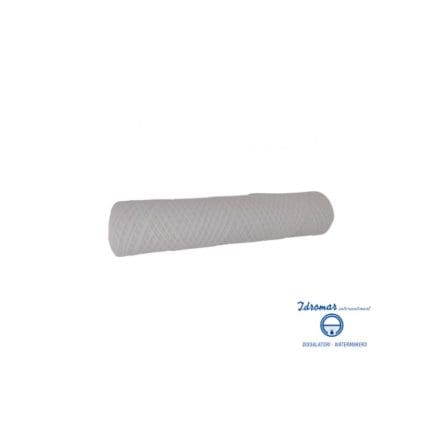 10" Wound Wire Cartridge 20 micron – code: 10MP20 – Idromar
 Desalination maintenance kit – code: Cleaning Kit (SC1 + SC2) – Schenker
 Stainless steel clamps Norma 12–22 mm – code: FAI0012022 – Toscogomma
 Brush with spring - code: SGM45 - Gianneschi Pumps and Blowers


How to avoid recurring problems with a more technical approach
Online searches often lead to comparing very similar pages, but a truly effective choice comes from a simple method: analyze the context, define the function, check measurements and supports, verify material compatibility. This is the core of the best nautical technical guides.
To avoid recurring errors, you can follow this operational sequence:
- identify the real problem, not just the component to be replaced;
- record measurements, center distances, dimensions, and direction of use;
- check the material of the mounting surface;
- verify if the component works alone or together with other elements;
- compare the available technical data before purchase.
This type of approach reduces returns, improvised adaptations, and repeated maintenance. If you are looking for a professional selection for your project, explore the category dedicated to nautical hardware or consult the available brands to find the most suitable solution for your onboard system.
FAQ
How to understand if a marine hardware is compatible with the one already installed?
To check compatibility, it is useful to verify the pitch, dimensions, thickness of the support, opening direction, and material of the mounting surface. Even if two components look similar, they may have different measurements or functions. If any information is unclear, check the product sheet.
What is the most common mistake in choosing nautical hardware?
The most frequent mistake is replacing a component based only on appearance, without analyzing the cause of the problem. If the failure depends on misalignment, weakened support, or incorrect use, the new component can also wear out quickly.
Why are measurements so important in marine hardware?
Measurements and dimensions directly affect assembly, stability, and functionality. Minimal differences in holes, maneuvering space, or support area can cause unstable fastenings, difficult openings, or inadvisable adaptations.
Do nautical technical guides really help to choose better?
Yes, because they allow you to compare solutions based on function, compatibility, and installation context, not just aesthetic similarity. They are particularly useful when you need to avoid recurring errors or compare multiple alternatives.


