


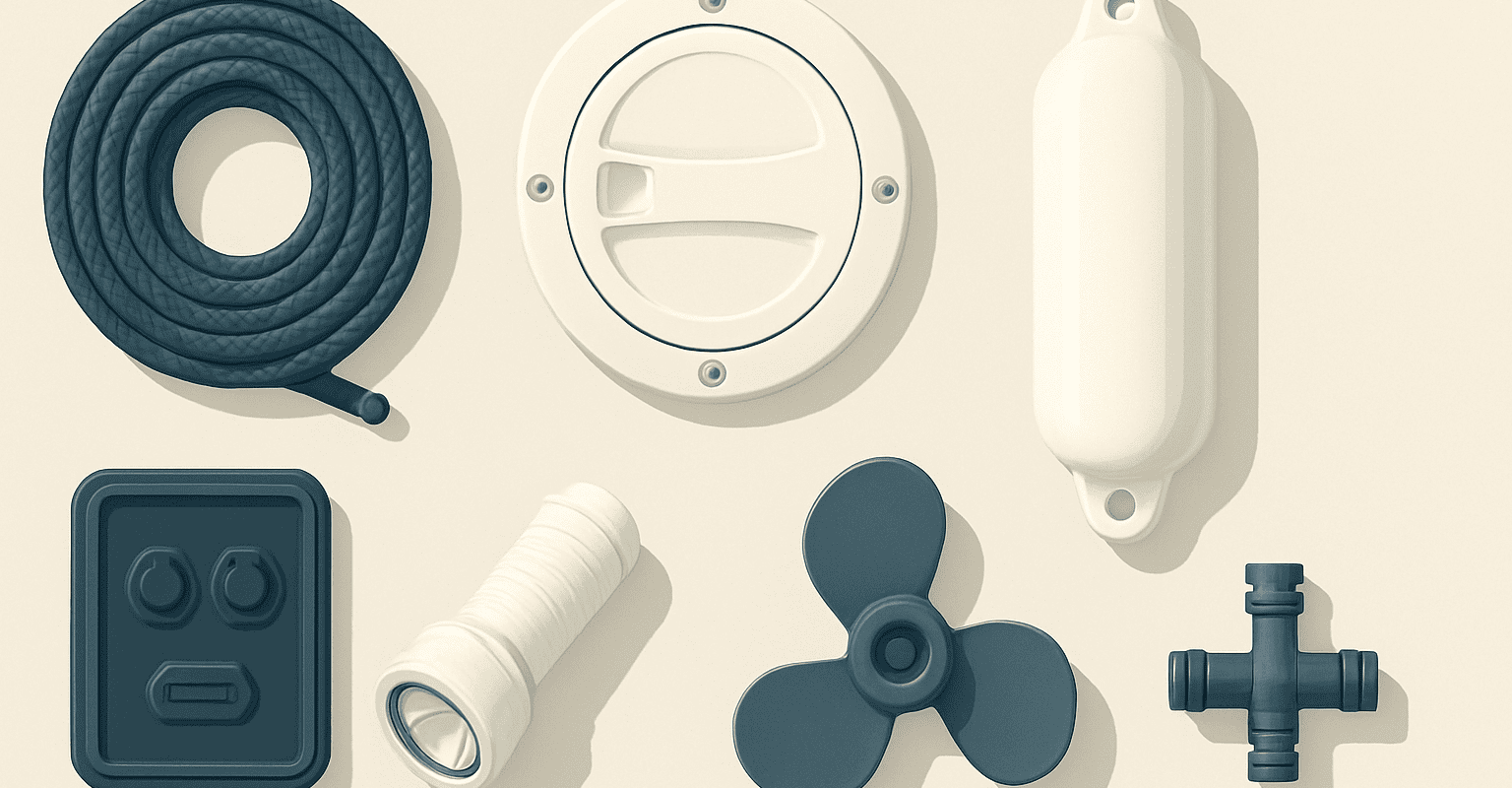
What boat accessories are for and why they affect onboard management
When talking about boat accessories, people often tend to think only of secondary or comfort elements. In reality, many accessory components play a direct role in the daily functionality of the boat, in ease of use and continuity of operations on board. A small worn component, poorly installed or simply incompatible can cause recurring annoyances, slow down activities or make the entire system it affects less reliable.
A good boat accessories guide it starts right here: understanding that accessories are not all the same and that each category meets a specific need. Some are used to connect, fix or protect; others help in fluid management, passage, control or routine maintenance. For this reason, it is useful to think not only about the part to be replaced but also about the context in which it works.
In a logic of boat accessories maintenance, periodically checking components most exposed to moisture, vibrations, salt, and mechanical wear helps prevent recurring problems. Failure does not always arise from an obvious defect: often the initial signal is irregular operation, unstable mounting or only apparent compatibility.
Se stai cercando riferimenti utili per orientarti tra categorie, ricambi e componenti di supporto, può essere utile consultare anche le guide tecniche del catalogo, i componenti per la gestione dei fluidi e gli accessori per installazione e collegamento.
When an accessory becomes a critical point
Accessories become critical especially in three situations:
- when they work in harsh environments, therefore with continuous exposure to moisture and residues;
- when they are subjected to frequent stresses, such as vibrations, tightening, repeated openings and closings;
- when they need to interface with other components, and therefore require correct measurements, attachments or materials.
In these cases, a quick diagnosis always starts with observation: presence of play, signs of deformation, stiffening, difficulty in mounting or traces of abnormal wear are clues not to be underestimated.
Boat accessories: compatibility, measurements and technical checks before purchase
One of the most common mistakes in choosing boat accessories is focusing only on the external appearance or generic function. In the nautical field, compatibility must be carefully checked because even minimal differences between connections, sizes or materials can compromise installation or reduce reliability over time.
Before ordering a component, it is advisable to check some basic aspects:
- installation point, to understand where the component will actually be installed;
- type of connection, especially if the accessory must interface with pipes, fittings, supports or specific surfaces;
- useful measurements, such as diameters, lengths, centers, thicknesses or sizes;
- material, in relation to the environment of use and the components already present;
- intended use, to avoid using a generic accessory in an unsuitable application.
If a detail is not immediately clear, the advice is simple: check the product sheet. A careful reading of the available information helps to avoid returns, improvised adaptations, or unstable installations.
Measurements to check for a quick diagnosis
When an existing accessory needs to be replaced, the most practical solution is to compare the old component with the new one before assembly. In particular, it is useful to check:
- internal and external diameters;
- shape and position of the attachments;
- available space around the installation point;
- required orientation during assembly;
- any fastening or sealing elements to be replaced together.
This check is important even when the problem seems trivial. An accessory that “almost fits” can cause mechanical stresses, forced connections, or premature wear of nearby parts.
Materials and operating environment
Compatibility is not only about size. Material also matters a lot because on a boat every component is exposed to conditions that can accelerate degradation. An accessory suitable for a dry or lightly stressed environment might not be the best choice in the presence of water, residues, vibrations, or continuous contact with other materials.
For this reason, in a proper boat accessories guide, it is always worth asking: does the component work in a protected or exposed area? Is it subject to frequent maneuvers? Does it need to maintain a constant seal over time? The answers help narrow down the choice more effectively than just visual similarity.
Typical errors in ordering or installing boat accessories
Many problems do not depend on the component itself, but on errors in the selection or assembly phase. In practice, a correct accessory but installed incorrectly can give the same symptoms as an incompatible replacement. For this reason, it is advisable to distinguish between order error and installation error.
Order based only on the shape of the part
One of the most frequent mistakes is choosing the replacement because it “looks the same.” In reality, two visually similar accessories can differ in attachment, threading, orientation, material, or intended use. The result is often forced assembly or unstable operation.
To avoid this problem:
- always compare the component to be replaced with available photos and data;
- do not stop at just the external shape;
- check key measurements before confirming the order;
- if necessary, check the product sheet.
Installation with improper tightening or misalignment
Another typical error concerns assembly. Excessive tightening can damage seats, seals, or fastening points; insufficient tightening, on the other hand, can cause play, vibrations, or leaks. Alignment is also fundamental: if the component works off-axis, deterioration can appear quickly.
The most common signs of incorrect installation are:
- difficulty in initial positioning;
- need to force connections or fittings;
- abnormal movement after assembly;
- signs of rubbing or irregular compression;
- uneven performance in daily use.
Replace only the visibly damaged part
original packaging boat accessories maintenance it is common to intervene only on the component showing the problem. However, when an accessory works in conjunction with sealing, fitting, or support elements, it is advisable to also check the connected parts. If the new component is inserted into an already compromised system, the defect may reoccur shortly.
An effective quick diagnosis should therefore include:
- visual inspection of the surrounding area;
- checking for wear, stiffening, or deformations;
- presence of residues, oxidations, or signs of infiltration;
- condition of supports, seals, and fastening points;
- consistency between the chosen accessory and the actual application.
Per approfondire questo approccio, possono essere utili anche le sezioni dedicate alla manutenzione tecnica e i ricambi per impianti e collegamenti.
Useful products, spare parts, and accessories to check in case of frequent problems
When a recurring malfunction emerges, the temptation is to immediately look for the main component. In many cases, however, the problem originates from one of the boat accessories that complete the system: connecting, support, sealing, fastening, or protection elements. It is precisely these details that make the difference between a temporary fix and a stable solution.
To better guide yourself, it is advisable to think in terms of control areas, not individual parts. This method helps to more quickly identify the cause of the problem and choose the correct spare part.
Connecting and passage components
If you notice flow difficulties, leaks, unstable assemblies, or insecure connections, the first elements to check are those that manage the passage between one part and another of the system. In this area, even an apparently secondary accessory can affect overall functioning.
Check in particular:
- condition of the joining points;
- integrity of the contact surfaces;
- presence of deformations or hardening;
- correct matching between diameters and fittings;
- any signs of forced assembly.
Fastening, support and protection elements
An accessory that vibrates, moves or works under tension is often not the real problem: it can be the support that holds it in place. For this reason, in a good boat accessories guide, it is useful to always include the inspection of brackets, supports, anchoring systems and components that protect the part during use.
If the component tends to move, rub or charge irregularly, check:
- stability of mounting;
- alignment with other elements;
- presence of wear on contact points;
- any support failures;
- compatibility of the accessory with its housing.
Wear parts in routine maintenance
In the routine of boat accessories maintenance, some components deserve more frequent checks because they work under heavy conditions or are often handled. Even without obvious failure, material aging can compromise sealing, smoothness or assembly stability.
A periodic check is advisable when you notice:
- abnormal stiffness during use;
- signs of surface deterioration;
- change of shape or loss of elasticity;
- difficulty in repositioning;
- increasing need for adjustments or corrective interventions.
In questi casi è utile consultare anche le categorie di ricambi e accessori nautici per confrontare le soluzioni disponibili in base all’applicazione.
Recommended products
Go to the Boat Accessories category
 Italian Merchant Navy Flag 80×120 cm – code: 35.453.06 – Osculati


How to set up a quick diagnosis of boat accessories without wasting time
A quick diagnosis does not mean acting superficially. It means, rather, following a logical order that allows isolating the problem before purchasing or replacing a component. This approach is particularly useful when the defect seems intermittent or when multiple accessories contribute to the same function.
A practical sequence can be this:
- observe the main symptom, for example leakage, instability, connection difficulty or abnormal wear;
- identify the affected area, without stopping at the first visibly marked piece;
- check compatibility and measurements of the current component;
- verify the contact points and the support elements;
- compare the replacement with what is required by the actual application;
- consult the product sheet if you have doubts about measurements, materials or intended use.
This method reduces the most common errors and makes the choice of components more effective. It also helps to build a more organized maintenance management, avoiding repeated replacements due to unresolved causes.
Boat accessories maintenance: periodic checks that help prevent breakdowns
Maintenance of accessories does not necessarily require complex interventions, but it requires consistency. A periodic check allows you to catch weak signals before they turn into a practical problem during the use of the boat. In particular, it is advisable to pay attention to all components exposed to moisture, vibrations, friction, and continuous cycles of assembly or adjustment.
Among the most useful good habits:
- regular visual inspection of the most stressed areas;
- cleaning of contact points where residues and deposits can alter the functioning;
- checking the stability of supports and fastenings;
- verification of the condition of materials, especially if they show stiffening or wear;
- timely replacement of components that have lost reliability.
Well-organized maintenance not only helps avoid unwanted stops: it also improves accuracy in choosing spare parts, because it allows intervention when the problem is still limited and easily identifiable.
If you want to find the right solution for your system or onboard configuration more quickly, explore the category dedicated to nautical accessories and spare parts in the Technofluid catalog: you will find useful components for replacement, inspection, and maintenance, with product sheets to check based on the specific application.
FAQ
How to understand if a boat accessory is compatible with my system?
To check compatibility, it is advisable to verify the installation point, type of connection, useful measurements, material, and intended use. If a detail is unclear, check the product sheet.
What are the most common mistakes when ordering boat accessories?
The most common mistakes are choosing the component based only on shape, not checking diameters or fittings, ignoring the material, and not considering the actual space available for installation.
When should a boat accessory be replaced even if it is not completely broken?
It is advisable to intervene when signs of stiffening, deformation, loss of stability, surface wear, or mounting difficulties appear. Even without obvious breakage, the component may no longer be reliable.
In boat accessory maintenance, what should be checked first?
It is generally useful to start with connections, anchor points, supports, fastenings, and areas subject to vibrations or humidity. A visual inspection of the surrounding area often helps to identify the real cause of the problem.
If a boat accessory looks the same as the old one, can I order it without further checks?
No, because two similar components can differ in attachment, orientation, dimensions, or material. Before ordering, it is always better to compare the technical data and, if necessary, check the product sheet.


