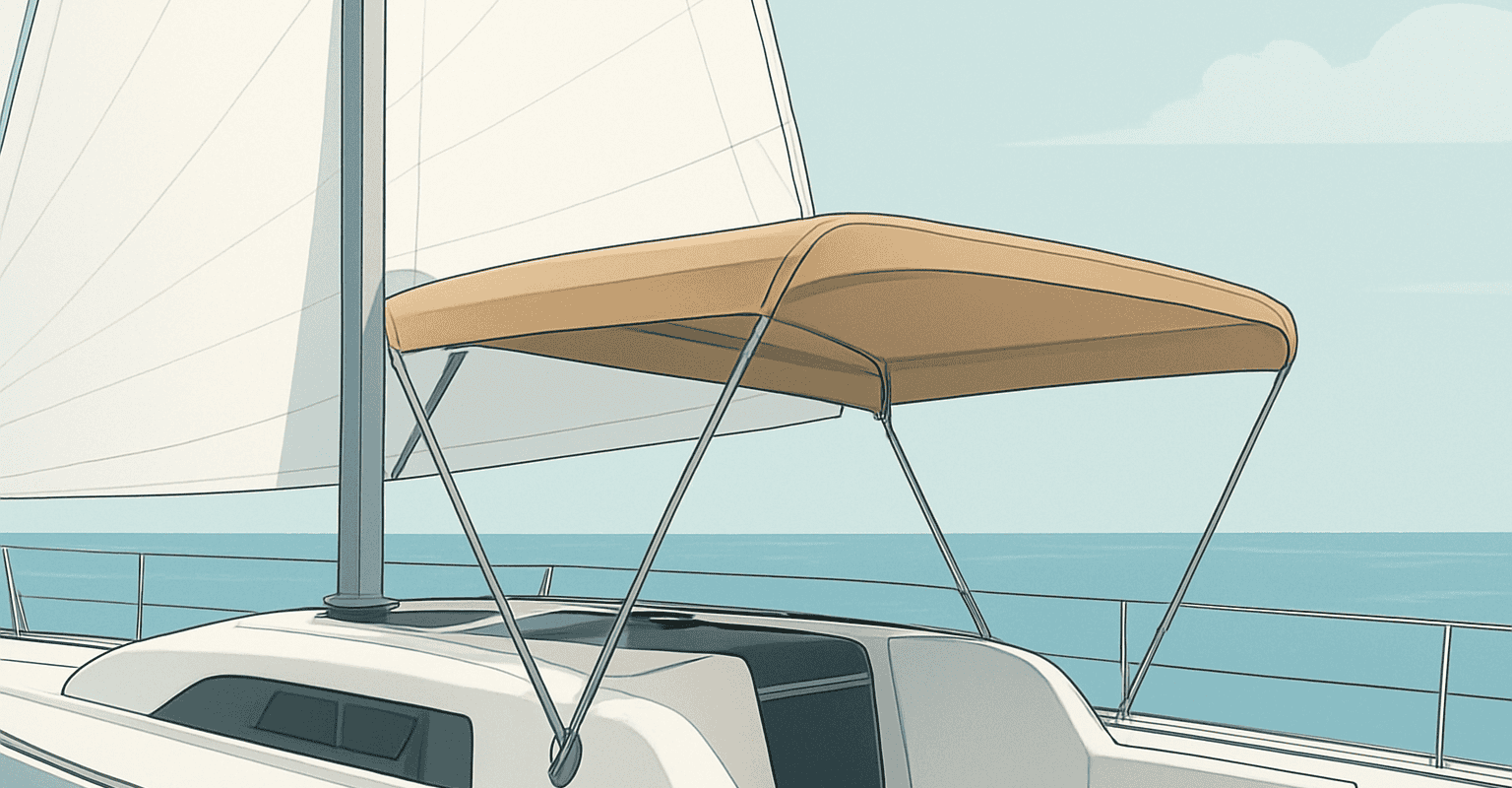
Those looking for sailboat awnings often starts from a simple question: which model to choose? In reality, the correct answer almost always depends on a more technical and less immediate factor, that is the system on which the awning must work. Cockpit geometry, presence of sprayhood, boom arrangement, maneuvering space and available attachment points substantially change the final choice.
For this reason, in nautical technical guides more useful it is not enough to compare shapes or sizes in the abstract. It is necessary to understand if a solution is really consistent with the boat's setup, with how you use it while sailing, and with the ease of opening, closing, and storage. An awning suitable on paper can become inconvenient if it interferes with passage on board, with the helm, or with maneuvers in the cockpit.
In this guide we analyze the criteria that help evaluate sailboat awnings compatibility in a concrete way, with a comparative approach: not to choose “the biggest” or “the strongest” in a generic sense, but to identify the solution that really suits the real configuration of the boat.
If you want to explore other accessories for comfort and protection on board, it can be useful to also consult To better guide you among components and complementary accessories, it can be useful to also consult, or read the content dedicated to cockpit covers and protections.
When sailboat awnings are really needed
Not all sailboats require the same type of cover, and the awning does not have the same function in all situations. The first step is to distinguish between occasional need and structural need.
If you use the boat mainly at anchor, in port, or during prolonged stops, the awning works as a comfort and shading element. In this case, the covered surface, the speed of opening, and the stability of the structure when the crew moves in the cockpit are very important. If instead you want to maintain frequent protection even while sailing, the issue changes: the space relative to the boom, the freedom of the sheets, and the possibility to close or adjust the system without complications become central.
A common mistake is to think that sailboat awnings are all equivalent as long as they “fit” in the available space. In reality, the difference is made by how they integrate with:
- boom height and its travel;
- traveler position, if present in the cockpit;
- sprayhood or other covers already installed;
- access to the helm and the helmsman’s view;
- side passages and crew freedom of movement.
In practice, the awning is really useful when it improves livability without introducing new interferences. If to install it you have to give up a comfortable passage, if it obstructs the view or forces continuous disassembly, the solution may prove less convenient than it seems.
Another aspect to consider is the type of boat usage. On a used cruiser for family sailing, cockpit coverage can have high priority. On a boat more oriented towards sporty navigation or with a compact cockpit, instead, a more discreet, less invasive, and easier to manage solution may be preferable. In these cases, it is worth comparing the awning not only with the available space but with the actual usage rhythm: how often you open it, when you close it, under what conditions you keep it mounted.
For those evaluating the set of external accessories, it may be useful to also see the insights on deck and cockpit accessories, so as to read the awning as part of a system and not as an isolated element.
Differences between solutions, sizes or compatibility of sailboat awnings
When comparing different solutions, the keyword is not just “size,” but compatibility. Talking about sailboat awnings compatibility means understanding if the structure really fits the boat layout and the intended type of use.
Compatibility with the cockpit
The cockpit is the first real reference. It’s not just the useful width that counts, but also the shape of the area to be covered. A wide and regular cockpit allows more freedom in choice; a narrow one, with shaped seats or particular accesses, requires a more careful evaluation of the support points and frame opening.
Before choosing, always check:
- if the fixing points are accessible and consistent with the structure;
- if the frame remains stable without obstructing handrails, side handrails or backrests;
- if once opened the awning leaves enough space to sit, steer, and pass through.
A theoretically correct measurement may not work if the cockpit has irregular volumes or if the fastenings end in an area difficult to reach.
Compatibility with boom, sheets and controls
On a sailboat, the difference compared to other boats is evident: above the cockpit move elements that cannot be ignored. The boom is the first constraint, but not the only one. The path of the sheets and the position of the controls led back to the cockpit also influence the choice.
If the awning is too high or too forward, it can conflict with the boom’s swing. If it is too far back, it can reduce protection precisely where it is most needed. For this reason, it is not enough to take a linear measurement: it is necessary to think in terms of occupied volume and movement of elements in navigation.
In case of doubts about the configuration, the best choice is always check the product sheet the details related to assembly, dimensions, and intended use.
Compatibility with existing sprayhood and covers
Many sailboats already have a sprayhood or a front cockpit cover. In these cases, the bimini should not be evaluated alone, but as part of a system. The correct question is not “does it fit?”, but “does it integrate well with what is already installed?”.
The aspects to observe are mainly three:
- continuity of the cover, to avoid uncovered areas that are not functional;
- interferences when opening and closing, which make daily handling uncomfortable;
- consistency of attachment points, to avoid overlapping accessories in a disorderly way.
A well-integrated solution makes the cockpit more livable. An improvised solution instead creates a double problem: less comfort and more operational complexity.
Useful measurements: what really matters
When comparing models, measurements are useful but must be read with judgment. The most important are those that help understand actual coverage, useful height e maneuvering space. It does not make much sense to aim for maximum coverage if the bimini then becomes difficult to use or forces uncomfortable postures in the cockpit.
For a sensible technical evaluation, always consider:
- effective width of the shaded area;
- useful height relative to the helmsman's position;
- length development relative to seats, accesses, and backrests;
- space needed when the bimini is folded.
This approach is typical of the best nautical technical guides: do not stop at the general sheet, but read the measurement in relation to the boat's actual setup.
Mistakes to avoid in choice or assembly
Most problems arise not from the product itself, but from an incomplete evaluation before purchase or installation. Here are the most common mistakes.
Choosing based on coverage alone
More shade does not automatically mean a better result. If the structure invades the cockpit or complicates maneuvering, the initial advantage quickly diminishes. Coverage must always be balanced with accessibility e functionality.
Ignoring the actual attachment points
Many comparisons are made based on photos or indicative measurements, without verifying where and how the awning can be installed. This leads to underestimating the position of the supports, the frame angle, and ease of use. Before choosing, always check if the mounting points are compatible with the boat’s structure and existing accessories.
Neglecting use while sailing
An awning can be perfect in port but impractical while sailing. If you plan to use it during transit, you must consider the helmsman’s freedom, forward visibility, and absence of interference with maneuvers. If this aspect is unclear, it is better to check the product sheet the recommended intended use.
Not considering opening and closing in the onboard routine
A system that looks good on paper can become inconvenient if it takes too much time or too many steps to open and close. On a boat, daily practicality matters as much as coverage. If the awning is perceived as “complicated,” it will end up being used less than expected.
Installing without assessing closed dimensions
Often the focus is only on the open position. In reality, even when closed, the awning takes up space and can interfere with backrests, access points, or equipment in the cockpit. A good installation works in both configurations.
For those comparing accessories to install on deck, it can be useful to also explore comfort solutions on board e nautical accessories for managing external spaces, so as to evaluate the awning in the overall context of the boat.
Products and categories to consider
In a serious technical comparison, it is not advisable to think only about the single item, but about solution categories that may best fit the boat. This approach helps to understand which family of sailing boat awnings is most consistent with your setup, even before going into the details of the individual model.
The categories to consider change based on four practical questions:
- how much space you really have in the cockpit;
- what coverage you want to achieve;
- how often you plan to open and close the awning;
- which accessories are already on board.
If the priority is easy-to-manage protection, a basic solution with compact dimensions and straightforward installation may be more suitable. However, if the goal is to increase the comfort of the cockpit during extended stops, it may make more sense to opt for configurations that prioritize continuous coverage and integration with other existing protections.
Another useful criterion is to distinguish between:
- boats with an open and free cockpit, where mounting flexibility is greater;
- boats with an already equipped cockpit, where every new element must coexist with steering, sprayhood, grab rails, or installed accessories;
- boats with a compact layout, where the advantage of wide coverage must be carefully weighed against the space occupied.
Here, comparing with the catalog becomes useful not so much to “find the most similar,” but to understand which categories best respond to your scenario. If a detail is not immediately clear, the correct step is always the same: check the product sheet information on compatibility, measurements, and installation methods.
This method is particularly effective for those coming from competitor-driven research: instead of stopping at superficial comparisons between shapes or images, the solution is evaluated based on the actual setup. This is precisely where a technical guide makes the difference.
Recommended products


How to understand which solution is really convenient based on the system
To sum up, the most reliable way to choose is not to start from the bimini, but from the boat. In other words: first read the setup, then select the solution.
An effective decision-making process can follow this sequence:
- Observe the cockpit: shape, usable width, accesses, seats, steering.
- Identify the upper constraints: boom, sheets, possible traveler, visibility.
- Check the accessories already present: sprayhood, grab rails, covers, supports.
- Define the main use: port, anchorage, navigation, short or extended stops.
- Compare the actual compatibility: opening, closing, space occupied, daily practicality.
If a solution passes all these steps, then it makes sense to explore it further. If even one of these points remains critical, it is likely that the bimini is not really the most convenient choice for your boat, even if it seems correct on paper.
To better navigate the available solutions, explore the category dedicated to awnings and brand accessories in the catalog: comparing options starting from your boat's configuration is the fastest way to find a system that is truly compatible and functional over time.
FAQ
How to understand if a bimini top is compatible with a sailboat?
Compatibility must be assessed considering the cockpit, boom height, presence of sprayhood, attachment points, and space for maneuvers. It is not enough to compare a generic measurement: you need to check how the awning integrates with the actual setup of the boat. In case of doubts, check the product sheet.
Does the size or the shape of the manhole matter more when choosing the awning?
Both are important, but the shape of the manhole often affects more than just the linear measurement. An irregular manhole, with particular accesses or shaped seats, can limit installation even when the width seems correct.
Can a sailboat awning interfere with the boom?
Yes, it is one of the most important aspects to check. The awning must be evaluated in relation to the boom's range of motion and the movement of the controls in the cockpit, otherwise it can be uncomfortable or impractical in real use.
If I already have a sprayhood, can I add a bimini top without any problems?
It depends on the boat's configuration and how the two covers integrate. You need to check the continuity of protection, interference during opening and closing, and consistency of attachment points. If the details are not clear, check the product sheet.
What is the most common mistake when choosing sailboat awnings?
The most common mistake is choosing based solely on the desired coverage, without considering space, the helmsman's view, cockpit access, and compatibility with the maneuvers. An apparently more protective solution can prove less practical in daily use.