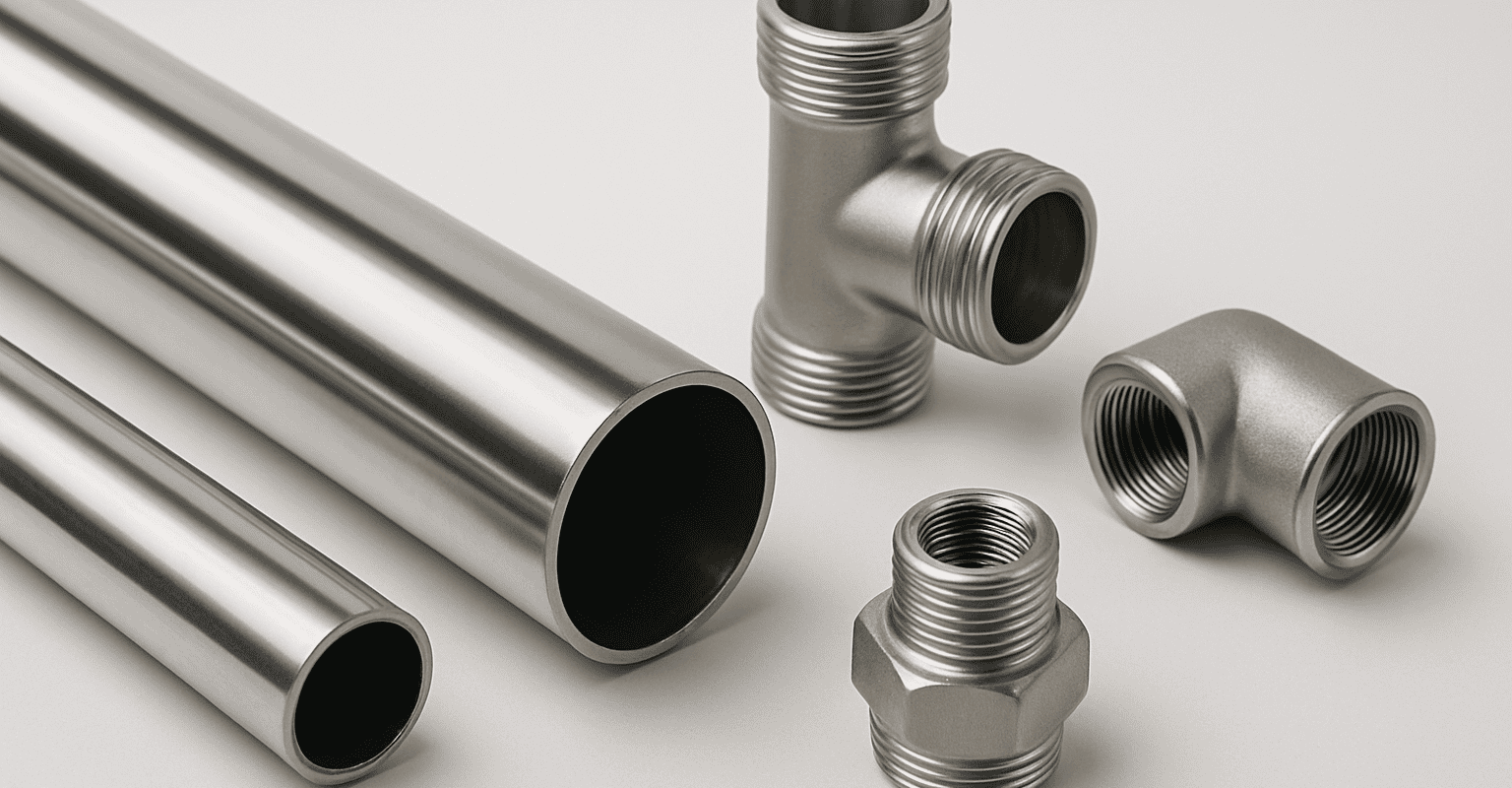
When to really consider 316 stainless steel pipe prices in a marine system
Talking about 316 stainless steel pipe prices ignoring the context of the system often leads to unhelpful comparisons. In the marine field, in fact, the apparent cost of a pipe says little if not read together with compatibility, circuit configuration, available fittings, and operating conditions.. This is exactly where the choice becomes technical, not just economic.
Those looking for a solution for plumbing and nautical fittings often tend to compare materials that are similar on paper but different in actual performance once installed. In an onboard system, convenience does not depend only on the pipe itself: the number of required adaptations, ease of installation, continuity with already present components, and ease of maintenance over time all matter.
For this reason, before stopping at the comparison between datasheets or commercial descriptions, it is advisable to check some aspects:
- type of fluid managed by the circuit;
- installation environment and presence of moisture or aggressive agents;
- need to connect the pipe with already installed components;
- available space for laying, bends, and fastenings;
- ease of inspection and replacement in case of future interventions.
In many cases, the correct question is not “how much does the pipe cost?”, but which solution reduces critical issues, adaptations, and system downtime.. This approach is particularly useful when working on lines where every component must interact with the rest of the system without forcing.
If you are comparing multiple options for your border line, it can be helpful to also explore the section dedicated to hydraulics and marine fittings, so you can evaluate the tube together with the connection elements and not as an isolated component.
Differences between solutions, sizes, and 316 stainless steel pipe price compatibility
One of the most common mistakes in competitor-driven searches is to compare products only by brief description. In reality, the key issue is the compatibility. 316 stainless steel pipe price compatibility tubi acciaio inox 316 prezzi compatibilità, the node is not just the material, but the relationship between pipe, fittings, terminals, bends, valves, and connection points of the system.
Two solutions may seem equivalent but involve very different requirements during installation. What often makes the difference are details such as:
- actual diameter and correspondence with the rest of the line;
- thickness and rigidity in relation to the type of laying;
- geometry of the fittings needed to complete the circuit;
- compatibility with existing supports, brackets, and passages;
- continuity with metallic or mixed components already present in the system.
In the nautical sector, these differences matter much more than they seem. A pipe that requires additional adapters or modifications to connection points can become less convenient than a solution initially perceived as more demanding. In other words, the price must be read together with the cost of integration into the system.
Measurements and connectivity: the real point of comparison
When analyzing different proposals, it is useful to start with a practical question: does the pipe integrate without corrective interventions? If the answer is uncertain, the comparison must be deepened. A minimal difference in measurements or type of fitting can require intermediate components, increase potential leak points, or make maintenance more complex.
For this reason, it is always advisable to check in the product sheet:
- available sizes;
- type of supported connection;
- any indications on laying;
- recommended combinations with fittings and accessories.
Another often overlooked aspect concerns the consistency of the entire line. In a well-designed marine system, the tube should not be chosen alone but as part of a chain. If you want to also compare the joining elements, it can be useful to consult fittings for marine systems and components for hydraulic lines to understand which combinations are more streamlined.
Mechanical compatibility and usability compatibility
Compatibility is not only dimensional. There is also a usage compatibility, that is the ability of the tube to fit correctly into the intended operational context. A system installed in tight spaces, with mandatory passages or frequent maintenance, requires a different evaluation compared to a more accessible line.
In this sense, real convenience emerges when the component:
- assembles without forcing;
- reduces the number of adaptations;
- simplifies future inspection;
- maintains consistency with the rest of the system.
This is why a serious comparison between 316 stainless steel pipe prices must always include the topic of compatibility. Limiting oneself to the economic data risks shifting the problem from the purchasing phase to the installation phase.
Mistakes to avoid when choosing and installing 316 stainless steel tubes
Even a good solution can lose value if chosen or installed with incomplete criteria. In the world of’plumbing and nautical fittings, the most frequent mistakes do not arise from absolutely wrong components, but from inconsistent pairings with the actual circuit.
Comparing only the material without looking at the system
The first mistake is thinking that selecting “316 stainless steel” is enough to automatically have the right solution. In reality, the material is only part of the decision. If the tube does not interface with existing fittings, terminals, or passages, the initial advantage quickly diminishes.
Before purchasing, it is advisable to map:
- entry and exit points of the line;
- components to keep;
- fittings to replace or adapt;
- space and orientation constraints.
Underestimating the actual installation on board
A second very common mistake is reasoning at the bench and not on the system. On a boat, spaces are often limited and paths not always linear. A theoretically correct tube can become difficult to install if it requires difficult maneuvers, unexpected bends, or additional accessories.
To avoid problems, it is useful to ask:
- Is the path direct or does it have obstacles?
- Are there points where the pipe must be easily inspectable?
- Is the connection to the fittings easy or does it require adaptations?
- Will future maintenance be simple?
These questions help to understand which solution is really convenient, beyond the initial comparison between similar offers.
Ignoring continuity with fittings and accessories
A pipe chosen without checking the connected accessories can generate an unexpected chain of replacements. This often happens when the pipe is considered as an independent element, while in reality it works together with fittings, supports, terminals, and other components of the circuit.
For a more complete evaluation, it can be helpful to also explore accessories for hydraulic systems and solutions for marine fittings, so you can check if the whole set is consistent already at the selection stage.
Products and categories to consider for a truly convenient choice
When the goal is to identify the most suitable solution, the comparison should not stop at the pipe alone. In a professional logic, it is advisable to evaluate complementary categories that directly affect the success of the assembly and the functionality of the system.
The areas to observe carefully are especially these:
- compatible fittings with the line to be built or updated;
- connecting elements for passages, branches, or changes of direction;
- fixing and support accessories for an orderly installation;
- completing components useful to avoid improvised adaptations.
This approach is especially useful when comparing multiple alternatives available on the market. An apparently similar solution to another can completely change value if it has a simpler and more coherent chain of compatibility.
In practice, real convenience emerges when:
- the components are easily found within the same technical ecosystem;
- the possible combinations are clear from the documentation;
- compatibility can be verified without interpretations;
- assembly does not require improvised solutions.
For this reason, when evaluating 316 stainless steel pipe prices, it is useful to observe not only the individual item but also the category context. If a system offers continuity between pipe and fittings, the choice becomes simpler and more solid over time.
A good method is to start from the system path and then trace back to the necessary components, checking in the product sheet everything related to measurements, connections, and compatibility. In the nautical field, this approach reduces the risk of purchases that are correct on paper but inefficient during installation.
Recommended products
Go to the Hydraulics and fittings category
 Hose holder type Rome M 1"x30 yellow – DVGW – code: 1056F*30 – Maestrini

 90° 1" M-F Elbow in yellow brass – DVGW – code: 0092F – Maestrini
 1“ Brass Anti-Corrosion F.F.F. ”T" Fitting – CR – DVGW – code: 7130F – Maestrini
 1/2"x3/8" anti-siphon valve in CR anti-corrosion brass – code: *7083D – Maestrini
 O-ring for 3/4" and 1" filters (4412) - Code: 0087-5EF - Maestrini


Useful links to better compare pipes, fittings, and compatibility
If you are considering different solutions for your system, it can be helpful to explore the sections dedicated to connected components. A broader comparison helps to understand if the choice of pipe is truly consistent with the rest of the line.
- Overview of hydraulics and nautical fittings
- In-depth look at fittings for onboard lines
- Useful accessories for system completion
- Compatible components for hydraulic circuits
If you want to steer towards a safer and more consistent choice with your system, explore the category dedicated to’plumbing and nautical fittings or the reference brand: comparing pipes, fittings, and accessories together allows you to identify the most convenient solution not only at purchase but especially in real integration onboard.
FAQ
How to understand if 316 stainless steel pipes are compatible with my nautical system?
Compatibility must be checked considering measurements, type of connection, existing fittings, and circuit configuration. Before purchasing, it is advisable to check the product sheet for information on diameters, pairings, and installation methods.
Comparing 316 stainless steel pipe prices enough to choose the best solution?
No. The economic comparison is useful only if accompanied by a technical evaluation. A solution may seem cost-effective at first but require adapters, modifications, or longer assembly times. The correct choice always also considers compatibility and integration into the system.
What mistakes are most often made when choosing pipes for plumbing and marine fittings?
The most common mistakes are choosing the tube without checking the fittings, ignoring the actual installation spaces, and evaluating the material without considering the entire system. In the nautical field, it is important to think about the complete line, not the single component.
Why does compatibility have such an impact on the evaluation of stainless steel 316 pipe prices?
Because real convenience depends on how easily the pipe integrates with the rest of the system. If adaptations or additional components are needed, the initial advantage may be reduced. Good compatibility simplifies assembly, maintenance, and line continuity.