Introduction and when it is needed
On a boat, a “simple” connection between hose and system can become the most delicate point of the entire circuit: a poorly chosen fitting, a wrong clamp or an incompatible thread can cause leaks, air suction or loosening over time. For this reason, knowing how to read measurements, threads and compatibility is essential when you buy hoses, clamps and marine fittings for water, fuel, bilge, washing or onboard service systems.
This guide helps you understand how to navigate between hose holder, diameters (inside/outside), and especially between BSP NPT threads and metric: what they mean, why they are not interchangeable “by eye” and how to check compatibility before ordering (or before tightening).
Basic concepts (how it works)
Hose, hose barb and clamp: the trio that must “speak the same language”
In many marine systems the most common connection is: hose barb fitting + flexible hose + clamp. The hose barb is the part that goes inside the hose; the clamp compresses the hose onto the hose barb; the fitting (or the threaded part of the hose barb) screws onto a fitting, a valve, a filter or a through-hull.
- Hose diameter: can be indicated as inside diameter (ID) or outside diameter (OD). In boating, ID often matters for compatibility with the hose barb.
- Hose barb diameter: must match the inside diameter of the hose (or be compatible with the hose tolerance). If in doubt, check the product sheet.
- Clampmust cover the outside diameter of the hose once inserted on the hose barb (so you also need to know the hose thickness).
Thread: it’s not just “how big it is”, but also “what type it is”
When a fitting screws onto a component, the thread comes into play. The most common families you will encounter are:
- BSP (British standard, very common in marine and European contexts)
- NPT (American standard, frequent on imported components or on some pumps/filters)
- Metric (threads in mm, present on some specific components)
The key point: BSP and NPT are not equivalent. Even when “they seem to screw together”, they can tighten poorly, damage the threads or leak over time.
1) Identify the type of connection required
1) Start from the system: what are you connecting?
Before choosing hoses and fittings, clarify:
- From where to where does the line go (tank, pump, filter, tap, through-hull, etc.).
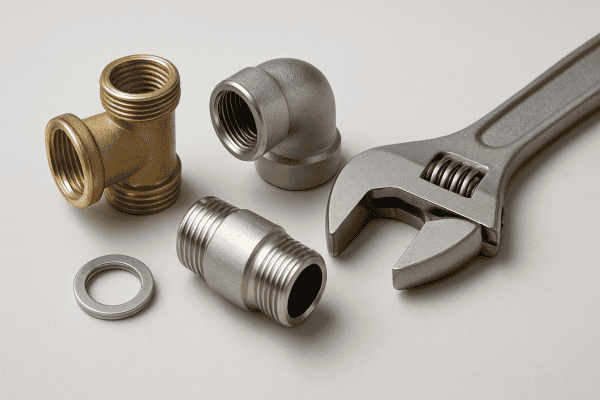
- What type of connection is needed: hose holder, hose connector with male/female thread, straight fitting, elbow, reducer, T.
- What type of thread does the component you need to screw onto have (BSP/NPT/metric). If not indicated, check the product sheet of the component or measure carefully.
2) Tube measurements: ID, OD, and thickness
Many errors arise here: a tube “of X” is bought thinking the measurement is universal. In reality, the measurement can refer to:
- ID (internal diameter): often the “functional” measurement for choosing the hose connector.
- OD (external diameter): mainly used to choose the clamp (clamping range).
- Thickness: changes the OD at the same ID; therefore, two tubes with the same ID may require different clamps.
Practical advice: if you are replacing an existing section, measure both the internal diameter and the external diameter of the old tube (if it is not deformed). Alternatively, bring a sample or compare with the product datasheet data.
3) Choosing the hose connector: straight, elbow, reducer
A hose connector is not “just a nozzle”: the geometry affects sealing and durability.
- Straight: simple solution, useful when the tube enters without bends.
- Elbow: reduces bends and crushes in tight spaces (typical under sinks or near pumps).
- Reducer: useful when you need to go from one tube diameter to another; better to do it with proper fittings instead of “adapting” with clamps on incompatible diameters.
In all cases, the knurled/ribbed part of the hose connector must be compatible with the tube. If you notice the tube goes on too easily or with too much difficulty, stop and check measurements and compatibility.
4) Materials: choose based on the environment and use
In boating, the material of the fitting and the clamp matters as much as the size. Without going into unspecified details, consider:
- Environmentexposed to salt spray, constant humidity, heat in the engine room.
- Compatibility between metalsmixed pairings can cause problems over time. If you are not sure, check the product sheet o chiedi supporto.
- Cable tieschoose models suitable for marine use and the type of hose; in some cases, two clamps in parallel are preferred (where it makes sense and where there is space), but it depends on the application and the fitting.
BSP/NPT/metric threads (practical table)
To correctly read a thread you need to understand two things: standard (BSP, NPT, metric) and type (cylindrical/parallel or tapered). Additionally, you need to distinguish between configuration e female.
How to recognize them (practically)
- BSPoften indicated as BSP, G (parallel) or R (tapered). Very common on European components.
- NPToften indicated as NPT. It is typically tapered.
- Metricindicated as M + diameter (e.g. Mxx) and pitch in mm. Do not confuse it with the “inches” of BSP/NPT.
If the description is unclear, do not rely on “it fits”: check the product sheet or compare with the threading of the existing component.
Practical comparison table (indicative)
| Standard | Typical unit | Common geometry | Often marked as | Compatibility notes |
|---|---|---|---|---|
| BSP | Inches (nominal) | Parallel or tapered | G (parallel), R (tapered), BSP | It is not interchangeable with NPT: pitches and angles may differ. |
| NPT | Inches (nominal) | Tapered | NPT | It can “screw” onto BSP deceptively, but it risks leakage or thread damage. |
| Metric | Millimeters | Parallel (often) | M + diameter + pitch | Do not compare by eye with inches: correct identification is needed. |
Sealing: where does the connection really “close”?
Sealing can occur:
- On the threads (typical of tapered): the fitting creates the seal, often with a suitable sealant.
- On a stop (typical of parallel): the seal occurs on a gasket or a seat. If the correct gasket is missing, tightening more does not solve the problem.
The correct method depends on the type of fitting and the seat. If not specified, check the product sheet of the fitting or the component you are screwing onto.
Correct installation (steps + errors to avoid)
Recommended steps for a clean assembly
- Identify thread and diameters: before assembling, confirm thread standard and tube measurement.
- Prepare the tube: clean and perpendicular cut; avoid crushing or “V” cuts.
- Insert the clamp first: slide the clamp onto the tube before inserting it onto the hose barb.
- Insert up to the useful stop: the tube must cover the grip area of the hose barb evenly.
- Position the clamp correctly: usually above the ribbed area, without ending on the edge of the tube.
- Tighten progressively: gradual tightening, without “choking” the tube. If using two clamps, stagger the screws to distribute better.
- Final check: check that there are no twists, tight bends, or interference with moving parts.
Common mistakes to avoid
- Mixing BSP and NPT threads “because it fits”: it is one of the most common mistakes with BSP NPT threads.
- Clamp out of range: if the clamp works almost fully open or almost fully closed, it is not the right choice.
- Over-tightening: it can cut the hose or deform the hose holder, worsening the seal over time.
- Bent hose: a curve that is too tight creates tension on the fitting and can promote leaks.
- Sealant used randomly: the seal is not always on the thread; if a gasket is needed and there isn’t one, the sealant might not solve the problem.
Maintenance (frequencies and checks)
Maintenance of hose-fitting connections is simple but must be regular. In a marine environment, vibrations and humidity accelerate the wear of clamps and hoses.
- Periodic visual inspection: look for signs of moisture, halos, crystallizations, corrosion, or deformed clamps.
- Check tightening: without overdoing it, check that the clamp has not loosened (especially after the first outings or after interventions on the system).
- Hose inspection: if you notice hardening, cracks, bulges, or flattening near the hose holder, consider replacement.
- Thread inspection: if a fitting was installed by forcing, the threads may be damaged; if in doubt, disassemble and check.
Frequencies depend on use and location (engine room vs dry locker). If you don’t know where to start, set a closer inspection at first and then adjust based on what you observe.
Common problems and solutions (troubleshooting)
Leak on the thread
- Possible cause: wrong standard (BSP vs NPT), seal expected on missing gasket, damaged thread.
- Solution: identify the correct standard; if the seal is on the seat, restore the correct gasket; if the thread is damaged, replace the fitting or adapter. In case of uncertainty, check the product sheet.
Leak between hose and hose holder
- Possible cause: incorrect diameter, unsuitable or poorly positioned clamp, hardened or ovalized hose.
- Solution: confirm hose ID and hose holder diameter; choose a clamp with an adequate range; reposition the clamp on the useful area; if the hose is old, replace it.
The fitting “engages” but then jams or grinds
- Possible cause: different threads (e.g., BSP on NPT), crooked start, dirt or burrs.
- Solution: do not force; clean and try again by hand; if it does not turn smoothly, stop and check thread compatibility.
Clamp that loosens over time
- Possible cause: out-of-size clamp, tube that “settles”, vibrations.
- Solution: check clamp range and quality; ensure the tube is properly inserted; consider a second clamp if the application allows.
Recommended products
Below you will find a selection of types useful to complete the system consistently. Variants (sizes, threads, materials) change depending on the application: check the product sheet before purchase.
- Nautical tubes and clamps: complete selection
- Nautical tubes for onboard systems
- Clamps for tubes: models and sizes
- Hose fittings: straight and elbow
- Threaded BSP/NPT adapters: for system compatibility
- Reducers and diameter transitions
- T fittings for branches
- Threaded elbows and hose fittings for tight spaces
- Valves and accessories with threaded connections
- Filters and system components: check thread type
Useful links
- Category Tubes and Clamps
- Category Nautical fittings
- Guide: how to measure internal/external diameter of a tube
- Guide: differences between BSP and NPT threads
- Support: send us photos and measurements to verify compatibility
FAQ
Can I screw an NPT onto a BSP (or vice versa) if it “seems” to fit?
It is not recommended: even if the initial screwing may seem correct, pitch and geometry may differ and cause leaks or thread damage. If you are not sure of the standard, check the product sheet or ask for support.
Is the fitting size in inches corresponding to the external diameter of the thread?
Usually no: in inch designations (BSP/NPT) the size is often “nominal” and does not directly match the external diameter measured with a caliper. To avoid errors, rely on the correct designation and the product sheet instructions.
To choose a clamp should I look at the diameter of the pipe or the hose fitting?
The clamp works on external diameter of the tube when inserted on the hose holder. So you need to know the OD of the tube (which also depends on the thickness) and choose a clamp with a suitable range.
What is the difference between male and female hose connectors?
Indicates the type of thread present on the fitting: configuration if it screws into a female, female if it receives a male. Besides the thread gender, you also need to check the standard (BSP/NPT/metric).
If the tube goes in very hard on the hose holder, is that normal?
Some friction is normal, but if you have to force excessively, you might have an incompatible diameter or an unsuitable tube. Stop the assembly and check measurements and compatibility on the product sheet.
When is a threaded adapter needed?
It is needed when you have to connect components with different standards (for example BSP NPT threads), or when you need to change the thread gender (male/female) or orientation. The choice depends on the exact combination: always check the codes.
Conclusion
Correctly reading measurements and threads saves you time, returns, and especially repeated interventions on board. If you are upgrading the system or replacing a connection, start from the tube diameters, choose the hose holder consistent one and do not improvise with threads: BSP, NPT, and metric must be identified precisely. To quickly find compatible tubes, clamps, and accessories, visit Hoses and Clamps and if you have doubts, compare the measurements with the product sheet or contact us with photos and installation details.
FAQ
Can I screw an NPT onto a BSP (or vice versa) if it “seems” to fit?
It is not recommended: even if the initial screwing seems correct, pitch and geometry may differ and cause leaks or thread damage. If you are not sure about the standard, check the product sheet or ask for support.
Is the fitting size in inches corresponding to the external diameter of the thread?
Usually no: in inch designations (BSP/NPT) the measurement is often nominal and does not directly correspond to the measured outer diameter. To avoid errors, rely on the correct designation and the product sheet indications.
To choose a clamp should I look at the diameter of the pipe or the hose fitting?
The clamp works on the outer diameter of the tube when it is inserted on the hose holder. Therefore, it is necessary to know the OD of the tube (which also depends on the thickness) and choose a clamp with a suitable range.
What is the difference between male and female hose connectors?
Indicates the type of thread present on the fitting: male if it screws into a female, female if it receives a male. Besides the thread gender, you must also check the standard (BSP/NPT/metric).
If the tube goes in very hard on the hose holder, is that normal?
Some friction is normal, but if you have to force excessively, you might have an incompatible diameter or an unsuitable tube. Stop the assembly and check measurements and compatibility on the product sheet.
When is a threaded adapter needed?
It is used when you need to connect components with different standards (for example BSP NPT threads), or when you need to change the thread gender or orientation. The choice depends on the exact combination: always check the codes.