


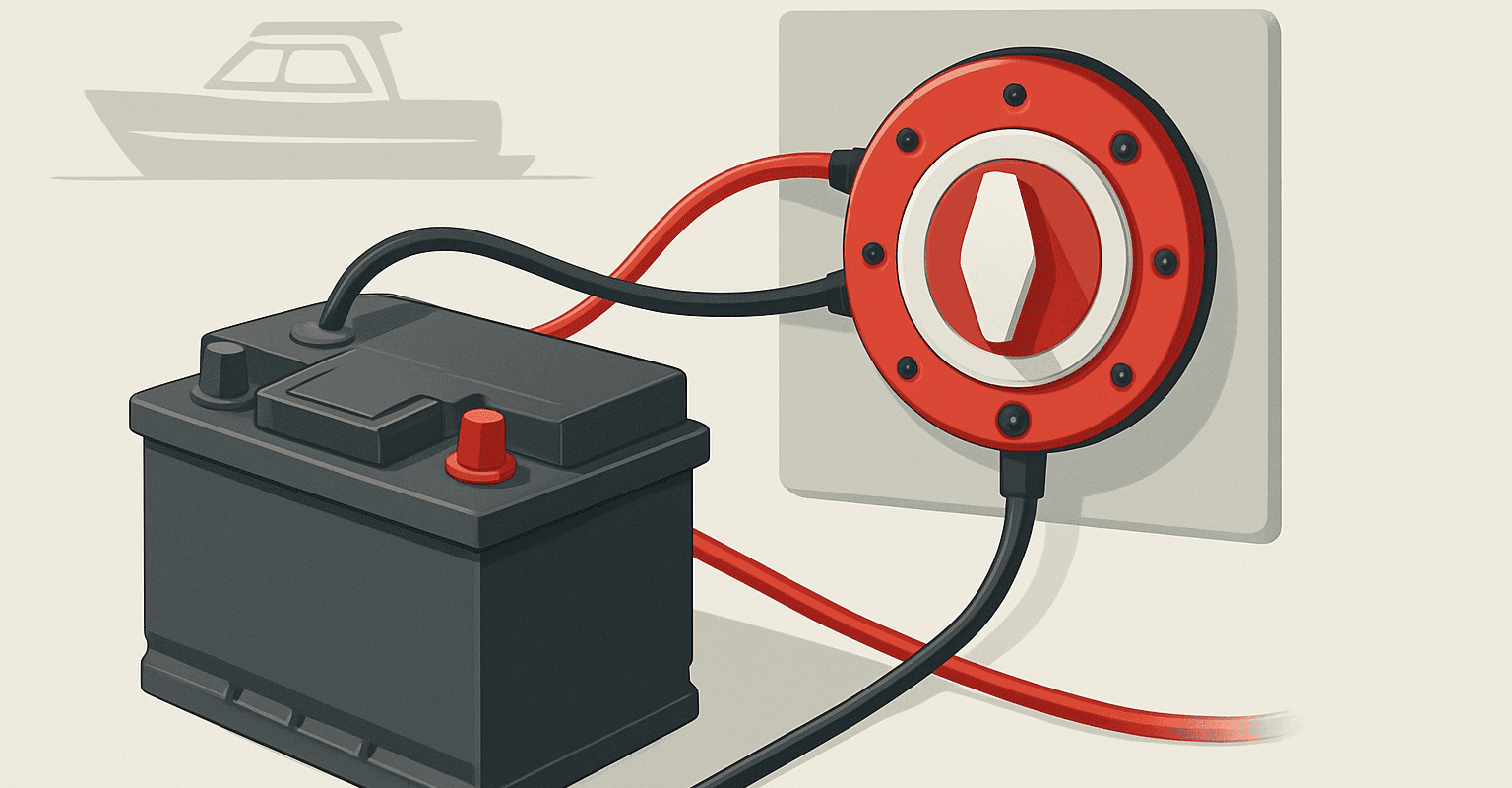
When you really need a boat battery switch
The boat battery disconnect switch it is not an accessory to consider only during refit or when the system shows an obvious problem. In many onboard configurations, it is instead a decisive component to properly manage the power supply, isolate the circuits when the boat is not in use, and simplify control operations on the electrical system.
Understanding if it is really needed means starting from a concrete question: how is the battery bank organized on board? A boat with a single battery dedicated to everything has different needs compared to a system with engine battery, separate services, chargers, panels, or always active loads. The larger the system, the more important it becomes to choose a consistent solution.
In practice, the battery switch becomes particularly useful when:
- you want to clearly separate the engine line from the service line;
- you need to avoid unwanted drains during downtime;
- you have multiple batteries and want a more orderly management of the circuits;
- you are reviewing the system and want to improve accessibility and operational safety;
- you have doubts about leaks or abnormal consumption and need a simple isolation point.
Not all boats, however, require the same solution. On a small essential system, a linear configuration may be enough. On a boat with multiple loads, instead, the choice must be considered in terms of compatibility with existing wiring, available space, and how you actually use the boat.
Se stai rivedendo l’impianto nel suo insieme, può esserti utile approfondire anche altre guide tecniche nautiche dedicate alla distribuzione elettrica di bordo, così da valutare lo stacca batterie non come elemento isolato ma come parte di una logica impiantistica completa.
Differences between solutions and boat battery switch compatibility
The point that creates the most confusion is not so much understanding if installing a battery switch, but which solution is really convenient based on the system. Many online comparisons stop at too generic descriptions, while the real difference lies in compatibility between component and onboard electrical architecture.
When talking about boat battery switch compatibility, at least four aspects must be considered: system diagram, installation position, usage mode, and presence of lines that must not be interrupted.
System with a single battery
In a simple configuration, with a single battery powering starting and services, the battery switch has an immediate function: cut off the main power supply when the boat is stationary or when you need to work on the system.
This solution is common on boats with basic equipment, but requires attention: if everything goes through a single point, every mounting and wiring choice directly affects ease of use. In these cases, it is advisable to check:
- if the chosen point is easily accessible;
- if the existing cables allow for an orderly connection;
- if there are loads that require continuous power;
- if total isolation is consistent with the actual use of the boat.
System with engine battery and service battery
Here the reasoning changes. When the banks are separate, the battery switch can be used to manage the two circuits separately. This is often a more logical choice because it avoids treating lines with different functions as identical.
The engine battery must remain dedicated to starting, while the services follow a different consumption logic. In a system of this type, compatibility concerns not only the component itself but also how it integrates with:
- selectors or switches already present;
- onboard electrical panels;
- charging systems;
- any parallels between batteries;
- priority loads connected directly.
Se stai confrontando diverse configurazioni, è utile leggere anche una panoramica su componenti per impianti elettrici nautici, così da capire se lo stacca batterie va inserito come semplice interruttore generale o come parte di una distribuzione più articolata.
Compatibility with spaces and accessibility
One of the most common mistakes is to evaluate the component only on paper, without considering The first mistake to avoid is considering the table as a universal accessory. In reality, the correct evaluation starts from. On a boat, the available space really influences the choice. A battery compartment that is hard to access, a narrow bulkhead, or the need to pass existing cables can make a theoretically correct solution impractical.
For this reason, the compatibility must also be read in a physical sense:
- component size;
- orientation of connections;
- ease of operation;
- visibility of open/closed position;
- possibility of inspection over time.
If a detail is not clear, check the product sheet. It is the simplest way to avoid a choice that is correct in theory but uncomfortable to use on board.
Lines that should not be interrupted without verification
Not all circuits should be treated the same way. Some lines may require continuity or be connected with particular logics. For this reason, before choosing the battery switch, it is advisable to map the system and understand which loads actually pass through the disconnection and which do not.
This step is especially crucial when the boat has undergone modifications over time. Subsequent additions, undocumented wiring, or accessories installed at different times can alter the system's reading. In these cases, a hasty choice risks complicating daily use instead of simplifying it.
Mistakes to avoid when choosing or installing the boat battery switch
The most delicate part is not the comparison between solutions, but the ability to avoid mistakes that then affect reliability, practicality, and maintenance. In nautical technical guides, this topic is often underestimated: the product is discussed, but not the context in which it will be used.
Choosing without starting from the actual system diagram
The first mistake is buying a boat battery switch based only on a generic description. Every system has its own logic: number of batteries, circuit separation, presence of shore or auxiliary charging sources, accessories installed over time. Without this preliminary reading, compatibility remains only assumed.
Before deciding, it is always advisable to note:
- how many batteries are present;
- which lines they power;
- where they are located;
- which cables reach the bank;
- which loads must remain active or isolated.
Install in a location that is difficult to reach
A useful battery switch but difficult to operate loses much of its practical value. If to reach it you have to remove panels, move material, or work in an uncomfortable position, you will end up using it less than necessary.
The ideal position is one that allows quick access, visibility, and easy maneuvering, without compromising cable passage. Even in this case, the best solution is not always the most intuitive at first glance.
Neglecting wiring order
A messy installation makes every future check more difficult. Tight, crossed, or hard-to-read cables complicate maintenance and increase the risk of errors when working on the system. The battery switch should fit into a clear path, with easily identifiable connections.
Se stai riorganizzando il vano tecnico, può essere utile consultare anche una guida su cablaggio e distribuzione elettrica a bordo per impostare il lavoro in modo più ordinato.
Ignoring changes made over time
Many boats no longer have the original system. Over time, instruments, lights, sockets, battery chargers, electronic accessories, or dedicated lines are added. The result is that the initial diagram no longer corresponds to the real situation. Installing a battery switch without checking these changes can lead to cutting unexpected circuits or leaving lines active that you thought were isolated.
For this reason, before installation, it is useful to do a practical check of what is actually connected. Even a simple visual inspection often reveals significant differences.
Confusing simplicity with universality
A simple solution is not automatically suitable for everyone. In some cases, a basic diagram is perfect; in others, it risks being too limiting compared to the system structure. The mistake is thinking there is a battery switch “right for all boats.” In reality, the correct choice always comes from a contextual evaluation.
Se hai dubbi sulle differenze tra configurazioni, può aiutarti confrontare anche altri accessori tecnici per la nautica che lavorano insieme al sistema di alimentazione, così da avere una visione più completa del quadro.
Products and categories to consider for a coherent system
When looking for a boat battery disconnect switch, the temptation is to focus on a single component. In reality, an effective choice almost always comes from a broader evaluation of the categories related to the electrical system. This approach is especially useful if you are comparing competing solutions and want to understand which one really suits your case, not just in theory.
The categories to consider are those that directly affect the logic of power supply and distribution. This does not mean buying everything together, but checking if the battery switch fits coherently into the system already present on board.
Elements to evaluate together with the battery switch
- Distribution boards and panels, to understand how line separation is managed;
- cables, terminals, and connection accessories, because a correct component also requires orderly connections;
- charging systems, if the system includes multiple power sources;
- selectors or battery management devices, if the bank is not configured in a basic way;
- protection and disconnection components, to maintain clear logic in the system.
Questo tipo di analisi evita un errore comune: scegliere il componente giusto ma inserirlo in un contesto sbagliato. Se stai costruendo o aggiornando il sistema, può essere utile consultare anche una sezione dedicata a soluzioni per impianti di bordo per capire come coordinare meglio i vari elementi.
Another often overlooked aspect concerns the future. Even if the system is simple today, you might add loads or modify the distribution. For this reason, it is advisable to consider a solution that is not only suitable for the current setup but also compatible with a possible evolution of the system. If a technical detail is unclear, check the product sheet.
In a serious technical comparison, the useful question is not “which is the best overall?”, but which solution works best with my system. This is the criterion that allows distinguishing a truly effective choice from a purchase made out of imitation or habit.
Recommended products

 10" Wound Wire Cartridge 20 micron – code: 10MP20 – Idromar
 Brush with spring - code: SGM45 - Gianneschi Pumps and Blowers
 Stainless steel clamps Norma 12–22 mm – code: FAI0012022 – Toscogomma



How to navigate between technical comparison and practical choice onboard
Those seeking information online on the topic often find content that oversimplifies the comparison. On one side there are brief datasheets, on the other very theoretical guides. The balance lies in translating the technique into a practical decision: which boat battery switch is really worth it based on the system you have.
To orient yourself concretely, try following this sequence:
- Read the actual system, not the one you remember or think you have.
- Define the goal: total isolation, bank separation, more orderly management, easier maintenance.
- Check physical compatibility with compartment, cable passages, and accessibility.
- Verify consistency with other components already onboard.
- Check the product sheet if you have doubts about construction or installation details.
This method helps avoid superficial comparisons and makes it easier to choose a truly suitable solution. In the best cases nautical technical guides, the value is not in saying which component to buy regardless, but in providing the criteria to correctly assess your own system.
If you want to complete the evaluation with a consistent selection of components for the onboard electrical system, explore the dedicated category or the available brands: you will find solutions designed to better integrate into different nautical configurations and more easily compare what your boat really needs.
FAQ
When is it really useful to install a battery disconnect switch on a boat?
It is useful when you want to isolate the system during downtime, better separate the engine battery and services, or simplify maintenance and inspections. It becomes even more important if there are multiple lines on board or system modifications made over time.
How to check the compatibility of a boat battery switch with the existing system?
It is advisable to start from the actual system layout: number of batteries, connected lines, presence of separate services, charging systems, and available space for installation. If a detail is unclear, check the product sheet.
Is it better to have a single solution or separate management between engine and services?
It depends on the onboard configuration. On simple systems, a linear solution may be sufficient, while with separate engine battery and service battery it is often more logical to also maintain distinct management. The correct choice depends on how the system is organized.
What is the most common mistake when choosing a boat battery switch?
The most common mistake is choosing the component without analyzing the actual wiring of the boat. Many systems have been modified over time and an apparently suitable solution may prove impractical or inconsistent with the lines actually present.
Where is it best to install the battery disconnect switch on a boat?
In an accessible point, easy to operate and compatible with the orderly passage of cables. An inconvenient position reduces the practical usefulness of the component and complicates both daily use and future inspections of the system.


