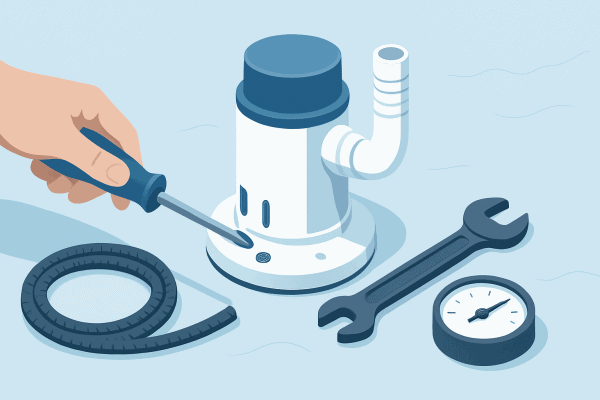
Introduction and when it is needed
At sea, bilge water is never a minor detail: it can come from leaks, splashes, condensation, small seepages, or a sudden event. bilge pump is one of the most important safety elements on board because it helps manage these accumulations and keep the lowest area of the boat dry.
This article is designed as quick troubleshooting: what to check when the pump does not start, starts but does not discharge, stops, makes noise, or discharges little. You will also find a practical guide on how to correctly choose and install a onboard pump, with useful advice for those considering purchasing among the many marine pumps available.
If you are looking for a complete overview of the category, you can start here: Bilge pumps.
Basic concepts (how it works)
Simply put, a bilge pump collects water from the bilge well and pushes it out through an outlet (discharge overboard) via a hose. The most common configurations are:
- Automatic pump: activates via a separate or integrated float switch (depending on the model). When the level rises, it starts; when it falls, it stops.
- Manual pump: activated by a switch/button at the panel or a dedicated point. It is useful as redundancy or to control startup in certain situations.
The components most often involved in problems are:
- Power supply (battery, fuse, connections, ground).
- Control (manual switch, float switch, control unit/relay if present).
- Hydraulics (hose, clamps, valves, through-hull/outlet, any restrictions).
- Mechanical part (impeller/rotor, filter grid, foreign objects).
Important note: some pumps have protections or specific operating logics (for example, self-check cycles or electronic sensors). If you are not sure, check the product sheet how the model you are using behaves.
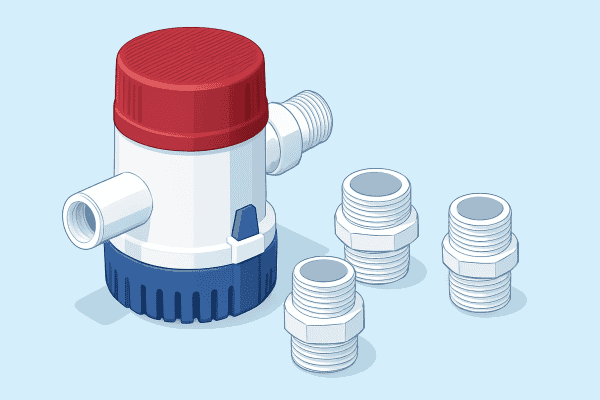
1) Identify the type of connection required
Choosing a bilge pump is not just “which model do I take”: it is a combination of usage scenario, boat layout and maintenance habits. Here are the main criteria.
1) Intended use and redundancy
For many boats it makes sense to consider two levels:
- Main pump for daily management (normal bilge water).
- Emergency pump or second higher pump, for when the level rises above normal.
Alternatively (or in addition) a manual pump as a backup may make sense. The choice depends on the available space and your safety strategy.
2) Power supply and system compatibility
Before purchasing, check:
- onboard system voltage (check in the product sheet);
- desired control type (manual, automatic, with separate float);
- if you want simple wiring or more advanced management (e.g. panel indication, level alarm, etc.).
3) Materials and environmental resistance
The bilge is a hostile environment: constant humidity, possible salt residues, oils, dirt. For this reason it is advisable to aim for:
- body and components resistant to corrosion;
- protected cables and connections (well insulated joints);
- filter/grate easily inspectable.
If your bilge tends to collect debris (chips, sand, residues), favor solutions that are easy to disassemble and clean.
4) Sizing: not just “how much it pumps”
The declared flow rate is a starting point, but on a boat also count:
- head (how much the water must “rise” to the discharge);
- length and route of the hose (bends and long stretches reduce efficiency);
- hose diameter and compatibility with fittings;
- continuous operation and thermal management (check the product sheet).
Flow rate and head (practical examples)
Many problems like “the pump doesn’t discharge” or “discharges little” are not due to the pump itself, but because the actual system is more demanding than expected. The head is the height (and overall resistance) the pump must overcome to bring the water to the discharge.
Example 1: nearby discharge and straight route
If the pump is mounted low and the discharge is relatively close, with a short hose and few bends, the actual performance tends to be closer to the expected one. In this case, the most frequent problems are:
- clogged grate;
- stuck float;
- oxidized electrical connection.
Example 2: high discharge with many bends
If the hose rises a lot, has several bends, and maybe passes through areas where it can be crushed, the effective flow rate can drop significantly. Here become crucial:
- correct hose diameter (avoids sudden reductions);
- route with wide bends and no constrictions;
- free outlet (no external obstruction).
If you are considering an upgrade, consider the system as a whole: often a small modification to the pipe route or connections solves more than just a pump replacement.
Correct installation (steps + errors to avoid)
A tidy installation reduces false alarms and increases reliability. Below is a practical guide; for specific model details, check the product sheet.
Recommended steps
- Clean the bilge and remove debris that could end up in the grate or block the float switch.
- Place the pump at the lowest practical point, ensuring it remains stable and accessible for maintenance.
- Define the pipe route: as direct as possible, with wide curves and no points where it can be crushed.
- Connect the pipe with appropriate clamps and check that the fitting is compatible (diameter and type of connector).
- Manage the wiring: clean, insulated connections protected from water; wiring secured and tidy to avoid pulls.
- Install/check the control (float switch or sensor): it must move freely, without interference.
- Functional test: manual and automatic test (if present), verifying that the discharge is regular and there are no backflows.
Common mistakes to avoid
- Undersized pipe or with reductions: increases losses and reduces performance.
- Too tight curves and crushed sections: can make the pump appear faulty.
- Unprotected electrical connections: rust and false contacts are among the main causes of sudden stops.
- Float switch in a dirty area or with obstacles: it gets stuck and does not activate the pump.
- Pump not accessible: if you can't clean it easily, maintenance will be postponed (until it gets stuck at the worst moment).
Maintenance (frequencies and checks)
Maintaining the bilge pump is simple, but it must be consistent. In general, short and frequent checks are better than long and rare interventions.
Essential periodic checks
- Visual inspection of the bilge: presence of debris, oily residues, wet cables, unusual odors.
- Grill/filter cleaning: remove hair, sand, fragments, cut ties, etc.
- Start test: try manual mode and check that the automation works correctly (if present).
- Hose and clamp check: check for cracks, crushes, or looseness.
- Connection check: look for oxidation, loose terminals, damaged sleeves.
Good practices that prevent “mysterious” failures”
- Do not leave the bilge “dirty”: debris is the primary cause of mechanical blockage.
- Label the cables and keep a diagram: when you need to intervene quickly, you reduce errors.
- Test the pump before going out, especially after periods of inactivity.
Common problems and solutions (troubleshooting)
Here you find a quick list of the most frequent symptoms with practical checks, ordered from the simplest to the most likely. Before intervening, secure the system and work carefully: water and electricity do not mix.
1) The pump does not start (total silence)
- Check fuse/switch: it seems trivial, but it is the primary cause. If it blows again, there is a downstream problem (short circuit, stuck pump, damaged wiring).
- Check power supply: battery, battery disconnect, terminals. A false contact can give “no signs of life”.
- Check ground/negative: oxide or loose terminal can interrupt the circuit.
- Direct test: if possible, try powering the pump directly (only if you know what you are doing). If it starts, the problem is in the control/wiring.
2) The pump starts manually but not automatically
- Float stuck: dirt, debris or incorrect positioning. It must move freely.
- Float wiring: check connections and insulation. Moisture creates oxide and false contacts.
- Electronic sensor (if present): some models require specific conditions or have control logic; check the product sheet.
3) The pump runs but does not discharge water
- Clogged grate or pump not submerged: if it sucks air, not priming, it does not push.
- Bent/crushed tube: check along the entire path, especially in narrow passages.
- Obstruction in the tube or drain: salt, dirt or deposits can block the flow.
- Water return: if water flows back, you may have an unfavorable path or a component that does not work as expected (check valve, if provided). If you are not sure it is compatible with your system, check the product sheet.
4) Discharges little or very slowly
- Tube diameter not adequate or reductions: increase losses.
- Too many bends: every curve “weighs” on the flow.
- High head: the discharge is too high compared to the pump or the path is too long.
- Low voltage: a discharged battery or undersized/oxidized cables can make the pump run “weak”.
5) The pump starts and stops continuously (short cycles)
- Float too sensitive or poorly positioned: small internal waves or turbulence make it oscillate.
- Water return in the pipe: when it turns off, the water flows back and immediately raises the level.
- Constant water inflow: check if there is a small continuous infiltration (tightening clamps, passages, seals).
6) Unusual noises, vibrations, “hot” smell”
- Foreign body in the impeller/rotor: turn off and inspect, then clean.
- Dry running: if the pump stays on without water, it can overheat. Check control and positioning.
- Unstable fastening: vibrations and noises increase if the pump moves or touches walls/structures.
7) Blown fuse or pump that “locks up”
- Mechanical blockage: debris or encrustations can stop the moving part and increase power consumption.
- Wiring short circuit: damaged sheath, wet joints, oxidized terminals.
- End-of-life pump: if after cleaning and checks the problem persists, consider replacing it with a suitable onboard pump for your system.
Recommended products
To help you navigate the available solutions, here is a selection of useful links to product sheets and related accessories. Compatibility details (voltage, fittings, automatic mode) depend on the model: check the product sheet.
- Automatic bilge pump (product sheet)
- Manual bilge pump (product sheet)
- Float switch for bilge (product sheet)
- Bilge level sensor (product sheet)
- Bilge discharge hose (product sheet)
- Fittings and adapters for bilge system (product sheet)
- Non-return valve for bilge discharge (product sheet)
- Stainless steel clamps for onboard piping (product sheet)
- Fuse holder and pump line protections (product sheet)
- Panel switch for pump control (product sheet)
Useful links
If you want to explore further or complete the system, these internal links help you navigate categories and related content:
- Category: bilge pumps
- Category: marine pumps
- Guide: basic onboard electrical system checks
- Guide: selection and installation of hoses on board
- Brand: Technofluid
FAQ
How do I understand if the problem is electrical or plumbing?
If the pump shows no signs (does not run), it is often electrical: fuse, switch, connections, ground. If instead it runs but does not pump, the problem is more often hydraulic: clogged grate, crushed hose, blockage or high head.
Is an automatic or manual pump better?
For daily use, the automatic pump is convenient because it operates on its own. The manual pump is useful as a direct control or as a backup. In many installations the best solution is to combine manual and automatic control (depending on the model: check the product sheet).
Why does the pump often start even if I don't see much water?
It may depend on a floating switch that oscillates, water returning in the pipe after shutdown, or a small continuous infiltration. Start by checking cleanliness, control positioning, and pipe routing.
Can I install a check valve on the drain?
In some systems it helps reduce water return, but it can also add resistance to the flow. Compatibility depends on the type of pump and installation: check the product sheet and evaluate the pipe routing.
How often should I test the bilge pump?
It depends on the use of the boat and how much the bilge tends to get dirty. A good habit is to do a quick test before outings and a more thorough check at regular intervals, including cleaning the grille and checking connections.
Conclusion
A reliable bilge pump comes from three things: consistent choice with the system, clean installation, and periodic checks. If you want to replace an onboard pump, add an automatic control, or simply compare options among marine pumps, visit the category Bilge pumps and, if you are interested in a specific reference, also explore the selection Technofluid to find the best solution for your boat.
FAQ
How do I understand if the problem is electrical or plumbing?
If the pump does not turn, it is often an electrical problem (fuse, switch, connections, ground). If it turns but does not discharge, it is more likely a hydraulic problem (clogged grille, crushed pipe, obstruction, or high head).
Is an automatic or manual pump better?
The automatic is convenient for daily management because it operates on its own; the manual is useful as direct control or backup. Often the best solution is to combine manual control and automation, depending on what is provided by the model: check the product sheet.
Why does the pump often start even if I don't see much water?
The typical causes are a float that swings or gets stuck, water returning in the pipe after shutdown, or a small continuous leak. Check cleanliness, control positioning, and pipe routing.
Can I install a check valve on the drain?
In some systems it reduces water return, but adds resistance to the flow. Compatibility depends on the pump and installation: check the product sheet and evaluate the pipe route.
How often should I test the bilge pump?
It depends on the use of the boat and how dirty the bilge gets. Generally, it is useful to do a quick test before outings and more thorough periodic checks with grill cleaning and connection verification.