


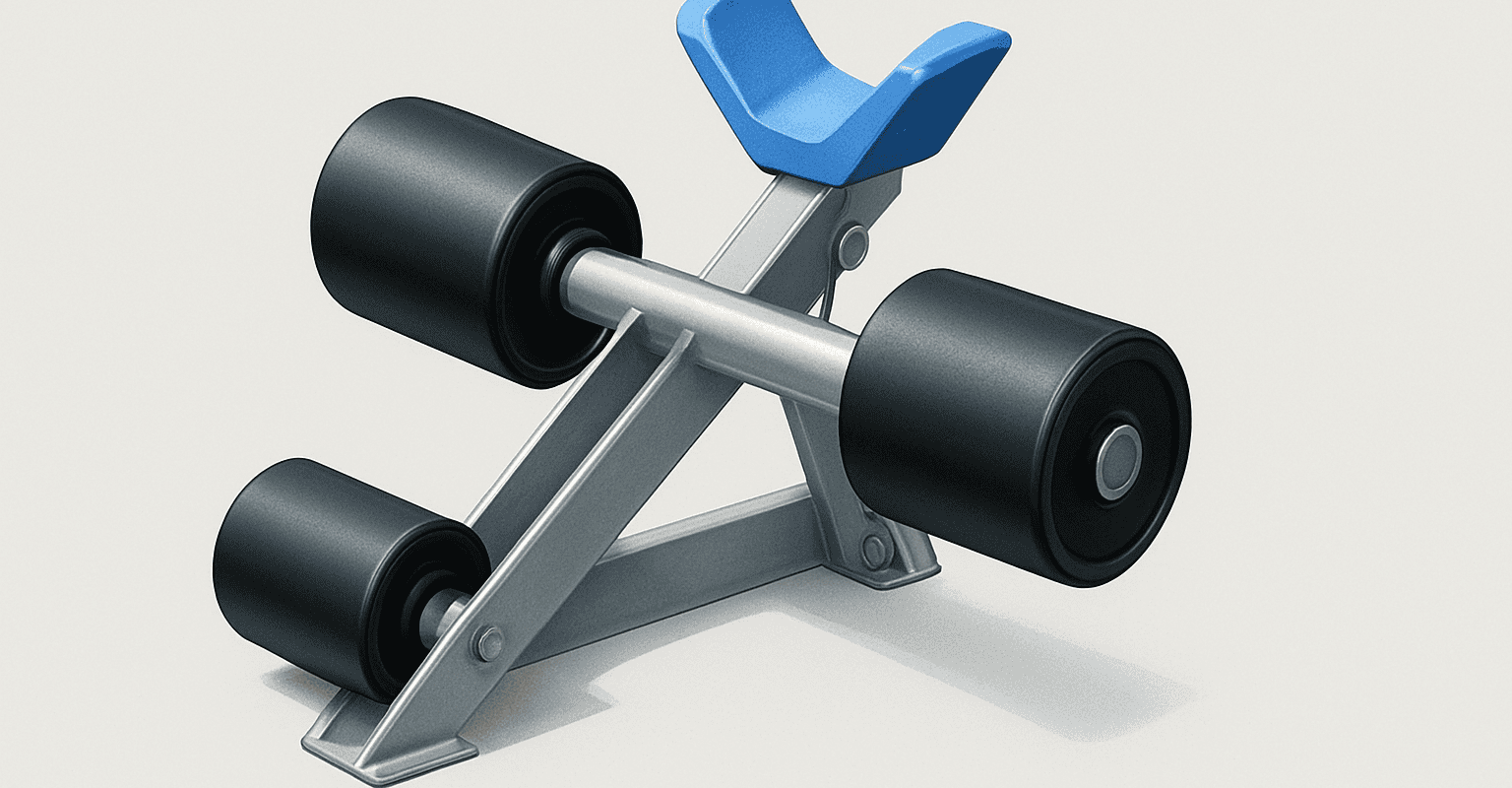
When boat trailer rollers are really needed
I boat trailer rollers are one of the components that most affect the daily management of launching, hauling, and transportation. Often their importance is noticed only when abnormal friction, irregular supports, or small marks on the hull that were not there before appear. In reality, periodic checks prevent many problems and help keep the trailer efficient over time.
Their task is not only to support the boat, but also to distribute the load consistently and to accompany the hull's movements during the most delicate phases. If a roller is worn, deformed, or not suitable for the boat's geometry, the whole system works worse: efforts increase, sliding becomes less smooth, and the final positioning may be inaccurate.
A check is particularly useful when:
- the boat tends to rise or descend from the trailer with difficulty;
- you notice uneven wear on the support points;
- some rollers turn poorly or get stuck;
- the hull no longer seems centered as before;
- after long storage periods, materials appear hardened, cracked, or marked.
In many nautical technical guides rollers tend to be talked about as a secondary accessory. In practice, however, they are an integral part of the trailer's setup. For this reason, it is advisable to observe them along with other contact and guide elements, to understand whether the problem concerns only the single roller or the entire support scheme.
If you want to deepen the topic of trailer maintenance as a whole, it may be useful to consult nautical technical guides and compare the different components that work in contact with the hull.
Signs not to ignore during use
There are signs that deserve immediate attention. They do not always mean that the roller needs to be replaced, but almost always indicate the need for a thorough check.
- Irregular rotation: the roller does not follow the movement and tends to skid.
- Marked surface: cuts, crushes, or localized wear can alter the contact.
- Incorrect alignment: the hull rests poorly or shifts laterally.
- Unusual noises: creaks or friction may be due to wear, dirt, or incorrect assembly.
- Uneven support: some points bear more than others, resulting in unbalanced work.
The practical rule is simple: if the behavior of the trailer has changed compared to the past, it is worth stopping and checking. Acting early is almost always more effective than waiting for a clear deterioration.
Differences between boat trailer rollers, sizes, and compatibility
One of the most common mistakes is to consider all rollers equivalent. In reality, differences in shapes, materials, profiles, and mounting systems directly affect use. The topic of boat trailer roller compatibility does not only concern diameter or length, but also how the roller interacts with supports, brackets, axles, and especially with the hull.
When comparing different solutions, it is useful to think on three levels:
- compatibility with the trailer, that is with the support on which the roller is installed;
- compatibility with the hull, therefore with shape, support line, and contact points;
- usage compatibility, related to the frequency of launching and the operational context.
Shape and contact point with the hull
Not all rollers work the same way. Some are designed to guide the hull through a specific area, others to support a point of contact more stably. The choice should not be made just “by sight”: an apparently similar shape can behave differently once under load.
To correctly assess compatibility, observe:
- how the boat rests during the loading and unloading phases;
- if the contact occurs fully or only on an edge;
- if the roller tends to work centered or off-center;
- if there are signs indicating concentrated pressures.
When in doubt about sizes or combinations, the safest solution is always the same: check the product sheet. This is especially true when replacing an existing component without being sure that the current configuration is the correct one.
Materials and behavior over time
Over time, the roller material can change response: it can harden, lose elasticity, wear unevenly, or show signs of stress. Even without going into specific details, it is important to know that the material's behavior affects both smoothness and the quality of contact with the hull.
For this reason, in nautical technical guides, the comparison between solutions should not be limited to just the measurement. A roller compatible on paper but poorly suited for real use can cause repeated inconveniences. If the trolley is used often, in different contexts or with frequent launching operations, the quality of its performance over time becomes a decisive criterion.
To guide you among related components, it can be useful to consult the accessories for nautical trolley and check how the different elements integrate with each other.
Boat trolley rollers compatibility: what to check before purchase
Before replacing a roller, it is advisable to make a small technical checklist. It is a simple step, but it avoids hasty purchases and reassembly.
- Check the type of support present on the trolley.
- Check the measurements of the existing component and the available space.
- Observe the area of the hull that comes into contact with the roller.
- Evaluate whether the wear of the old roller is due to normal wear or incorrect alignment.
- Make sure the fastening system is consistent with the trolley structure.
If you are comparing multiple options, it can help to also read the solutions for hull support and guidance, so you can understand whether the roller should be considered alone or together with other support points.
Mistakes to avoid in choosing or mounting
Many problems attributed to rollers actually arise from an incomplete choice or inaccurate assembly. Even a correct component can perform poorly if installed without checking alignment, position, and freedom of rotation.
Replacing only the visibly worn part
is a common mistake: the most damaged roller is changed and everything else is left unchanged. In some cases this may be enough, but often localized wear is a symptom of a broader problem. If only one point of the trolley works too much, the reason must be sought in the distribution of supports, not just in the single component.
A complete check should include:
- general condition of the existing rollers;
- symmetry between right and left side;
- correct positioning of the supports;
- presence of play, friction or blockages.
Mounting without checking alignment
A roller mechanically mounted correctly can still be ineffective if it is not aligned with the hull's path. This leads to partial contacts, imperfect rotation, and premature wear. After mounting, it is good practice to simulate or carefully observe the boat's behavior during positioning on the trailer.
Typical signs of alignment needing review are:
- boat tends to move sideways;
- roller works only on a portion of the surface;
- obvious pressure on only one side;
- difficulty in final centering.
Neglecting dirt, salt, and residues
Maintenance is not only about replacement. Dirt, residues, and deposits can compromise rotation and alter contact. A roller that still seems valid can cause problems simply because it no longer works smoothly.
A useful routine includes:
- periodic cleaning of contact surfaces;
- visual inspection after intensive use or long storage;
- checking the roller's freedom of movement;
- inspection of supports to detect deformations or misalignments.
For those who want a broader overview of maintenance, it may be useful to read technical advice for storage and transport.
Products and categories to consider for a consistent support system
When talking about boat trailer rollers, the focus should not be limited to the single spare part. In many cases, the best result is obtained by evaluating the entire support and guidance system. If a new component is inserted into an already compromised configuration, the improvement can only be partial.
The categories to consider are those that directly affect contact, centering, and hull sliding. In particular, it is advisable to check the condition of:
- main and side rollers;
- supports and fixing points;
- guiding elements that help centering;
- components subject to wear during launching and hauling phases.
This approach is also useful for comparison: instead of only asking which roller to choose, it is more effective to ask which configuration works best with your trailer and your boat. This is where the topic of compatibility becomes truly technical.
If you are considering an overall upgrade, it can be useful to consult the components dedicated to moving the boat on the trailer and compare the available solutions based on the type of use.
Another important aspect is continuity between the various contact points. If the rollers have very different shapes or behaviors, the hull may encounter irregular resistance during movement. For this reason, in the most careful choices, the whole is always evaluated and not the single isolated piece.
In case of doubts about measurements, attachments, or combinations, the correct procedure remains to compare the existing component with the available information and, when necessary, check the product sheet.
Recommended products


Periodic checks that help prevent wear and premature replacements
Effective maintenance does not require complex operations, but consistency. A few regular checks are enough to detect early signs of failure or incompatibility.
Here is a practical sequence to follow:
- Visual inspection: look for cuts, crushes, deformations, and irregular wear.
- Rotation check: the roller must move without obvious sticking.
- Support verification: check if the hull works evenly on the intended points.
- Support examination: brackets and fastenings must be stable and consistent.
- Post-storage check: long periods of inactivity can change the behavior of materials.
This simple routine helps to understand if it is time to replace the roller, review the assembly, or intervene on a larger part of the trailer. In a professional or frequent use context, these checks make the difference between smooth management and a series of repeated small problems.
If you want to choose more confidently among compatible categories and components, explore the section dedicated to spare parts and accessories for boat trailers: it is the fastest way to compare solutions consistent with your setup and identify the most suitable support for your support system.
FAQ
How to tell if the boat trailer rollers need to be replaced?
The most common signs are irregular rotation, cracked or deformed surface, uneven hull support, difficulty in launching and hauling, and localized wear. If the behavior of the trolley changes from usual, it is advisable to check rollers and supports immediately.
Does the compatibility of boat trailer rollers depend only on the measurements?
No. The measurements are important, but compatibility also concerns the type of support, the shape of the roller, the contact point with the hull, and the fastening system. If in doubt, check the product sheet.
Is it correct to replace only one worn roller?
It depends on the cause of the wear. If the damage is isolated, it may be enough, but often a worn roller indicates an alignment or load distribution problem. For this reason, it is advisable to check the entire support system.
What checks to perform after a long storage period?
After storage, it is useful to check for any hardening of the material, deformations, rotation blocks, accumulated dirt, and correct alignment of the supports. Even if the roller appears intact, its behavior may have changed over time.
Can incorrect installation ruin even new rollers?
Yes. If the roller is not aligned with the hull track or works off-center, it can wear out quickly and create friction or irregular supports. After installation, it is always useful to check how the boat behaves during positioning on the trailer.


